 Ayesha Khan
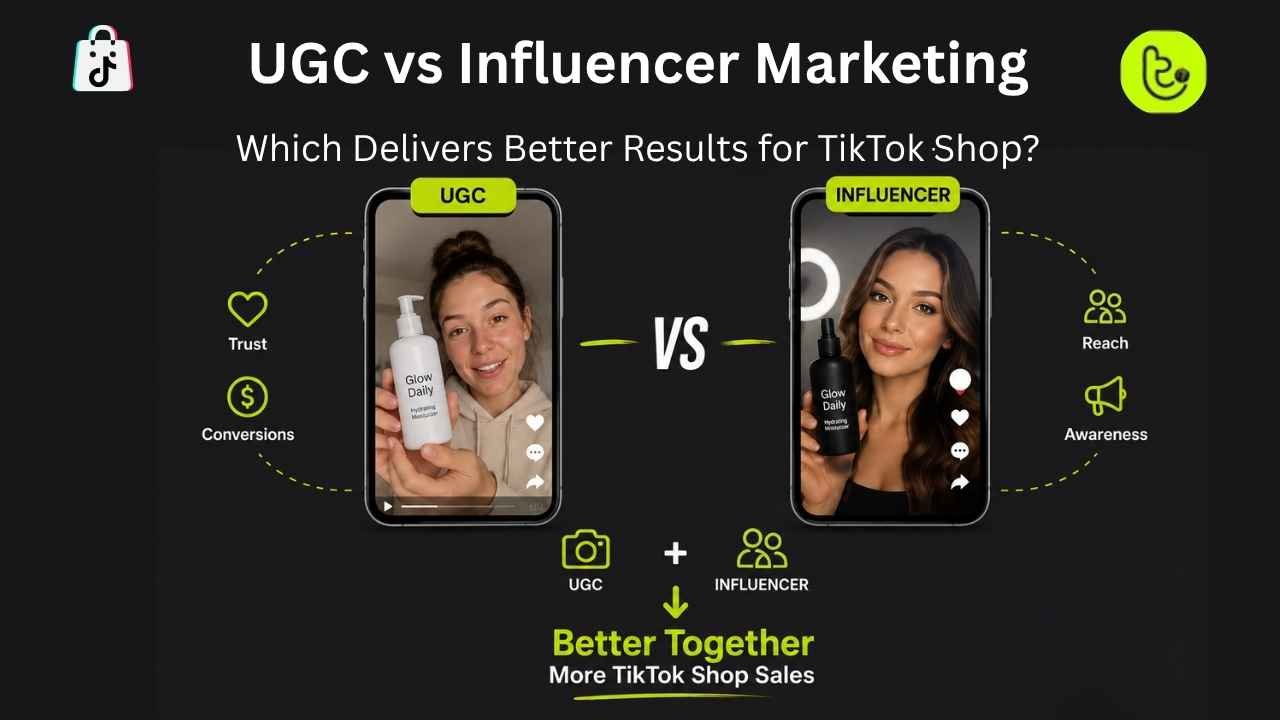
UGC and influencer marketing aren’t competing for the same job. UGC is often stronger for building trust, showcasing real product experiences, and improving conversions, while influencer marketing helps brands reach new audiences and build credibility faster. The best approach depends on your goals, budget, product stage, and existing brand presence.
For TikTok Shop, the question isn’t always about choosing one over the other. Many successful brands combine both strategies, using influencers to create awareness and UGC to help customers feel confident about purchasing.
In this guide, you’ll learn the differences between UGC and influencer marketing, their benefits, ROI potential, and how to build a TikTok Shop strategy that turns creator content into consistent sales.
What Is UGC vs Influencer Marketing for TikTok Shop?
Before deciding which approach fits your TikTok Shop goals, you need to understand what each strategy involves. Although both rely on creator content, they differ in how they’re produced, used, and measured.
What Is User-Generated Content (UGC)?
UGC content for TikTok Shop refers to short-form videos made by everyday creators or real customers that look and feel like organic TikTok content, filmed on a phone, shot in a bedroom or kitchen, with no studio lighting or scripted delivery. It’s built to blend into the For You Page rather than stand out as an ad.
UGC creators are typically not chosen for their follower count. Many have small or no public followings at all; they’re hired specifically for their ability to act like a relatable customer on camera.
Some UGC is organic, made unprompted by actual buyers who post about a product they purchased. Most brand UGC today, though, is paid: brands commission creators to film content that looks organic, then use it in the Shop, in ads, or on the brand’s own account.
Customers trust UGC because it doesn’t read as marketing. A shaky, close-up video of someone applying a product in their bathroom mirror carries a kind of credibility a polished commercial simply can’t fake. Inside TikTok Shop specifically, UGC shows up as product demo videos, “GRWM” (get ready with me) style content, unboxings, before-and-afters, and honest reviews, often stitched directly into product listings and video shopping tabs.
What Is Influencer Marketing?
TikTok Shop influencer marketing means partnering with creators who already have an established, engaged audience and asking them to promote or sell a product to that audience.
These partnerships take several forms: flat-fee sponsored content, affiliate arrangements where the creator earns commission on sales, and live shopping partnerships where creators sell products in real time during a TikTok LIVE.
Influencers are usually grouped by audience size: nano-influencers (roughly 1,000–10,000 followers) with tight-knit, highly engaged communities; micro-influencers (10,000–100,000) who balance reach with authenticity; macro-influencers (100,000–1 million) who offer broad visibility; and celebrity or mega-influencers (1 million+) who bring mass awareness but often lower per-follower engagement.
Each tier plays a different role in a TikTok Shop marketing strategy, from tight-niche conversion to broad brand awareness.
The Biggest Difference Between UGC and Influencer Marketing
The core distinction comes down to what you’re paying for. With UGC, you’re paying for content,a believable, native-feeling asset you can own and reuse. With influencer marketing, you’re paying for access to an audience and the trust that the creator has already built with them.
| Factor | UGC | Influencer Marketing |
|---|---|---|
| Creator type | Everyday creators, often unknown | Established creators with a following |
| Audience size | None required — creator has little to no reach | Built-in audience, ranges from niche to massive |
| Brand ownership | Brand typically owns full usage rights | Often limited to the creator’s own channel |
| Trust level | High — feels like a real customer | High, but tied to the creator’s personal brand |
| Cost | Lower per asset | Higher, scales with follower count |
| Content style | Native, unscripted, demo-style | Polished or personality-driven, on-brand for the creator |
| Best objective | Conversion and ad creative | Reach and awareness |
| ROI potential | Strong for conversion-focused spend | Strong for awareness-focused spend |
| Scalability | Easy to produce in volume | Limited by creator availability and budget |
Why This Choice Matters More Than Ever for TikTok Shop
Shopping behavior on TikTok has fundamentally shifted. People aren’t just discovering products through ads anymore, they’re buying directly from videos they trust, often without ever leaving the app.
TikTok’s algorithm is built to reward content that keeps people watching, not content that looks like an advertisement, which means overly polished commercials tend to get buried while authentic, engaging videos get pushed to more feeds.
Authenticity has become a real purchasing driver, not just a nice-to-have. Viewers can tell the difference between a genuine reaction and a scripted pitch, and that distinction shapes whether they trust a product enough to tap “buy.”
Social proof, seeing someone who looks like an ordinary person actually use and like a product, consistently drives more conversions than brand messaging alone.
This is exactly why relying on a single viral video is a fragile strategy. One hit doesn’t build a durable Shop. Brands that treat content as an ongoing system, consistently producing and testing both UGC and influencer content, build the kind of momentum that keeps sales steady instead of spiking once and disappearing.
Benefits of UGC Content for TikTok Shop
UGC has become one of the most effective ways to build trust and influence buying decisions on TikTok Shop. Because it feels authentic and relatable, it helps shoppers connect with your products in ways traditional advertising often can’t.
Here are the biggest benefits of using UGC content for TikTok Shop.
Builds Authentic Customer Trust
UGC works because it doesn’t try too hard. The lack of polish is the point, imperfect lighting, casual delivery, and an unscripted feel all signal that this is a real product experience, not a paid performance, even when it technically is paid.
Improves Conversion Rates
Because UGC shows a product in actual use, texture, sizing, application, real results, it answers the questions a shopper would otherwise have to guess at. That product demonstration angle, delivered from a customer’s point of view rather than a brand’s, builds the kind of purchase confidence that turns a scroll into a sale.
Produces More Content at Lower Cost
Because UGC creators don’t require audience-size fees, brands can commission multiple creators at once and produce a high volume of content variations for a fraction of what a single influencer partnership might cost. That makes scaling content production, and testing what actually works, far more realistic.
Gives Brands More Creative Control
Most UGC contracts include full usage rights, which means brands can repurpose the same video across the Shop, paid ads, and organic posts. That flexibility, owning the asset outright rather than borrowing reach, is one of the most underrated advantages of a UGC-first approach.
Best Situations to Use UGC
• Product launches with no existing reviews
• Beauty and skincare products
• Fashion and apparel
• Home and lifestyle products
• Health and wellness products
• Everyday consumer goods that benefit from a demo
Benefits of Influencer Marketing for TikTok Shop
Influencer marketing gives your brand access to established communities that already trust the creator’s recommendations. When paired with the right creators and a clear strategy, it can increase visibility, generate qualified traffic, and drive more sales on TikTok Shop. Here are the key benefits it offers.
Expands Brand Awareness Quickly
An influencer partnership puts a product in front of an existing audience instantly. That built-in reach, paired with the social proof of someone the audience already follows and trusts, creates faster visibility than most brands can achieve organically.
Creates Instant Credibility
Followers don’t just watch influencers, many feel a genuine relationship with them. A trusted recommendation from someone a viewer already admires carries weight a brand alone can’t manufacture, and that community influence often shortens the path from discovery to purchase.
Drives Traffic During Product Launches
Influencer content is especially effective for concentrated moments, new collection drops, seasonal campaigns, and flash sales all benefit from a creator pushing a time-sensitive message to an audience already primed to listen.
Supports Live Shopping Events
Creator-hosted TikTok LIVEs let influencers demonstrate products in real time, answer questions on the spot, and run limited-time promotions, a format that consistently drives some of the highest engagement and conversion on TikTok Shop.
Best Situations to Use Influencer Marketing
• New or unknown brands building initial awareness
• Competitive, crowded product categories
• Major product launches
• Limited-edition or time-sensitive drops
UGC vs Influencer Marketing for TikTok Shop: Head-to-Head Comparison
| Category | UGC | Influencer Marketing | Winner |
|---|---|---|---|
| Cost | Lower per video | Higher, scales with reach | UGC |
| Content ownership | Brand typically owns rights | Usage often limited or licensed | UGC |
| Trust | High, feels personal | High, tied to creator’s reputation | Tie |
| Reach | Minimal on its own | Built-in, often large | Influencer |
| Engagement | Strong when native-feeling | Strong within the creator’s community | Tie |
| Conversion rate | Typically higher | Solid, but reach-driven | UGC |
| Brand awareness | Limited | Excellent | Influencer |
| Scalability | Easy to produce in volume | Limited by creator availability | UGC |
| ROI | Strong for performance spend | Strong for awareness spend | Depends on goal |
| Long-term value | Reusable ad creative | One-time audience access | UGC |
| Ad performance | Performs well as native ad creative | Performs well for retargeting/awareness | Tie |
| Repurposing opportunities | High — owned content | Low — rights-restricted | UGC |
Which Strategy Delivers Better ROI?
ROI depends on more than the type of content you create. Factors like your product, audience, campaign goals, content quality, and how you use the videos after creation all influence the results.
Let’s compare how UGC and influencer marketing perform when it comes to short-term gains, long-term value, and overall investment.
Short-Term ROI
For an immediate sales spike, a launch week, a flash sale, a seasonal promotion, influencer marketing tends to move faster because it borrows an audience that’s already primed to buy. UGC can support these moments, but it rarely creates the same instant surge on its own.
Long-Term ROI
Over months rather than days, UGC tends to pull ahead. It becomes evergreen and creative that keeps performing long after the original posting date, builds a compounding library of customer trust, and gradually lowers acquisition costs as better-performing variations get identified and reused.
Hidden Costs Brands Often Ignore
• Licensing fees for extended or exclusive usage rights
• Editing and post-production time
• Creator sourcing and vetting
• Ongoing campaign management
• Content testing across multiple variations before scaling spend
How to Choose Between UGC and Influencer Marketing
Choosing between UGC and influencer marketing starts with understanding what you want to achieve. Your budget, product type, target audience, and campaign goals all play a role in deciding which approach will deliver the best results for your TikTok Shop.
Use the following guidelines to identify the strategy that fits your brand.
Choose UGC If…
• You need affordable, high-volume content for testing
• Your priority is conversion rate, not reach
• You want full ownership of your content library
• You’re launching a new product and need believable social proof fast
Choose Influencers If…
• You’re entering a competitive category and need visibility fast
• You have a launch moment or limited-time drop to promote
• You want to tap into an audience that doesn’t know your brand yet
• You’re planning a live shopping event
Use Both If…
Most brands that see sustained TikTok Shop growth don’t pick a side, they sequence the two strategies to reflect how a real customer actually moves from discovery to purchase and back into content again:
Discovery
↓
Influencer video
↓
Product page
↓
UGC reviews
↓
Purchase
↓
Customer-generated content
An influencer introduces the product to a new audience; UGC on the product page closes the sale by answering practical questions; and happy customers eventually create their own content, feeding the cycle again.
Step-by-Step Strategy to Combine UGC and Influencer Marketing Successfully
Combining UGC and influencer marketing allows you to use the strengths of both approaches. Right creators can help introduce your brand to new audiences, while UGC can provide the authentic content needed to build trust and encourage purchases.
Follow these steps to create a TikTok Shop strategy that turns creator content into measurable results.
Step 1: Define your campaign objective
Decide upfront whether this campaign is built for awareness, conversion, or both, the objective determines the creator mix, budget split, and success metrics before a single video gets made.
Step 2: Choose the right creators
Pair UGC creators for demo-style, conversion-focused content with influencers whose audience genuinely matches your target customer, rather than defaulting to whoever has the biggest following.
Step 3: Create clear creative briefs
Give creators specific direction on key selling points, tone, and required disclosures, while leaving room for their natural delivery style, over-scripting is what makes content feel like an ad again.
Step 4: Produce multiple content variations
Commission several hooks, angles, and formats per product instead of a single video, since you won’t know which version performs best until it’s tested against real viewers.
Step 5: Test videos organically
Post variations organically first to see which hooks and formats earn watch time and engagement before committing paid budget behind any of them.
Step 6: Turn winning videos into TikTok ads
Take whatever performs best organically and put paid spend behind it as native-feeling ad creative, this is where UGC’s reusability pays off most.
Step 7: Track performance metrics
Measure results against clear benchmarks rather than gut feel, and let the data,not follower counts or personal taste, decide what gets scaled.
Metrics to Track
• CTR (click-through rate)
• CVR (conversion rate)
• ROAS (return on ad spend)
• CPA (cost per acquisition)
• Watch time
• Engagement rate
Together, these metrics form the backbone of a repeatable TikTok Shop marketing strategy, one where decisions are based on what’s actually converting, not on which video felt the most exciting to make.
Common Mistakes That Reduce TikTok Shop Sales
Even with the right creators and content strategy, small mistakes can limit your TikTok Shop performance. Many brands focus on creating more videos but overlook the factors that influence trust, engagement, and conversions.
Avoiding these common mistakes can help you get better results from your UGC and influencer campaigns.
- Choosing creators based only on follower count
- Ignoring audience fit between the creator and the target customer
- Using overly scripted videos that feel like ads
- Forgetting to secure content licensing and usage rights
- Not testing multiple creatives before scaling spend
- Relying on a single content format instead of a mix
- Measuring vanity metrics like views instead of revenue
How Tiksly Helps Brands Build High-Converting TikTok Shop Campaigns
As a TikTok Shop Official Creative Partner, Tiksly helps brands create and scale high-performing TikTok Shop campaigns by combining creator partnerships, UGC content, influencer marketing, and data-driven strategies.
From finding the right creators and managing collaborations to producing authentic content and optimizing campaigns, Tiksly helps brands build a consistent content engine designed to increase visibility, trust, and sales.
With expertise in TikTok Shop management, creator campaigns, affiliate partnerships, and performance optimization, Tiksly supports brands at every stage of growth.
By analyzing what content drives results and refining campaigns based on real performance insights, Tiksly helps brands turn TikTok engagement into measurable business growth.
Conclusion
UGC and influencer marketing solve different problems: UGC builds trust and drives conversion at a lower cost, while influencer marketing delivers fast reach and instant credibility. Neither replaces the other, and the right mix depends on your goals, your budget, and how established your brand already is.
For most brands, the strongest results come from a balanced approach, using influencers to introduce the product and UGC to close the sale, then feeding real customer content back into the cycle. Brands that combine authentic UGC with strategic influencer partnerships consistently build the kind of sustainable, repeatable growth that a single viral moment never could.
Ready to find the right creator strategy for your brand? Book a free 1:1 consultation with Tiksly experts and discover how to build a TikTok Shop campaign designed to increase visibility, engagement, and sales.
Frequently Asked Questions
Is UGC better than influencer marketing for TikTok Shop?
Neither is universally better. UGC tends to win on cost and conversion, while influencer marketing wins on reach and speed. The strongest results usually come from using both together.
What’s the difference between UGC creators and influencers?
UGC creators are hired to produce native-feeling content, regardless of their own following. Influencers are chosen specifically because they already have an engaged audience they can promote a product to.
Which is more affordable for small businesses?
UGC is generally the more budget-friendly starting point, since it doesn’t require paying for audience size and can be produced in volume at a lower per-video cost.
Can you use UGC and influencer marketing together?
Yes — and most brands seeing sustained growth do exactly this, using influencers to build awareness and UGC to close the sale on the product page.
How do you measure ROI from TikTok Shop campaigns?
Track CTR, conversion rate, ROAS, CPA, watch time, and engagement rate across both content types, then let performance data, not follower counts, guide where the budget gets scaled.
Which products perform best with UGC content for TikTok Shop?
Products that benefit from a visual demonstration, beauty, fashion, home goods, health and wellness, and everyday consumer products, tend to perform especially well with UGC.