 Ayesha Khan
A creator with 2 million followers can generate huge reach, yet produce few sales. A creator with 8,000 followers may reach fewer people but generate stronger product interest and conversions.
That is the challenge with choosing influencers for TikTok Shop. The biggest audience is not always the most profitable one.
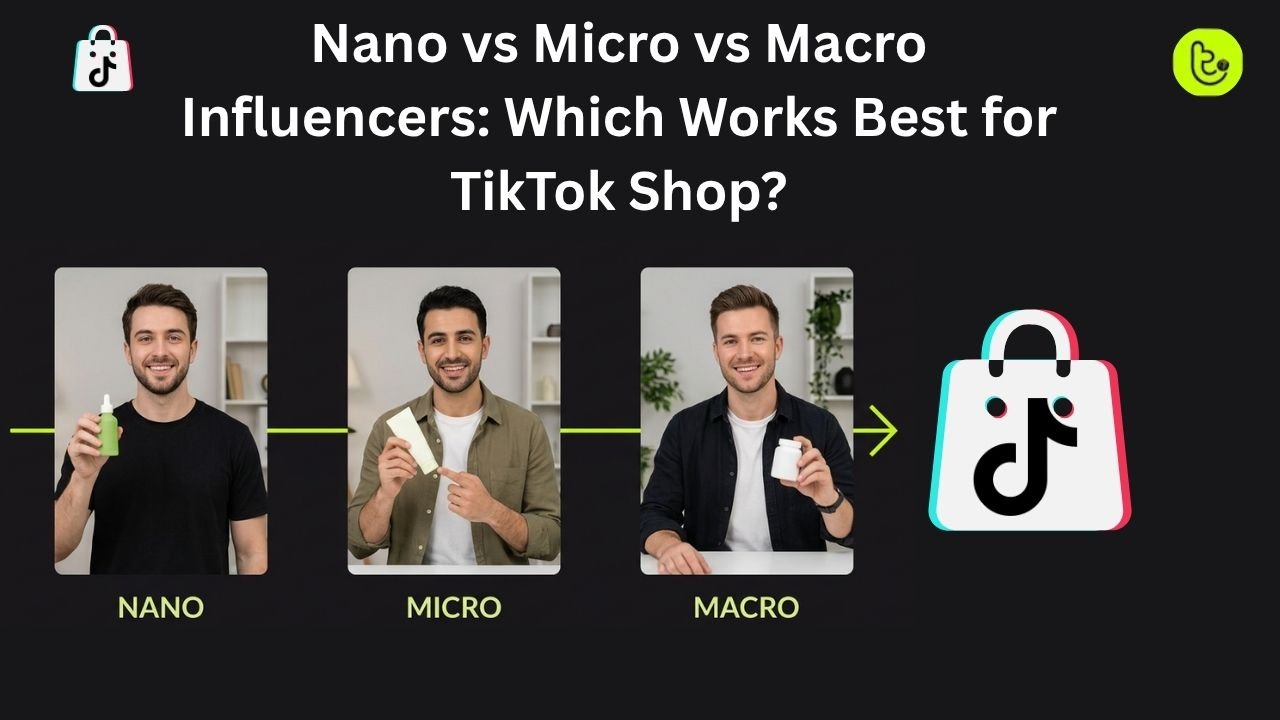
Nano, micro, and macro influencers each offer different advantages. Nano creators can help brands test products and content. Micro influencers can offer a useful balance between reach and relevance. Macro influencers can quickly put a product in front of a large audience.
The best option depends on your product, budget, audience, and campaign goal.
Quick answer: Micro influencers are often a strong starting point for sales-focused TikTok Shop campaigns. Nano influencers are useful for testing and UGC, while macro influencers are better for broad awareness and major launches.
Nano vs Micro vs Macro Influencers: What’s the Difference?
Influencer tiers are generally classified by follower count, although definitions vary between platforms and marketing companies.
| Creator type | Followers | Main advantage | Best for |
|---|---|---|---|
| Nano | 1K–10K | Close audience relationships | Testing and UGC |
| Micro | 10K–100K | Reach and niche relevance | Sales and scaling |
| Macro | 100K–1M+ | Large-scale reach | Awareness and launches |
Follower count gives you a starting point, but it does not tell you whether a creator can sell your product.
A 15,000-follower creator whose audience closely matches your target customer may generate better results than a 500,000-follower creator with a broad audience.
For TikTok Shop, pay attention to audience fit, content quality, product clicks, conversions, and revenue, not followers alone.
Nano Influencers for TikTok Shop
Nano influencers typically have 1,000 to 10,000 followers. Their smaller audiences often allow them to build strong relationships within a specific niche.
For TikTok Shop sellers, their biggest advantage is flexibility. You can work with several nano creators, test different content ideas, and identify what gets people interested in your product.
Advantages
- Lower collaboration costs in many cases
- Strong niche relevance
- Useful for product testing
- Good source of authentic UGC
- Multiple creators can test different content angles
- Suitable for affiliate campaigns where available
Limitations
- Lower reach per creator
- More creators may be required to generate scale
- Managing a large creator group can take more time
- Content quality can vary
Best use: Start with nano creators when you need to test a product, audience, hook, or creative concept before committing more budget.
Micro Influencers for TikTok Shop
Micro influencers generally have 10,000 to 100,000 followers. They often have a defined niche and enough reach to generate meaningful traffic.
This makes them a practical choice for brands that have moved beyond initial testing and want to generate consistent sales.
Advantages
- Strong niche relevance
- Greater individual reach than nano creators
- Established content skills
- Good fit for demonstrations and reviews
- Useful for affiliate and performance campaigns
- Easier to scale successful partnerships
Limitations
- Usually cost more than nano creators
- Some require an upfront fee
- A larger audience still does not guarantee conversions
- Audience quality needs to be checked carefully
Best use: Choose micro influencers when your priority is generating sales while maintaining strong audience-product relevance.
Macro Influencers for TikTok Shop
Macro influencers generally have 100,000 to 1 million or more followers, depending on the classification system.
Their biggest advantage is reach. One successful collaboration can introduce your product to a large audience in a short period.
Advantages
- Large potential reach
- Strong awareness potential
- Useful for major launches
- Can create rapid visibility
- Suitable for products with broad appeal
Limitations
- Higher collaboration costs
- Broader audiences may have weaker product relevance
- High views do not guarantee purchases
- One creator can consume a large portion of the campaign budget
Best use: Use macro influencers when broad exposure is more important than highly targeted creator testing.
Nano vs Micro vs Macro: Which Is Best for TikTok Shop?
There is no universal winner. The right tier depends on what you need the campaign to accomplish.
| Goal | Best starting point | Why |
|---|---|---|
| Product testing | Nano | Lets you test multiple creators and concepts |
| Authentic UGC | Nano | Smaller creators can produce personal, product-focused content |
| Direct sales | Micro | Combines useful reach with niche relevance |
| Niche products | Nano or Micro | Their audiences are often more focused |
| Scaling sales | Micro | Offers stronger individual reach and creator volume |
| Brand awareness | Macro | Provides broader exposure |
| Major launch | Macro + Micro | Combines reach with targeted content |
| Creative testing | Nano | Makes it easier to test multiple angles |
The key question is not “Which influencer tier is best?”
It is “Which creator can achieve my campaign goal at an acceptable cost?”
How Much Do TikTok Shop Influencers Cost?
There is no fixed rate for nano, micro, or macro TikTok Shop influencers. Pricing can depend on audience size, niche, content quality, location, engagement, deliverables, usage rights, exclusivity, and creator demand.
Common compensation models include:
| Model | How it works | Useful for |
|---|---|---|
| Product gifting | Creator receives the product | Testing and UGC |
| Affiliate commission | Creator earns from qualifying sales | Performance campaigns |
| Flat fee | Creator receives an agreed payment | Guaranteed content |
| Hybrid | Upfront fee plus commission | Larger partnerships |
Do not judge a creator only by their asking price.
A creator charging $500 may be more profitable than one charging $100 if the first creator generates significantly more sales.
For TikTok Shop, compare:
Creator cost → clicks → conversions → orders → revenue → profit
Useful performance metrics include:
- Product clicks
- CTR
- Conversion rate
- Orders
- GMV
- Commission
- CPA
- Revenue
- Profit
How to Choose the Right TikTok Shop Influencer
Choosing the wrong creator can waste your budget even if their content gets thousands of views. Before agreeing to a collaboration, check these areas.
1. Audience-Product Fit
Ask whether the creator’s audience has a genuine reason to buy your product.
A skincare creator may be a better choice for a beauty product than a general lifestyle creator with a much larger following.
2. Recent Content Performance
Look at recent videos rather than relying on an old viral post.
Check views, comments, shares, product-related discussions, and consistency.
3. Audience Quality
Read the comments. Do viewers ask questions, discuss the product category, or show buying intent?
High engagement numbers are less useful when the audience has little interest in what you sell.
4. Sponsored Content
Review previous brand collaborations.
Look for creators who can introduce products naturally without making every video feel like an advertisement.
5. Content Ability
Consider whether the creator can demonstrate your product effectively.
Depending on the product, useful formats may include:
- Tutorials
- Reviews
- Demonstrations
- Comparisons
- Problem-solution videos
- Routines
- Before-and-after content
6. Audience Location
If your TikTok Shop only serves specific markets, make sure the creator’s audience is located where you can sell and deliver.
7. TikTok Shop Eligibility
Confirm that the creator can participate in the TikTok Shop affiliate or collaboration program available in your target market.
8. Reliability
A creator with strong metrics can still become expensive if they miss deadlines, communicate poorly, or repeatedly require revisions.
How to Build a TikTok Shop Influencer Strategy
You do not need to choose between hundreds of creators blindly. Build a testing process that helps you identify what works.
Step 1: Set Your Goal
Decide what success means before contacting creators.
You may want to:
- Generate sales
- Produce UGC
- Test creative ideas
- Increase product discovery
- Build awareness
- Support a product launch
Your goal determines which creator tier makes the most sense.
Step 2: Find Relevant Creators
Search within your product category and examine creators based on audience fit, recent content, engagement, location, and previous product promotions.
Avoid making follower count your main filter.
Step 3: Run a Small Test
Instead of putting your entire budget behind one creator, test several relevant nano or micro influencers.
Give creators enough flexibility to produce content in their own style while providing the information they need about your product.
Step 4: Track Each Creator Separately
Record performance at the creator level.
Track:
Views → clicks → conversion rate → orders → GMV → CPA → profit
This shows which creators generate actual business results.
Step 5: Scale the Winners
Once you identify creators who consistently perform well, increase your investment in those partnerships.
You can request additional content, promote more products through the same creator, increase affiliate incentives where appropriate, or recruit similar creators.
Step 6: Keep Testing
A successful creator or content format should become a starting point for the next test.
Continue testing new creators and angles while maintaining your proven partnerships.
Should You Use Nano, Micro, or Macro Influencers?
You do not have to use one influencer tier exclusively.
A multi-tier strategy can work well when your campaign has different stages.
Nano → Test
Use nano creators to test products, audiences, hooks, and creative formats.
Micro → Convert and Scale
Use micro creators when you have identified promising products and content angles and want more consistent sales.
Macro → Amplify
Use macro creators when you need broad exposure for a major launch or awareness campaign.
For example, a new product could start with 5 to 10 nano creators. The strongest content and audiences can then guide your micro influencer campaign. A macro creator can be added when the brand is ready for wider exposure.
This gives you a way to learn before increasing your investment.
How Many TikTok Shop Influencers Should You Work With?
There is no ideal number for every brand.
Your budget, product price, margins, campaign objective, and creator availability should determine your testing volume.
A simple starting framework is:
- Small test: 5 to 10 creators
- Broader test: 10 to 25 creators
- Scaling: Increase investment in proven creators
The purpose of testing several creators is to find patterns.
If three creators with similar audiences generate strong results using the same product angle, you have a stronger basis for scaling than if one creator happens to produce a single viral video.
Can Nano Influencers Outperform Macro Influencers?
Yes.
A smaller creator can outperform a macro influencer when their audience is more relevant and their content generates stronger buying intent.
Imagine a 500,000-follower lifestyle creator promoting a specialist product and a 7,000-follower creator whose audience is specifically interested in that product category.
The macro creator may generate more views. The nano creator may generate more clicks, a higher conversion rate, or more orders relative to the campaign cost.
That is why TikTok Shop sellers should evaluate the full sales funnel rather than stopping at reach.
Reach → Clicks → Conversions → Orders → Revenue → Profit
The creator with the highest follower count may not be the creator producing the best return. Explore TikTok Shop Influencer Outreach Services to find creators who align with your brand and can drive meaningful results.
Common TikTok Shop Influencer Mistakes
Choosing Creators Based Only on Followers
Large audiences can produce impressive numbers without producing enough sales to justify the cost.
Treating Views as the Main KPI
Views tell you about exposure. They do not tell you how many people bought the product.
Spending the Full Budget on One Creator
Testing several creators gives you more information before making a larger investment.
Ignoring Audience Fit
A creator can be successful in one category and completely unsuitable for another.
Over-Scripting Content
Give creators clear product information and campaign requirements, but allow enough creative freedom for the content to feel natural.
Failing to Track Individual Results
Combine creator data and you lose the ability to identify your strongest partnerships.
How Tiksly Can Help With TikTok Shop Influencer Marketing
Finding creators is only one part of TikTok Shop influencer marketing. Brands also need a way to test content, track results, and scale successful partnerships.
Tiksly can help brands build a structured TikTok Shop creator strategy, including:
- Creator identification
- Influencer strategy
- TikTok Shop content concepts
- Creator collaboration
- Creative testing
- Affiliate campaign support
- Performance tracking
- Winner identification
- Campaign scaling
The goal is to build a repeatable creator program that can generate measurable results instead of relying on a single viral video.
Nano vs Micro vs Macro Influencers: Which One Should You Choose?
Choose nano influencers when you need:
- Product testing
- Authentic UGC
- Highly targeted audiences
- Multiple creative experiments
- Lower-cost testing
Choose micro influencers when you need:
- Sales
- Niche reach
- Strong audience-product fit
- More individual creator reach
- Scalable partnerships
Choose macro influencers when you need:
- Broad awareness
- Large-scale exposure
- Major product launches
- Mass-market reach
Choose multiple tiers when you want to test, validate, scale, and amplify your campaigns at different stages.
Final Verdict
Nano, micro, and macro influencers can all work for TikTok Shop, but they solve different problems.
Nano creators are strongest for testing and UGC. Micro influencers are often the best starting point for sales and scaling. Macro influencers are most useful when broad reach and awareness are the priority.
The safest approach is to match the creator tier to your goal, test before scaling, and measure actual business results.
Follower count can tell you how large a creator’s audience is. It cannot tell you how profitable that creator will be for your TikTok Shop campaign.
Ready to Build Your TikTok Shop Creator Strategy?
Get help finding relevant creators, testing content, and scaling partnerships that deliver results. Book a 1:1 consultation with Tiksly today.
FAQs
How many followers is considered a nano influencer?
A nano influencer typically has between 1,000 and 10,000 followers, although definitions can vary.
How many followers does a micro influencer have?
A micro influencer commonly has between 10,000 and 100,000 followers.
How many followers does a macro influencer have?
Macro influencers commonly have 100,000 to 1 million or more followers, depending on the classification system.
Which influencer type is best for TikTok Shop?
Micro influencers are often a strong starting point for sales-focused campaigns. Nano creators work well for testing and UGC, while macro creators are useful for broad awareness.
Are nano influencers better than micro influencers?
Neither is always better. Nano creators can offer strong audience connection and testing opportunities, while micro influencers provide greater individual reach. The right choice depends on your campaign.
Do TikTok Shop influencers get paid?
Yes. Compensation can include product gifting, affiliate commissions, flat fees, or hybrid arrangements.
Does follower count matter on TikTok Shop?
Follower count can indicate potential reach, but it does not guarantee sales. Audience relevance, clicks, conversions, orders, and revenue provide more useful performance signals.
How do you find influencers for TikTok Shop?
Search for creators in your product category and evaluate their audience, recent content, engagement, location, content quality, and TikTok Shop eligibility. You can also use creator and affiliate tools or work with a specialist partner.