 Ayesha Khan
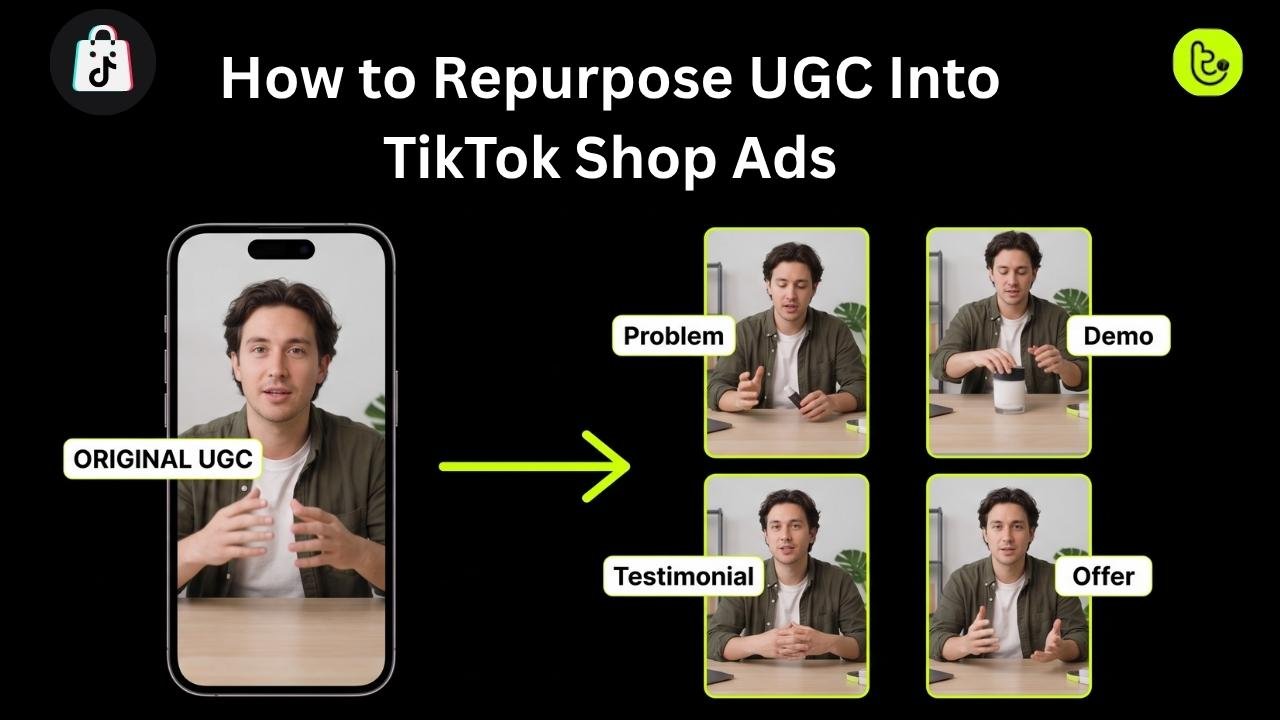
Repurposing UGC means taking a creator video you already have and pulling its strongest moments into several different TikTok Shop ad creatives. One video, cut and reframed the right way, can become five or six ads instead of one. Change the hook, the opening shot, which benefits the spotlight, the CTA, the captions, the pacing, and the same footage reads as a completely different ad.
For TikTok Shop sellers, that matters because creative production is expensive and slow, and the algorithm rewards variety over repetition. Repurposing well-performing UGC gets you faster turnaround, lower cost per ad, more variations to test against each other, and a longer usable life for content you’ve already paid to produce.
There’s a real difference between reusing a video, posting the exact same clip again, and repurposing it, which means rebuilding it into something with its own creative angle. This guide covers the second one: what to change, what to leave alone, and how to test what you make.
What Does It Mean to Repurpose UGC Into TikTok Shop Ads?
Organic UGC is built to feel native to the feed. Paid TikTok Shop creative has the same job, but it also needs to move someone toward a purchase. Repurposing bridges the two: you keep the organic feel and layer in the structure a paid ad needs.
The same source video can become several different ad types, including:
- Hook variations that test different opening lines
- Short-form cuts trimmed down to the highest-retention seconds
- Product demonstration ads built around the clearest usage moment
- Problem-solution ads that lead with the customer’s frustration
- Testimonial-style ads centered on the creator’s own experience
- Offer-focused ads where the product or promotion leads
- FAQ or objection-handling ads that address a specific hesitation
None of these need to look identical, and they shouldn’t. The idea is one source asset, multiple creative angles, not one video copied six times with a different caption.
When Should You Repurpose Existing UGC?
- The video already has strong engagement or watch time
- It clearly demonstrates the product in use
- Customers are responding well to a specific benefit it shows
- It contains several usable moments, not just one good clip
- You need more ad variations quickly and don’t have time to brief a new creator
Which Parts of UGC Can You Repurpose?
- The first 1 to 3 seconds
- The creator’s hook
- The product demonstration
- The customer’s stated problem
- The specific benefit called out
- The testimonial moment
- A before-and-after moment, where the product supports one
- Objection handling
- The CTA
- On-screen text and captions
Why Repurpose UGC for TikTok Shop Ads?
More creative variations mean more chances to find out what actually drives action. Different audiences respond to different angles from the same product experience, one segment reacts to the price, another to the result, another to the creator saying it fixed a problem they recognize. Repurposing is how you find that out without commissioning a new shoot for every test.
Running the same unedited UGC asset on repeat also has a shelf life. Once an audience has seen it a few times, performance drops even if the underlying product story is still strong. Repurposing extends that shelf life by giving the same story a new entry point.
Repurposing vs. Creating a New UGC Ad From Scratch
| Factor | Repurposed UGC | New UGC |
|---|---|---|
| Production time | Lower | Higher |
| Starting asset | Existing content | New creator brief |
| Testing potential | High, with multiple variations | High |
| Cost | Often lower | Usually higher |
| Authenticity | Retained from original creator | Depends on the new creator |
| Best use | Scaling proven creative angles | Testing new concepts |
Neither replaces the other. Repurposing scales what’s already working while new UGC keeps the pipeline fresh with concepts you haven’t tried yet. A creative strategy that leans entirely on one or the other tends to stall out.
How to Repurpose UGC Into TikTok Shop Ads, Step by Step
Once you have your UGC variations ready, the next step is to test them systematically and use performance data to guide your next round of creativity.
Step 1: Identify Your Strongest UGC Assets
Review what you already have and look for strong opening hooks, clear product demonstrations, specific customer benefits, natural testimonials, relatable problems, and sections with high retention.
Don’t pick a video on views alone, a clip with modest reach but a sharp, specific product message is often more useful than a viral one with a vague pitch.
Step 2: Break the Original UGC Into Creative Components
Map the video against a simple structure: Hook → Problem → Product → Demonstration → Benefit → Proof → CTA.
- Mark timestamps for each usable section
- Identify more than one possible hook within the same video
- Separate product-focused footage from talking-head footage
- Flag moments that still make sense without the full original context
Step 3: Create Multiple Hook Variations
The opening few seconds decide whether someone keeps watching, and they can reposition the same footage entirely.
Try a problem-led hook, a curiosity hook, a product-result hook, a testimonial hook, a question hook, or a common-mistake hook. Keep the creator’s natural delivery wherever you can, the hook is the part most worth testing on its own, separate from everything after it.
Step 4: Turn One UGC Video Into Different Ad Formats
- Variation A: Problem → Solution. Lead with the customer’s pain point, then move quickly into the product as the fix.
- Variation B: Product Demonstration. Open with the product in use, with the creator’s commentary as supporting context.
- Variation C: Testimonial. Lead with the creator’s strongest personal experience, then follow with proof and a CTA.
- Variation D: Objection Handler. Name a common concern directly, then use the existing footage to address it.
- Variation E: Offer or Product Focus. Lead with the product or a relevant shopping incentive, using the UGC as social proof.
Step 5: Edit the UGC for Paid Performance
- Cut slow openings
- Tighten pauses
- Add readable captions
- Keep key product information visible on screen
- Use quick visual changes only where they earn their place
- Keep the creator’s authentic delivery intact
- Reframe for vertical viewing where needed
- Stop short of over-polishing it into something that looks like a traditional commercial
Step 6: Add TikTok Shop-Specific Messaging
Make the product’s value obvious and connect the creative clearly to what’s being sold. Use a shopping-focused CTA, keep product claims accurate and supported, and make sure pricing, discounts, and availability are current at the time the ad runs. Don’t manufacture urgency that isn’t real.
Step 7: Build and Test Multiple Creative Variations
Set up a simple testing matrix and change one variable at a time:
| Variable | Example Variations |
|---|---|
| Hook | Problem / Result / Curiosity |
| Length | Short / Medium |
| Format | Testimonial / Demo |
| Angle | Benefit / Pain point |
| CTA | Product-focused / Offer-focused |
| Opening visual | Creator / Product |
Changing several variables in one version makes it impossible to know which change actually moved performance. Start with differences that are meaningful, not cosmetic edits that look different but test the same thing twice.
Step 8: Review Performance and Repurpose the Winners
Look past one metric. Review hook performance, watch time and retention, click-through behavior, product engagement, conversion performance, and cost efficiency. Then take whatever’s winning and build the next round of variations from it, turning the pattern into a repeatable template rather than a one-off win.
UGC Repurposing Examples for TikTok Shop Ads
The best way to understand UGC repurposing is to see how one original video can be turned into several TikTok Shop ad concepts without creating new content from scratch.
Example: Skincare Product
Say the original UGC has a creator explaining a skincare concern, showing the product in use, and sharing her result. That single video can support five distinct ads:
- Problem-led ad: opens on the skincare concern
- Demo-led ad: opens on product application
- Testimonial ad: leads with the creator’s result
- FAQ ad: answers a common customer question
- Benefit-led ad: focuses on the product’s strongest relevant benefit
The footage stays the same. What changes is which part of the story leads, and that’s often enough to make each version feel distinct.
Common Mistakes When Repurposing UGC for TikTok Shop Ads
Repurposing UGC can give you more creative options from the same source material, but poor editing choices can reduce its impact and limit ad performance.
Using the Same Hook in Every Version
This caps your testing before it starts, every variation ends up measuring the same first three seconds.
Cutting the Video Without a Clear Advertising Angle
A shorter cut isn’t automatically a stronger ad. Every edit should serve a specific purpose, not just trim runtime.
Removing the Creator’s Authentic Voice
Over-editing UGC until it sounds scripted defeats the point of using UGC at all. Keep the natural language and real reactions.
Focusing Only on Views
High views don’t guarantee sales. Look at the full path from view to checkout, not just reach.
Making Unsupported Product Claims
Check product information before publishing any variation, and avoid misleading claims about health, performance, or results.
Failing to Refresh Creative
Even a strong-performing UGC ad loses effectiveness over time. Build a system for producing new variations from proven assets on an ongoing basis, rather than running one version until it stops working.
How to Build a Repeatable UGC-to-Ad Workflow
Once you have avoided the common repurposing mistakes, the next step is to turn the process into a repeatable system that helps you consistently produce, test, and improve TikTok Shop ads.
Create a UGC Repurposing Content Library
Organize assets by product, creator, hook, creative angle, product benefit, ad format, performance, and date tested, so nothing gets rebuilt from scratch that already exists somewhere in your library.
Create a Creative Testing Calendar
Schedule new variations on a regular cadence, reuse proven angles with fresh openings, and balance winning concepts against new experiments. Document results so future creative decisions rest on evidence instead of guesswork.
Collect UGC → audit assets → extract hooks → identify angles → edit variations → add TikTok Shop messaging → launch tests → analyze performance → repurpose winners.
How Tiksly Can Help With TikTok Shop Creative
Turning one UGC video into a working ad system takes more than a video editor, it takes a creative strategy behind the cuts. Tiksly works with TikTok Shop brands on UGC creative strategy, concept development, repurposing, hook development, ad variation production, creative testing, and performance-led iteration.
The goal is moving brands from a handful of one-off UGC videos to a structured creative library, then to multiple TikTok Shop ad concepts running in parallel, then to ongoing testing and optimization built around what the data actually shows. That combination, creator authenticity paired with a structured production and testing workflow, is where most of the performance gains sit.
Turn One UGC Asset Into a TikTok Shop Creative System
UGC gets more valuable when a brand builds several creative possibilities out of one strong piece of source material, instead of running it once and moving on. The workflow is consistent: select, break down, re-angle, edit, test, measure, and repurpose the winners.
None of that happens automatically. It takes creative judgment, an understanding of the audience, accurate product messaging, and a testing habit that doesn’t skip steps. The goal isn’t more videos for the sake of volume, it’s a creative process that keeps producing ads worth running.
If you want help turning your existing UGC into a stronger TikTok Shop ad strategy, book a free 1:1 consultation with Tiksly experts. Get practical guidance on creative angles, ad testing, and ways to repurpose your UGC into more effective TikTok Shop campaigns.
FAQs
Can you use the same UGC video for multiple TikTok Shop ads?
Yes, as long as the edits, hooks, angles, or messaging create a meaningful difference between versions. Confirm creator usage rights and ad authorization before running any variation as a paid ad.
How many TikTok Shop ads can you make from one UGC video?
There’s no fixed number. It depends on the usable footage, the product, the creator’s delivery, and how many genuinely different angles the video supports. Prioritize meaningful variations over cutting arbitrary versions just to hit a count.
How do you repurpose UGC for TikTok ads without making it repetitive?
Change the creative angle, hook, opening visual, pacing, product emphasis, or CTA between versions, while keeping the original creator’s voice intact.
Should you edit UGC before using it as a TikTok Shop ad?
Yes, when the edit improves clarity, pacing, messaging, or testing potential. Just don’t edit away the qualities that made it feel like real UGC in the first place.
How do you know which repurposed UGC ad is working?
Compare performance across the metrics that actually matter for the campaign, then look for patterns across hooks, angles, formats, and product messages rather than judging each ad in isolation.