 Ayesha Khan
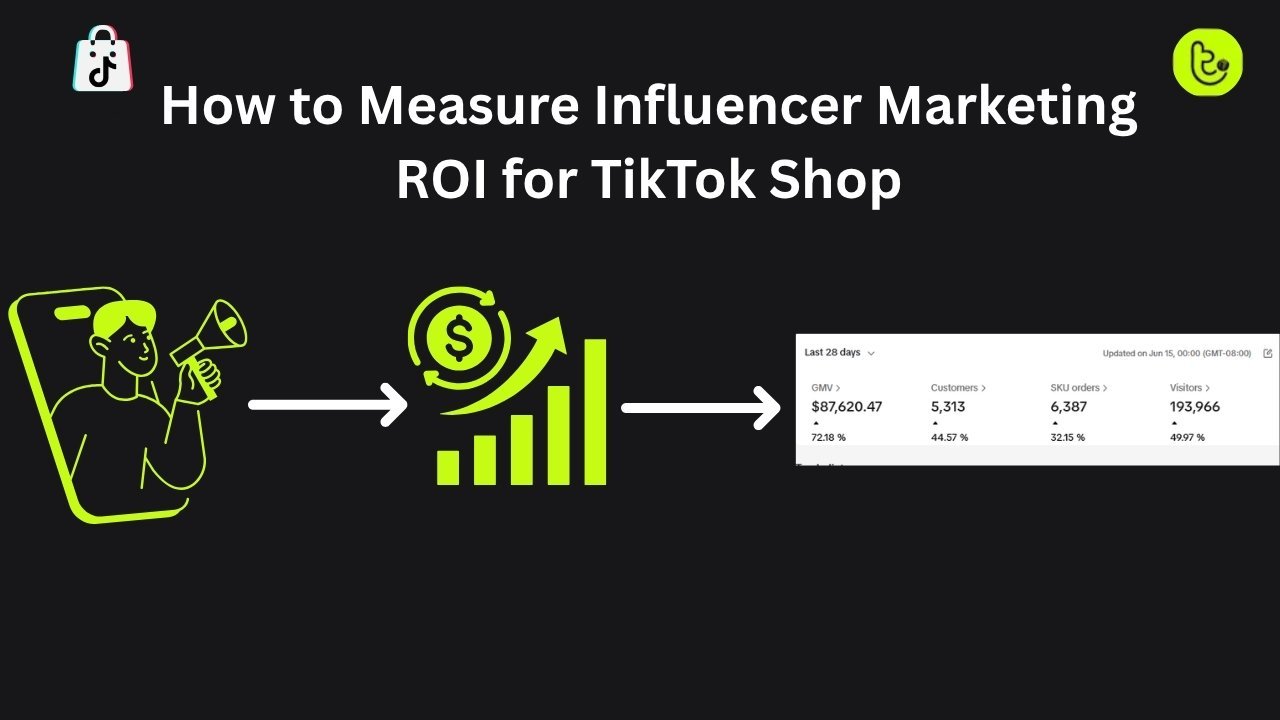
If a TikTok Shop creator posts your product and $4,000 in GMV shows up in Seller Center a week later, that number alone doesn’t tell you whether the collaboration made money. To actually measure influencer marketing ROI for TikTok Shop, you need to net that GMV against commission, product cost, samples, refunds, and the platform’s referral fee, then compare what’s left to what you spent to get the post in front of buyers.
Most sellers stop at “GMV went up,” which is why so many affiliate programs feel busy without being profitable. This guide covers the formula, the TikTok Shop-specific metrics that change the math, and a step-by-step process for turning creator performance into a number you can defend to a finance team.
Why TikTok Shop Changes the ROI Math
On most platforms, influencer ROI is a guessing game stitched together from UTM links, promo codes, and post-purchase surveys hoping someone remembers where they saw a product. TikTok Shop removes a step: a viewer can watch a video, tap the product card, and check out without leaving the app.
That in-app path gives you cleaner attribution than Instagram or YouTube affiliate links, but it also means the platform’s own definitions, like GMV, Direct GMV, and attribution windows, become the terms your ROI math has to run on. Get those definitions wrong and your ROI number will be wrong even if your spreadsheet formula is right.
The Core Formula to Measure Influencer Marketing ROI for TikTok Shop
The base formula is simple:
ROI = (Revenue − Total Cost) ÷ Total Cost × 100
The complexity is entirely in what belongs on each side of that equation, and this is where most sellers undercount cost or overcount revenue.
What Counts as Revenue
Revenue is the GMV attributed to a creator’s content, adjusted for returns and cancellations, not the raw number shown on a leaderboard. If you’re comparing creators or campaigns, use the same TikTok Shop affiliate attribution window and the same GMV definition (Direct GMV versus broader attributed GMV) for every creator, or the comparison won’t hold up.
What Counts as True Cost
Total cost includes the commission you pay on every affiliate sale, the wholesale cost of any product you gifted, shipping for samples, any flat fee paid to the creator, and TikTok Shop’s standard referral fee, which sits at a flat 6% on most categories. Sellers who skip the referral fee and product cost routinely report ROI numbers that look far healthier than the business actually is.
The Metrics That Actually Move the Number
GMV gets all the attention because it’s the first number in Seller Center, but a handful of other metrics decide whether that GMV translates into profit.
TikTok Shop Affiliate GMV vs. Direct GMV
TikTok Shop affiliate GMV is the total order value tied to a creator across the attribution window, including purchases that happened after multiple touchpoints. Direct GMV is narrower: it’s the value of orders placed straight from that creator’s content under last-click logic.
Use Direct GMV when you want to know what a specific video actually sold, and use broader affiliate GMV when you’re evaluating a creator’s overall influence on a launch.
Understanding the TikTok Shop Affiliate Attribution Window
TikTok Shop’s standard TikTok Shop affiliate attribution window runs 7 days after a click and 1 day after a view, with the most recent touchpoint getting credit and clicks outranking views.
That window matters because a creator whose video goes viral on day one might get under-credited for sales that trickle in on day nine, while a creator who posts right before a payday could look artificially strong. Set expectations with creators around this window before the campaign, not after you’re arguing about payout.
Sample-to-Sale Conversion Rate
For seeded (unpaid) collaborations, track how many of the creators you sent product to actually generated sales, not just how many posted. A creator who posts but drives zero orders is a content cost, not a sales channel. This ratio is what should decide who gets moved from free samples to paid or commission-boosted partnerships.
If you’re building a structured seeding program, TikTok Shop creator seeding can help you understand how to approach creators and turn product gifting into a measurable sales channel.
Cost Per Acquisition by Creator
Divide total cost for a creator (commission, product, shipping, any fee) by the number of orders they generated. Comparing CPA across creators, and against your paid-ad CPA, tells you instantly whether a partnership is worth scaling or should be cut.
Step-by-Step: How to Measure Influencer Marketing ROI for TikTok Shop
To get an accurate picture of your TikTok Shop influencer performance, track each creator’s revenue and costs consistently from the start. Here’s how to measure it step by step:
- Set your attribution rules before launch. Decide whether you’re measuring Direct GMV or broader affiliate GMV, and confirm the attribution window with every creator so nobody disputes credit later.
- Log true cost per creator as you go. Commission, product cost, shipping, and any flat fee, tracked at the creator level, not lumped into one program-wide budget line.
- Pull GMV and order counts from Seller Center’s Affiliate Center, not from a public leaderboard, since leaderboard numbers aren’t adjusted for returns or your specific attribution definition.
- Subtract returns and cancellations from GMV before you calculate revenue. TikTok Shop counts orders at payment time, so a spike in refunds a week later won’t automatically correct your dashboard.
- Run the ROI formula per creator, not just per campaign. A campaign-wide ROI can hide two or three creators losing money while one high performer carries the average.
- Segment by tier and repeat the calculation monthly. A creator’s ROI in month one, mostly gifted samples, looks different from their ROI in month three, once they’re on a negotiated commission. Measuring at a single point in time misses that shift.
TikTok Shop Affiliate GMV vs. Creator Profit
Affiliate GMV | Creator Profit | |
|---|---|---|
What it measures | Total order value attributed to a creator | Revenue left after commission, product cost, refunds, and fees |
Best used for | Ranking reach and top-line influence | Deciding budget allocation and who to scale |
Where it hides risk | Ignores returns, commission rate, and cost | Requires more setup to calculate per creator |
When to check it | Weekly, for pipeline visibility | Monthly, before renewing or upgrading a partnership |
A creator who drives $8,000 in GMV can still be a net loss once you account for $3,000 in seeded product, a $2,000 flat fee, and a high return rate on that category. GMV tells you what happened. Profit tells you whether it was worth it.
Common Mistakes That Skew TikTok Shop ROI Attribution
Even with the right ROI formula, small tracking errors can make your TikTok Shop results look better or worse than they really are. Watch out for these common attribution mistakes:
- Comparing creators across different attribution windows or GMV definitions. If one creator’s number is Direct GMV and another’s includes multi-touch attribution, the comparison is meaningless.
- Ignoring the platform referral fee. A flat 6% off the top changes ROI more than most sellers assume once volume scales.
- Treating “posted content” as a success metric on its own. A post with no attributed sales isn’t a win, even if it got views.
- Skipping a commission protection buffer. TikTok Shop holds commission for a set period after purchase to account for returns; calculating ROI before that window closes overstates results.
- Judging a seeding program on GMV alone, instead of tracking which seeded creators actually converted into repeat, commission-earning partners.
TikTok Shop Creator ROI Benchmarks: What Good Actually Looks Like
There isn’t one universal number for TikTok Shop creator ROI benchmarks. Your target can vary based on product category, profit margin, creator costs, and how mature your affiliate program is. Before setting a target, it helps to understand what a strong ROI actually looks like and what can influence that number.
What Is a Good TikTok Shop Creator ROI?
Industry data on affiliate seeding puts a reasonable floor around 3:1, meaning $3 in attributed revenue for every $1 spent on gifted products and fulfillment once a program is past its first few months.
Sellers running structured programs with creator briefs, tiered commissions, and per-creator tracking tend to land well above that floor. Sellers onboarding a handful of creators and hoping for the best often land closer to it or below.
The difference is rarely about which creators they picked. It often comes down to whether the seller is tracking costs and conversions at the creator level.
Which Creators Usually Drive the Most ROI?
It also helps to know where GMV actually comes from before building a benchmark around it. A small share of active creators, often under 10% of everyone in a program, can account for the majority of affiliate sales.
Mid-tier creators, roughly 10,000 to 100,000 followers with engagement above 3.5%, can deliver strong returns because their rates may still be lower than their conversion potential. For this reason, your most useful benchmark should come from your top-performing creators and their actual profitability, rather than relying only on the overall program average.
If you’re deciding which creator tier fits your TikTok Shop strategy, see our guide to nano, micro, and macro influencers for TikTok Shop for a closer comparison of their strengths, costs, and potential ROI
How Tiksly Can Help
Measuring ROI accurately is only useful if the underlying content is good enough to convert in the first place. As a TikTok Shop Official Creative Partner, Tiksly works with brands on the creative side of this equation: sourcing and vetting creators for product fit, briefing them so content sells instead of just entertaining, and producing UGC and product-focused videos designed for the TikTok Shop funnel.
If you need help finding creators who fit your products and campaign goals, explore our TikTok Shop influencer outreach services.
For sellers who already have the tracking in place but are seeing weak sample-to-sale conversion or inconsistent creator output, Tiksly can help diagnose whether the gap is a creator-fit problem, a content problem, or a briefing problem, and build a creative testing process around whichever one it turns out to be. If your GMV is healthy but your ROI isn’t, the fix is often upstream of the dashboard.
Conclusion
Getting this right isn’t complicated, but it does require discipline most affiliate programs skip. To measure influencer marketing ROI for TikTok Shop with any accuracy, define your attribution window and GMV type before launch, track true cost at the creator level, net out returns before calling anything revenue, and run the math per creator instead of per campaign.
The sellers who do this consistently aren’t necessarily picking better creators than everyone else. They’re the ones who know, creator by creator, which partnerships are actually profitable and which ones just look busy on a dashboard.
Want to improve your TikTok Shop creator ROI? Book a 1:1 consultation with Tiksly to review your creator strategy, identify what’s holding back conversions, and build a more profitable approach.
FAQs
1. What’s a good ROI for TikTok Shop influencer marketing?
There’s no single figure that applies everywhere, but a commonly cited floor for a maturing seeding program is around 3:1 revenue-to-cost. Category margin, commission rate, and return rate all shift that number, so compare your ROI against your own program’s history rather than an industry average.
2. Does TikTok Shop GMV include returns and cancellations?
Yes. GMV is calculated at payment time and includes orders that are later canceled or refunded, which is why you need to net out returns before treating GMV as revenue.
3. How long is TikTok Shop’s attribution window for affiliate sales?
The default is 7 days after a click and 1 day after a view-through, with the most recent interaction and clicks over views taking priority. Confirm this with any tool or agency you’re using, since some third-party dashboards apply different windows.
4. Should I use promo codes or TikTok’s native affiliate links to track ROI?
Native affiliate links inside TikTok Shop are generally the most reliable since they tie directly to the platform’s own order data. Promo codes are useful as a backup, especially for cross-platform creators, but they rely on buyers remembering to enter them and can undercount real conversions.
5. How do I know if a seeded (unpaid) creator is worth upgrading to paid?
Look at sample-to-sale conversion, not just whether they posted. A creator who reliably turns gifted product into orders, even a modest number, is a better upgrade candidate than one with high views and no attributed sales.