 Ayesha Khan
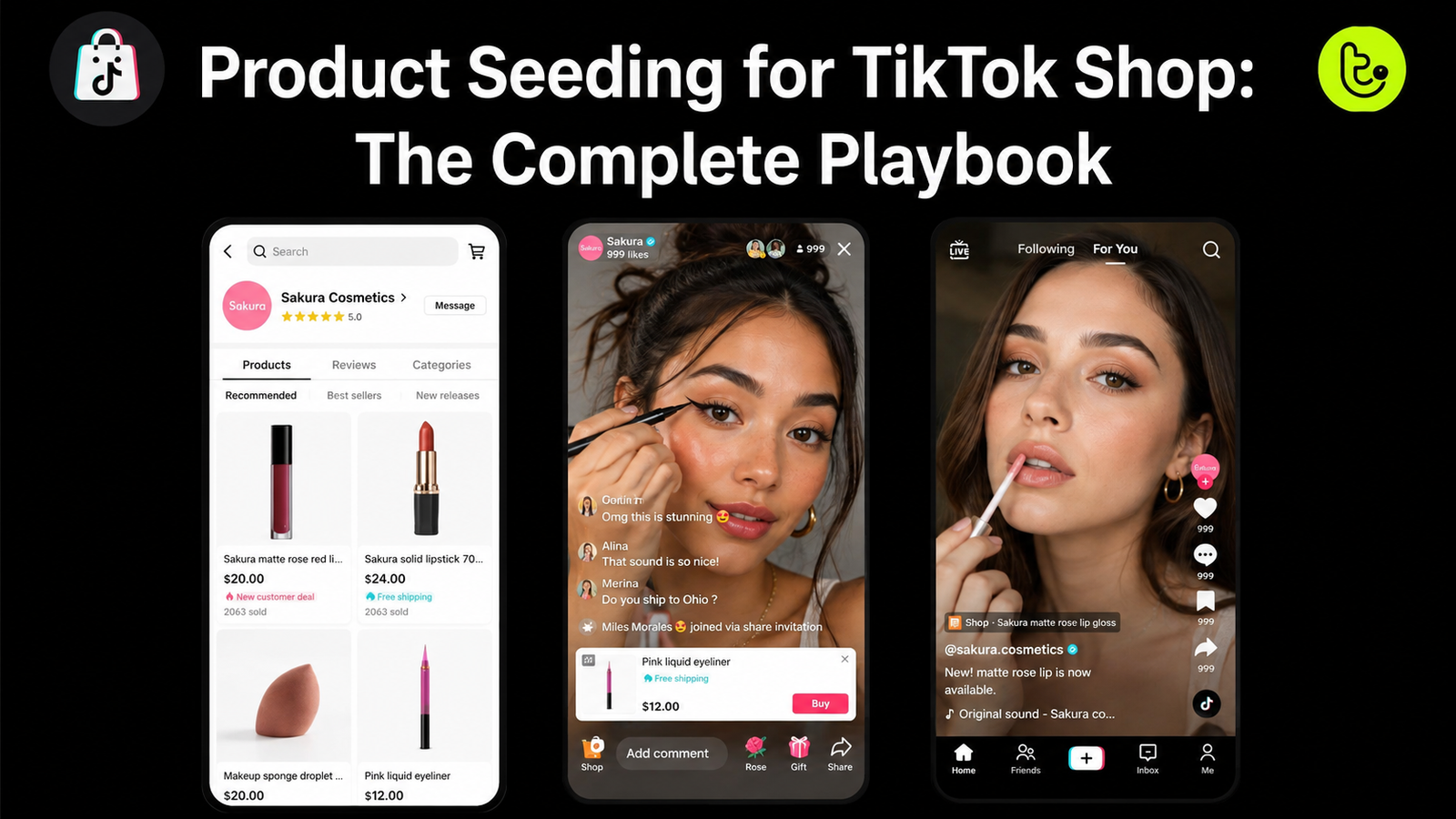
Product seeding for TikTok Shop means sending products to selected creators so they can try them, film with them, and decide whether to promote them through TikTok Shop’s affiliate program.
Done well, it’s not a gifting exercise, it’s a structured way to generate creator content, get products in front of the right audiences, and open the door to affiliate sales. Done poorly, it’s a box of free samples with nothing to show for it.
The difference between the two comes down to structure. Brands that treat seeding as a real acquisition channel pick products carefully, define what a good creator match looks like, track what happens after the box ships, and put more budget behind whatever’s working.
This guide covers how to choose products, find and vet creators, structure outreach and commissions, manage a campaign after samples go out, and measure whether any of it paid off.
What Is Product Seeding for TikTok Shop?
Traditional influencer gifting is often just a product and a hope. Affiliate product seeding adds a mechanism: creators get a commission when their content drives a sale, so there’s a reason to post beyond goodwill.
Paid creator campaigns go further still, with a contract and a defined deliverable. UGC production is its own category, brands pay specifically for usable content, whether or not it’s ever posted publicly.
Seeding sits early in the TikTok Shop funnel. A sample goes out, a creator makes something with it, that content gets discovered, someone clicks the affiliate link, and, if the fit is right, they buy.
Sample, content, discovery, click, purchase. Each step can break down, which is why tracking the whole chain matters more than watching any single metric.
How TikTok Shop product seeding works
The process is straightforward on paper:
● Pick a product worth seeding.
● Define what the ideal creator looks like.
● Find and vet creators against that profile.
● Reach out directly or use TikTok Shop’s collaboration tools.
● Offer the product and a commission structure.
● Ship it.
● Track the content and any resulting sales.
● Find out who’s actually converting, and do more of that.
The work is in steps 3, 4, and 7, everything else is logistics.
Why Product Seeding Matters for TikTok Shop Sellers
A strong product seeding strategy can deliver value at several stages, from generating authentic content to reaching the right audiences and creating new sales opportunities. Here’s how each part contributes to TikTok Shop growth:
Generate more product-focused content
Seeded creators tend to produce the kind of content that’s hard to manufacture in-house: demos, reviews, tutorials, unboxings, before-and-afters where relevant, problem-solution videos. It reads as testing, not advertising, because that’s mostly what it is.
Put products in front of relevant audiences
Follower count is the easiest number to look at and often the least useful one. A creator with 40,000 followers in a tight niche can outperform one with 400,000 general-interest followers, because the smaller audience actually wants what’s being shown. Engagement, content quality, and purchase intent tell you more than reach alone.
Turn samples into affiliate opportunities
When a creator’s content drives a qualifying sale through their affiliate link, they earn a commission. That’s the mechanism that turns a free product into an incentive to keep posting. TikTok Shop also allows authorized affiliate videos to be used in Shop Ads, so strong organic content from a seeding campaign doesn’t have to stay organic, it can get a paid push once it’s proven itself.
How to Build a TikTok Shop Product Seeding Strategy
Once you know what you want to promote and what success looks like, the next step is finding creators who can present your products naturally to the right audience. This is where a clear creator selection process becomes essential
Step 1: Choose the right products for seeding
Not every SKU is worth seeding. The products that work best are easy to show on camera, visually interesting, solve a specific problem, and carry a margin healthy enough to absorb the cost of the sample and the commission. Reliable inventory matters too, there’s no faster way to burn a creator relationship than promising a restock that doesn’t happen.
Step 2: Set your campaign objective
A seeding campaign can aim at different things: awareness, affiliate content volume, first sales on a new product, finding creators worth a longer-term relationship, building a UGC library, or testing whether a new product resonates at all. The objective decides who you recruit and what “success” looks like, a campaign built to find repeat partners looks different from one built to move inventory fast.
Step 3: Define your ideal creator profile
Build the profile around niche, audience, content style, average views, engagement, category experience, prior TikTok Shop activity, video quality, and brand safety. Where the data exists, conversion history is worth more than any of it. Follower count shouldn’t be the primary filter, it’s the number that’s easiest to see and the one most likely to mislead.
How to Find and Vet TikTok Shop Creators
Finding suitable creators is only the first part of the process. Before sending products, sellers need to assess creator quality, audience fit, and campaign potential so samples go to partners who can actually contribute to the campaign’s goals.
Where to find creators
TikTok Shop’s affiliate ecosystem is the starting point, through Open Collaboration and Target Collaboration. Open Collaboration makes a product available for any eligible creator to pick up; Target Collaboration lets a seller invite specific creators directly. Beyond the platform tools, there’s direct research on TikTok itself, existing creator relationships, and partner or agency networks.
What to check before sending a sample
Before a product ships, it’s worth checking whether the creator’s audience is actually relevant, whether they post consistently, whether their videos show products naturally rather than as an ad read, and whether their comment sections show real buying interest, questions about price, sizing, where to get it.
It also helps to check whether they’ve promoted similar products before, whether their content fits the brand, and whether there are signs of inflated or automated engagement.
Micro-creators vs. larger creators
Factor | Micro-creators | Larger creators |
|---|---|---|
Audience size | Smaller | Larger |
Relationship with audience | Often stronger | Varies |
Sample cost | Easier to manage | Can be higher |
Testing volume | Easier to scale | More selective |
Potential reach | Lower per creator | Higher per creator |
Best use | Testing and niche targeting | Reach and amplification |
The right mix depends on the product, the budget, and what the campaign is actually trying to do. Testing phases lean micro; amplification phases lean larger.
How to Run TikTok Shop Creator Outreach
Once you have identified the right creators, your next priority is reaching out in a way that feels relevant and gives them a clear reason to respond. A focused outreach process can improve response rates while setting the right expectations from the start.
What to include in your outreach message
A message worth responding to opens with something specific to the creator, explains why the product fits what they already make, introduces the sample offer, states the commission clearly, sets expectations for content, and ends with an obvious next step.
Product seeding outreach template
Outreach Template Creator name A genuine, specific observation about their content Product value proposition Free sample offer Commission details Content expectations Clear response instructions |
|---|
How do I ask TikTok creators to promote my product? Lead with specifics about their content, offer the product and commission plainly, and ask for a clear yes or no rather than a vague “let us know.”
Follow-up without spamming creators
One initial message and one reasonable follow-up is enough. Beyond that, it starts to look like spam rather than outreach. Track who responds, and drop unresponsive creators from future lists instead of messaging them again next campaign, the goal is a relationship, not a broadcast list.
How to Use TikTok Shop Free Samples Strategically
Free samples can be a powerful part of a TikTok Shop strategy when they are tied to clear goals and tracked carefully. Once you know when and why to send them, the next step is measuring what those samples actually produce.
When to offer free samples
Samples make the most sense around product launches, new creator campaigns, testing a new product’s appeal, recruiting affiliates, seasonal pushes, and expansion into creator niches the brand hasn’t worked with yet.
What to consider before sending samples
Before a sample goes out, weigh the product cost, shipping, commission rate, the creator’s likely acceptance rate, expected content output, margin, inventory on hand, and expected sales value. Skipping this math is how seeding budgets disappear without a clear return.
Avoid the free-sample trap
Sending products to hundreds of creators with no vetting, no tracking, and no follow-up is the most common way to waste a seeding budget. TikTok’s own Shop materials emphasize affiliate content volume and creator-driven creative as part of how Shop growth actually happens, volume without structure doesn’t get you there.
How to Manage the Campaign After Samples Are Sent
Sending the sample is only the midpoint of the campaign. Once creators receive the product, sellers need a clear process for tracking activity, supporting creators, and identifying which partnerships are worth developing further.
Track the full creator journey
The full path looks like this: creator identified, contacted, accepted, sample sent, sample received, content posted, affiliate clicks, orders, GMV, repeat collaboration. Each stage is a place things can stall, so it’s worth tracking all of them, not just the ones at the end.
Follow up with creators after delivery
Confirm the product arrived. Give the creator time to actually use it before expecting content. Answer their product questions and hand them useful information — but don’t script every line of the video. The more natural the presentation, the more it works.
Identify high-potential creators
Watch for consistent posting, strong content quality, engagement, videos that actually center the product, affiliate clicks, conversions, and repeat performance over time. One good video is a data point. There is a pattern.
How to Measure Product Seeding for TikTok Shop
Measuring the right KPIs helps sellers see which parts of the seeding campaign are working and where money is being wasted. The goal is to connect creator activity with content output, sales, and the overall return on each sample sent.
Essential product-seeding KPIs
● Samples sent and acceptance rate
● Delivery rate
● Content creation and posting rate
● Affiliate clicks and conversion rate
● Orders and GMV
● Creator commissions
● Cost per acquired customer and cost per piece of content
● Revenue per sample and overall ROI
The metrics that matter most
Views are the easiest number to report and the least connected to revenue. What actually matters is the full equation: sample cost plus shipping plus commissions, weighed against revenue generated and the value of the content itself.
How to decide which creators to scale
High content + high sales | Scale the relationship |
|---|---|
High content + low sales | Test a different product or offer |
Low content + high potential | Work on the relationship before writing them off |
Low content + low sales | Stop sending samples |
Product Seeding vs. Other TikTok Shop Creator Strategies
Each creator strategy offers a different balance of cost, control, content volume, and performance potential. Understanding these differences helps sellers choose the approach that best fits their product, budget, and campaign goals.
Product seeding vs. paid influencer campaigns
Seeding has lower upfront cost and lower risk per creator, but less certainty about whether content shows up at all. Paid campaigns guarantee a deliverable but cost more regardless of how it performs. Seeding scales more easily because there’s no negotiated fee per creator.
Product seeding vs. UGC campaigns
Seeding is about getting a product into a creator’s hands and seeing what they make with it. Paid UGC campaigns come with specific contractual deliverables, a set number of videos, specific shots, specific messaging. A seeded creator’s content tends to be more organic; paid UGC is more controlled.
Product seeding vs. affiliate-only outreach
Affiliate-only outreach skips the free product and just asks creators to promote using their own units or none at all, it’s lower cost but usually lower response. Product seeding tends to work better as part of an affiliate strategy than as a standalone gifting tactic.
How to Scale a TikTok Shop Product Seeding Program
Once a seeding campaign has proven which creators, products, and content styles perform, the next step is to scale those findings into a repeatable system. At the same time, avoiding common mistakes helps protect your budget and maintain strong creator relationships.
Start with controlled testing
Start with a defined pool of creators, test a few different profiles against each other, measure both content and sales, and look for what’s actually working before increasing spend.
Build a creator database
Track niche, audience, products received, content produced, sales, GMV, commission paid, last collaboration date, and performance tier. This is what turns a one-off campaign into a repeatable channel.
Turn winning creators into long-term partners
The creators who convert consistently are worth more than a one-time sample. That can mean repeat sends, early access to new products, higher-value paid collaborations, or authorizing their best content for use in TikTok Shop Ads.
Common Product Seeding Mistakes to Avoid
- Sending products with no vetting: Wastes budget on creators whose audiences don’t match the product.
- Choosing creators by follower count alone: Overlooks engagement, content quality, and audience relevance.
- Skipping follow-up: Can result in missed content opportunities that a simple follow-up could have unlocked.
- Measuring views instead of clicks, orders, GMV, and ROI: Makes it harder to determine whether the campaign is generating real business results.
- Scaling before finding a pattern that converts: Increases spending before you know which creators, products, and content styles actually work.
A Practical 30-Day Action Plan
A 30-day plan gives sellers a simple structure for moving from product selection and creator outreach to sample distribution, performance tracking, and scaling. Each week builds on the work completed in the previous stage.
Week | Focus | Key Actions |
|---|---|---|
Week 1 | Strategy and product selection | Choose 1 to 3 priority products; define the target audience; set campaign goals; determine commission and sample budget; create creator criteria. |
Week 2 | Creator research and outreach | Build and vet the creator list; start personalized outreach; launch or optimize TikTok Shop collaborations; track responses. |
Week 3 | Samples and content | Ship approved samples; confirm delivery; follow up with creators; collect content; monitor early performance. |
Week 4 | Analyze and scale | Identify top creators and content angles; compare content output with sales; shift the sample budget toward what works; set up repeat collaborations; test authorized creator content for paid amplification where appropriate. |
How Tiksly Can Help With Product Seeding for TikTok Shop
Tiksly is listed as a Seller/Creator Partner in TikTok Shop’s official partner directory. Its product seeding support covers creator discovery, vetting, outreach, sample distribution, affiliate campaigns, content creation, and performance tracking.
By connecting these steps, Tiksly helps brands get products in front of relevant creators, turn samples into content and affiliate sales, and use campaign data to improve future seeding efforts.
Conclusion
Product seeding works when the product, creator, and follow-through all hold up. Free samples alone do not build a successful channel. The campaigns that scale are the ones that track what happens after the product ships and put more budget behind the creators and content that drive results.
For brands that don’t have the bandwidth to manage creator outreach, seeding logistics, and performance tracking in-house, an experienced TikTok Shop partner like Tiksly can manage the process from start to finish while keeping the campaign tied to real sales data.
Looking to build a more effective product seeding strategy? Book a free 1:1 consultation with Tiksly to create a seeding plan built around your products, audience, and growth goals.
FAQs
What is product seeding for TikTok Shop?
It’s the practice of sending products to selected creators so they can test and feature them, often as part of TikTok Shop’s affiliate program, with the goal of generating content and affiliate sales rather than just brand exposure.
How does product seeding work on TikTok Shop?
A brand picks a product, identifies creators who fit it, reaches out with a sample and commission offer, ships the product, and tracks the content and sales that follow — using Open Collaboration or Target Collaboration where useful.
Are TikTok Shop free samples worth it for brands?
It depends on the product’s margin, how well the creator fits, and whether the resulting content and sales justify the cost. There’s no guaranteed outcome — the math has to work for the specific product and creator pool.
How do I find creators for TikTok Shop product seeding?
Through TikTok Shop’s own creator ecosystem — Open Collaboration and Target Collaboration — plus direct research on the platform, existing relationships, and partner or agency networks.
How many free samples should I send to TikTok creators?
There’s no universal number. It depends on sample cost relative to margin, the size of a qualified creator pool, the campaign’s objective, and what past campaigns have shown about conversion rates.
How do I measure the ROI of TikTok Shop product seeding?
Add up product and sample cost, shipping, and commissions paid, then weigh that against revenue or GMV generated, customers acquired, and — where it can be measured — the standalone value of the content itself.
What is the difference between product seeding and influencer marketing?
Seeding is typically unpaid beyond the product and commission, with looser content expectations and easier scale. Paid influencer marketing involves a fee, a contracted deliverable, and more control over the final content, but at higher cost and lower scalability.
Can brands use creator videos from product-seeding campaigns in TikTok Shop Ads?
Yes, if the creator authorizes it. Eligible affiliate creator videos can be used in Shop Ads, which lets a brand extend strong organic content into a paid campaign without producing new creative from scratch.