 Ayesha Khan
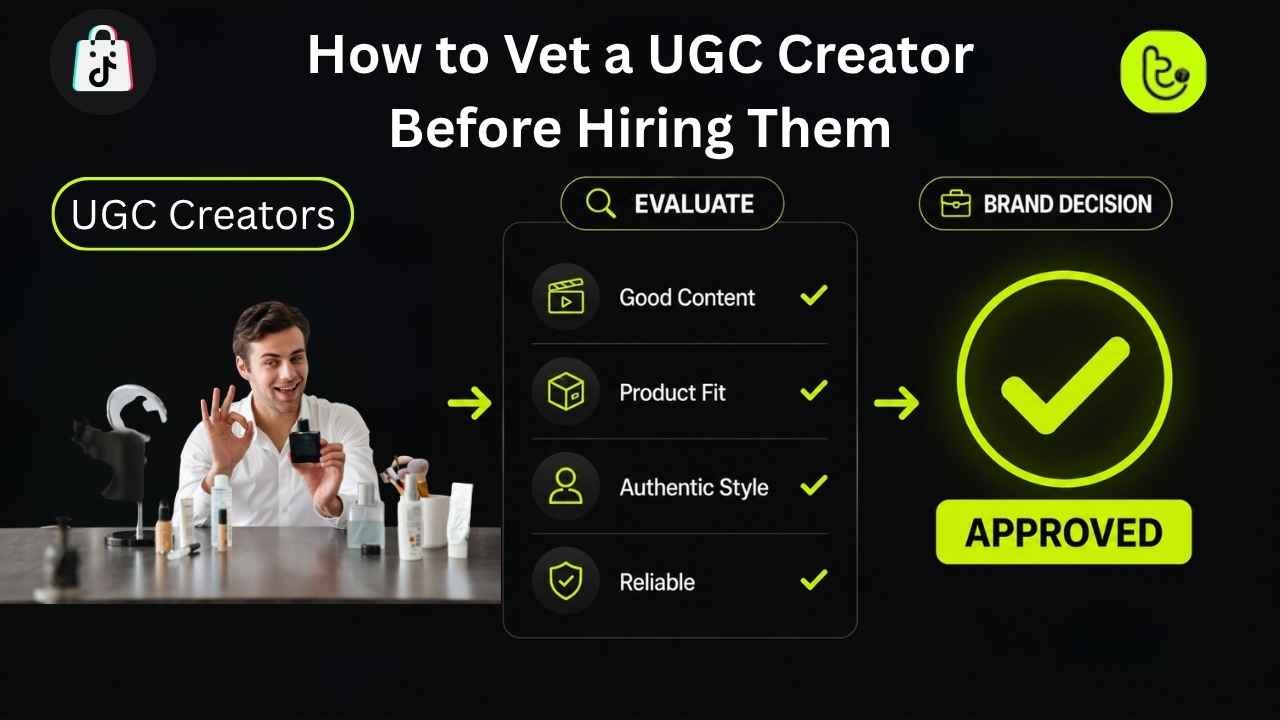
The best way to vet a UGC creator before hiring them is to evaluate five things: their portfolio, content quality, audience and product fit, reliability, and commercial terms such as usage rights and revisions. A creator’s reel can look polished and still be the wrong fit for your campaign, strong videos don’t guarantee they’ll follow a brief, hit a deadline, or represent your product the way your audience expects.
Follower count is often the first thing brands check, and it’s usually the least useful signal. A UGC creator is hired to produce content, not to reach an audience, so their creative ability matters far more than their follower total. What matters more is whether they can produce content that matches your campaign goal, a strong hook, a natural delivery, and a product demonstration that feels real rather than scripted.
For TikTok Shop brands, vetting goes a step further. You’re not just hiring someone to make a nice-looking video. You need product demonstrations that hold up on a shopping platform, conversion-focused messaging, dependable turnaround, and a creator who understands how to sell as an affiliate. This guide walks through what to check, in what order, before you sign anyone.
What Should You Look for in a UGC Creator?
Before you get into a step-by-step process, it helps to know what you’re actually evaluating. Six areas cover most of what determines whether a UGC creator will work out: content quality, authenticity, creative ability, reliability, audience and product fit, and commercial readiness. A creator can be strong in one area and weak in another, so it’s worth checking all six rather than judging on first impressions alone.
Content quality
Check the technical basics first: video quality, lighting, audio, framing, editing, product visibility, and on-camera presence. Professional-looking content doesn’t have to mean expensive production — plenty of strong UGC is filmed on a phone in natural light. What matters is whether the footage is clean enough to use, the audio is clear, and the product is actually visible in the shot.
Authenticity
Look for natural speech, genuine reactions, relatable settings, personal storytelling, and product demonstrations that feel believable rather than performed. Authenticity is the reason UGC outperforms traditional ads in the first place, so this is worth weighing heavily even when the production value is lower.
Creative ability
Assess whether the creator can write or improve a hook, adapt a brief to their own voice, demonstrate the product convincingly, handle objections on camera, and create different content angles without every video feeling like a repeat. A creator who can only follow a script word-for-word is far less useful than one who can take a brief and run with it.
Reliability
Check response time, deadline history, how they handle revisions, professionalism in communication, and whether they actually follow instructions. This is the area that’s hardest to judge from a portfolio alone, which is why later steps in this guide focus on testing it directly.
Audience and product fit
There’s a difference between a creator who looks good on camera and a creator who makes sense for your product. A skincare-focused creator with a small, engaged following may convert better for a beauty brand than a lifestyle creator with ten times the audience but no credibility in the category.
Commercial readiness
Check their understanding of deliverables, rates, usage rights, paid advertising terms, exclusivity, revisions, and raw footage. Creators who are new to brand work often haven’t thought through these terms, which can turn into friction later if you don’t clarify them upfront.
How to Vet a UGC Creator Before Hiring Them: 9-Step Process
Once you know what to look for, the next question is how to actually run the process. The nine steps below take you from defining the brief to running a small paid test, in the order most brands find works best.
Step 1: Define What You Need From the Creator
Before you review a single profile, get specific about what you’re hiring for: number of videos, video length, platform, campaign objective, target audience, product, creative style, deadline, whether the content is for organic posting or paid use, and any required deliverables.
Vague briefs make it much harder to compare creators fairly. If one candidate assumes a 30-second organic video and another assumes a 15-second ad-ready clip, you’re not actually comparing like for like.
Practical tip: write a simple one-page creator brief before you contact anyone. You’ll reuse it for every candidate, and it becomes the reference point for step 7’s communication test.
Step 2: Review the Creator’s Portfolio
This is where most of the real signal lives. Look for relevant examples, experience in or near your niche, natural product demonstrations, strong hooks, natural delivery, appropriate pacing, range across content styles, and believable brand integrations rather than obviously scripted reads.
A quick portfolio checklist: Does the creator have relevant examples? Have they worked in your niche before? Can they demonstrate products naturally? Are their hooks strong? Does their delivery feel natural rather than stiff? Are videos paced appropriately for the platform? Do they show range across different content styles? Do previous brand integrations feel believable?
How do I evaluate a UGC creator portfolio? Watch at least three to five recent videos, note whether the hook holds attention in the first few seconds, and check whether the delivery style matches how your own audience talks and shops.
Step 3: Analyze Their First 3 Seconds
On short-form platforms, the opening line decides whether anyone watches the rest. Look for a strong opening statement, a product-first hook, a problem/solution setup, curiosity, a demonstration that starts immediately, or a pattern interruption that breaks the scroll.
A weak hook sounds like a slow introduction: “Hi guys, so today I wanted to talk about…”. A strong hook gets straight to a claim, a problem, or a visual: showing the product mid-use before a word is spoken, or opening with a specific result.
Not every video needs a viral hook. What matters is whether the opening gives a viewer a reason to keep watching, not whether it’s flashy.
Step 4: Check Authenticity and On-Camera Delivery
Evaluate voice, facial expressions, body language, eye contact, how they physically interact with the product, script delivery, natural pauses, and whether personal storytelling comes through.
There’s a real difference between polished content and content that feels overly rehearsed. Polished is fine, even desirable, as long as it doesn’t tip into sounding like a script being read aloud.
Red flag: a creator who delivers every product review with the same tone, structure, and phrases, video after video. That’s a sign the content is templated rather than genuinely engaged with each product.
Step 5: Check Product and Audience Fit
This step is about whether the creator can speak credibly to your actual buyer. Check previous niche experience, audience demographics where relevant, the creator’s personality, lifestyle compatibility with the product, existing product familiarity, and general communication style.
For TikTok Shop specifically, product-creator fit directly affects how credible a recommendation looks. A creator who clearly uses and understands products like yours will come across as more trustworthy than one reciting benefits from a brief.
Step 6: Verify Previous Brand Work
Ask for previous campaign examples, published content, client references where available, performance data if the creator is willing to share it, and examples of revisions or multiple creative concepts from the same project.
There’s a meaningful difference between a creator telling you “I’ve worked with brands” and a creator showing you “here’s evidence of the type of work I’ve delivered.” Ask for the second.
What to verify: was the content actually created by this creator, is it recent, is it relevant to your campaign, and can they explain their role in it clearly?
Step 7: Test Their Communication and Reliability
This step moves past creative quality and into how the creator will actually be to work with. Before hiring, observe how quickly they respond, whether they answer questions clearly, whether they follow your brief, whether they ask useful questions, whether they confirm deadlines, and whether they flag delays early rather than going quiet.
A useful mini-test: send the same short brief to every shortlisted creator and compare how each one responds. The response itself, tone, speed, thoroughness, often tells you more about what it’ll be like to work with them than the portfolio does.
Step 8: Confirm Rates, Deliverables, and Usage Rights
Before signing, confirm the number of videos, video length, number of concepts, whether raw footage is included, the number of revisions, organic usage, paid ad usage, duration of usage, platforms, geographic restrictions, exclusivity, whitelisting or Spark Ads access where applicable, and renewal terms.
Content creation fees and usage rights are separate considerations, and it’s worth treating them that way in negotiations rather than assuming one covers the other.
What should be included in a UGC creator contract? At minimum: deliverables and deadlines, number of revisions, raw footage terms, and usage rights covering organic and paid use, duration, platform, and geography.
Step 9: Run a Small Paid Test Before a Large Campaign
If a creator is untested, start small: one to two videos, one creative concept, a defined deadline, a defined revision limit, and clearly documented usage rights.
Measure content quality, communication throughout the process, deadline adherence, revision quality, audience response where applicable, and conversion performance where you have the data to see it.
A small test limits your downside before you commit a larger budget to a creator you haven’t actually worked with yet.
How to Compare UGC Creators Before Hiring
| Criteria | What to Check | Why It Matters |
|---|---|---|
| Portfolio | Relevant examples | Shows actual capability |
| Hook quality | First 3 seconds | Supports retention |
| Authenticity | Natural delivery | Builds credibility |
| Product fit | Relevant experience | Makes recommendations believable |
| Communication | Response and clarity | Reduces campaign friction |
| Reliability | Deadlines and revisions | Protects your timeline |
| Pricing | Deliverables and rights | Prevents unexpected costs |
| Creative range | Multiple concepts | Gives campaigns more testing options |
| Brand safety | Past content and conduct | Protects your brand |
| TikTok Shop experience | Product-focused content | Helps support commerce goals |
UGC creator vs influencer: Which should you hire?
A UGC creator is primarily hired for content production, you own or license the footage and decide where it runs. An influencer is primarily hired for access to their audience, since the content is typically posted on their own channel.
A creator affiliate sits in between: they combine content creation with sales commissions, which is common in TikTok Shop programs. The right choice depends on your campaign objective, not on follower count.
UGC Creator Red Flags to Watch Before Hiring
- No relevant portfolio examples
- Generic or copied content
- Unclear pricing
- Vague usage rights
- Poor communication before the project even starts
- Unrealistic performance promises
- Refusal to clarify revisions
- Consistently missed deadlines
- Content that conflicts with your brand values
- Follower count used as the only proof of value
UGC Creator Green Flags to Watch Before Hiring
- Clear communication
- Relevant examples
- Strong creative ideas
- Realistic expectations
- Clear pricing
- Flexible collaboration
- Professional contracts
- Consistent delivery
How to Vet a UGC Creator Specifically for TikTok Shop
TikTok Shop UGC has a job beyond entertainment, it needs to support the buying journey, from the first few seconds of the video through to the tap-to-purchase moment. That means vetting for TikTok Shop takes a few extra checks on top of the general process above.
Check whether they can demonstrate the product
Look for clear product demonstrations, benefit-focused messaging, real-life use cases, strong product visibility on screen, and a clear call to action.
Look for conversion-focused creative
Assess whether they can address buyer objections, explain product benefits clearly, show the product actually being used, create urgency without misleading claims, and make product recommendations feel natural rather than like a scripted ad read.
Check TikTok Shop experience
Review previous TikTok Shop content, affiliate content, product tagging experience where relevant, TikTok Shop Creator Marketplace experience, and general familiarity with TikTok’s commerce format.
Evaluate creator fit beyond follower count
A smaller creator with strong product communication skills can be more useful for UGC than a large creator whose audience reach isn’t relevant to your campaign. For TikTok Shop, credibility with the right niche tends to matter more than raw reach.
How Tiksly Can Help You Vet and Manage UGC Creators for TikTok Shop
Vetting one creator well is manageable. Vetting dozens or hundreds of creators, tracking deliverables, negotiating terms, and identifying who’s worth rebooking is a different problem, and it’s the one most brands run into as their TikTok Shop creator program grows.
Tiksly works as a TikTok Shop official creative partner, and creator discovery, vetting, outreach, negotiation, campaign management, approval, performance tracking, and ongoing relationship management are among the services it currently supports for brands running creator programs at scale.
Creator discovery and vetting
Support identifying creators based on product category, audience fit, content style, campaign requirements, and TikTok Shop suitability, rather than starting from a blank list of names.
Creator outreach and negotiation
Coverage for creator communication, campaign terms, deliverables, rates, usage requirements, and general campaign coordination, so brands aren’t handling every negotiation individually.
Content and campaign management
Coordination across briefs, content approvals, creator relationships, campaign tracking, and performance analysis, keeping a growing creator roster organized rather than scattered across spreadsheets and DMs.
Why this matters as your creator program grows
Finding one good creator is manageable on your own. Vetting dozens or hundreds of creators, tracking deliverables, negotiating terms, and identifying which ones are worth rebooking requires a repeatable system rather than one-off vetting each time.
How to Build a UGC Creator Vetting Scorecard
A scorecard turns the process above into something you can actually compare across candidates, rather than relying on gut feeling after watching a few videos.
| Category | Points |
|---|---|
| Portfolio quality | 20 points |
| Product/audience fit | 15 points |
| Hook and storytelling ability | 15 points |
| Authenticity | 15 points |
| Reliability and communication | 15 points |
| Commercial readiness | 10 points |
| Brand safety | 5 points |
| TikTok Shop experience | 5 points |
How to use the score
• 80 to 100: Strong candidate
• 65 to 79: Consider testing
• Below 65: Investigate further or move on
Treat the score as a support for human judgment, not a replacement for it. A creator may score well on paper and still not be the right fit for your specific brief.
Questions to Ask a UGC Creator Before Hiring Them
• Can you share examples relevant to our product?
• What’s your typical turnaround time?
• How many revisions are included?
• Do you provide raw footage?
• What usage rights are included?
• Can you create multiple hooks for one concept?
• Have you created TikTok Shop content before?
• Are you comfortable following a detailed creative brief?
• How do you handle creative feedback?
• Can you provide examples of previous paid campaigns?
• Are there any category exclusivity restrictions?
• What happens if a deadline changes?
Conclusion
The right UGC creator should fit your product, understand your audience, create authentic content, and deliver reliably. A strong vetting process helps you assess those factors before you commit your budget, so you can build creator partnerships with greater confidence.
If you need help finding and managing the right creators for TikTok Shop, book a free 1:1 consultation with Tiksly experts. We can help you build a creator strategy based on your products, audience, and campaign goals.
FAQs
How do I vet a UGC creator before hiring them?
Review their portfolio for relevant, authentic examples, check whether their style fits your audience, test their communication and turnaround time, confirm rates and usage rights in writing, and run a small paid test before committing to a larger campaign.
What should I look for in a UGC creator portfolio?
Focus on relevance to your niche, authentic and natural delivery, strong opening hooks, believable storytelling, convincing product demonstrations, and range across different creative styles rather than one repeated format.
How do I know if a UGC creator is reliable?
Reliability shows up in how they communicate before you’ve even hired them: response time, clarity, and whether they follow instructions. Check their deadline history, ask about their revision process, and run a small paid test before a larger booking.
Does a UGC creator need a large following?
No. UGC creators are hired primarily to produce content, not to reach an audience with their own following, so creative ability, authenticity, and product fit matter far more than follower count.
How much should I pay a UGC creator?
There’s no single standard rate. Pricing depends on content volume, complexity, creator experience, usage rights, number of revisions, exclusivity terms, and whether the content will be used in paid advertising.
What usage rights should I get from a UGC creator?
Clarify organic usage, paid advertising usage, duration of usage, platforms, geographic restrictions, and whitelisting or Spark Ads access if you plan to boost the content as an ad.
Should I test a UGC creator before hiring them for a large campaign?
Yes, especially if the creator is untested. Start with a small paid project — one or two videos with a defined deadline, revision limit, and usage rights — before committing a larger budget.
How do I choose a UGC creator for TikTok Shop?
Prioritize product fit, natural selling ability, convincing product demonstrations, TikTok-native creative instincts, and prior experience with TikTok Shop or affiliate content over general follower count.