 Ayesha Khan
You’re getting views on your TikTok videos. Engagement looks fine, comments are coming in, and the content is clearly being pushed.
But your TikTok Shop dashboard tells a different story. Sales are not following the same momentum.
This usually points to a breakdown in conversion, not traffic. TikTok is built to distribute content that keeps people watching, not necessarily content that leads to buying. So getting attention is common, turning that attention into sales is where most sellers struggle.
This is where things start to feel confusing. Everything looks like it is working, but revenue stays flat.
When Millions of Views Don’t Turn Into Sales
If you have ever checked your analytics after a video performs well and still saw zero or very few orders, you are not alone.
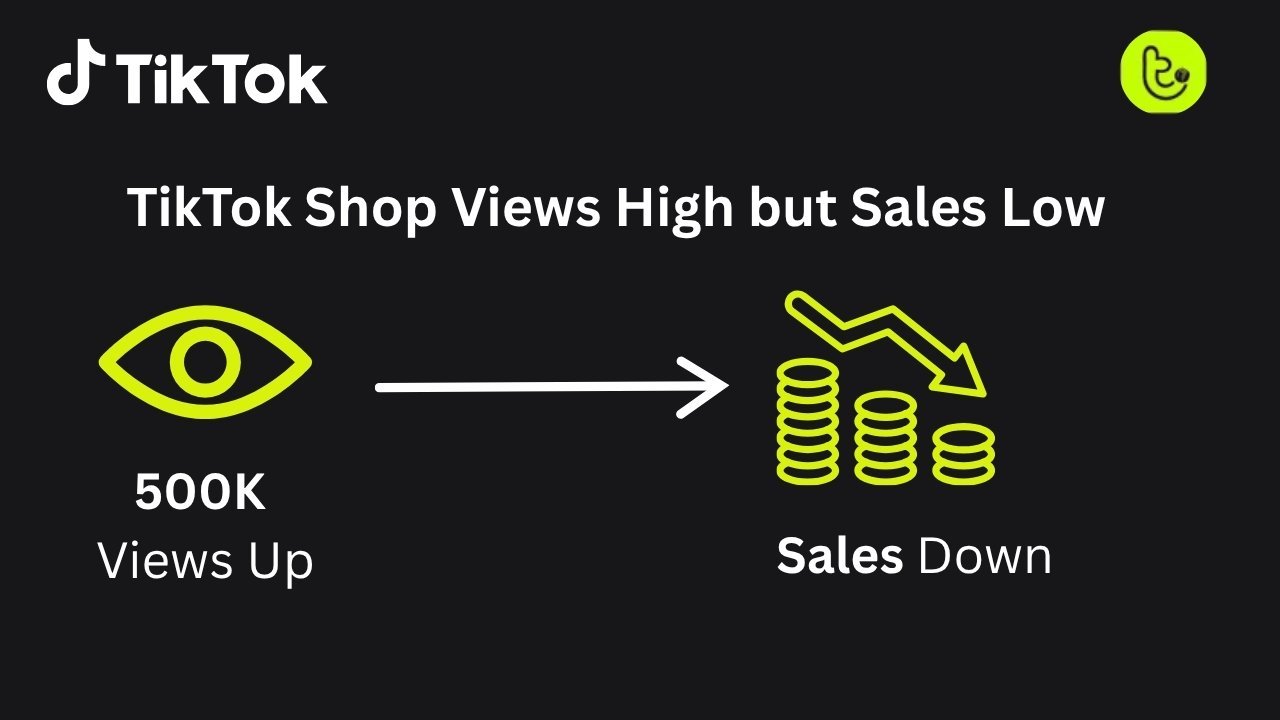
Many TikTok Shop sellers share the same experience. Videos can cross huge view counts, even go viral, and still fail to produce meaningful sales.
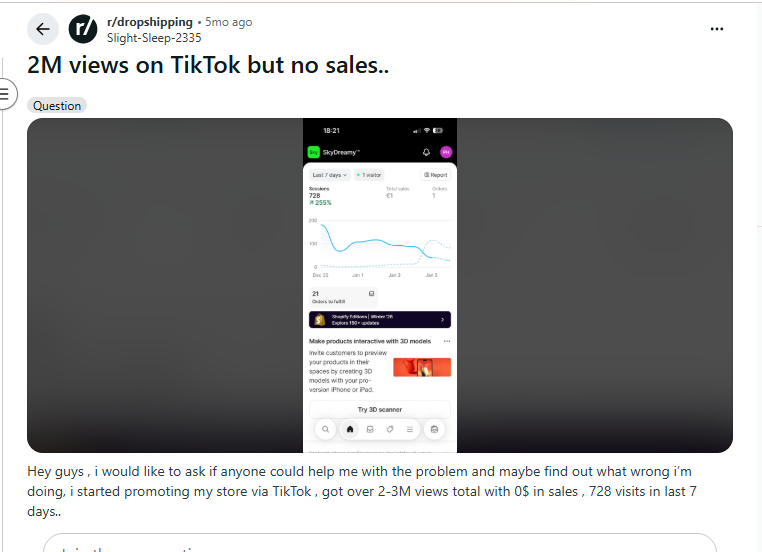
What makes this pattern important is that it keeps repeating across different niches and products. It is usually not a content visibility issue, but a disconnect somewhere in the conversion process that stops viewers from becoming buyers.
This is exactly what the next section breaks down, where users drop off inside your TikTok Shop funnel and why it happens.
Once you see how common this pattern is among sellers, the next question becomes pretty simple: what does “good” actually look like on TikTok Shop, and how do you know if your numbers are strong or need work?
What Counts as a Strong Conversion Rate on TikTok Shop?
Before you judge how your TikTok Shop is performing, you need to understand how conversion actually works. A view simply shows reach, a click shows curiosity, and a purchase confirms intent. The challenge is that users don’t move in a straight line, and small drop-offs at each step can completely change your final results.
In most cases, low sales are not about lack of traffic. It is about where users stop inside the journey.
TikTok Shop Conversion Funnel Explained
Every TikTok Shop sale follows a predictable path. When you map it properly, it becomes easier to see where things are breaking down.
TikTok Shop Funnel Stages
- Video View — someone watches your content
- Click-Through Rate (CTR) — they tap your product link
- Product Page View — they land on your listing
- Add-to-Cart — they show intent to buy
- Checkout — they start the payment process
- Conversion Rate (CVR) — they complete the purchase
Each step acts like a filter. A strong video might bring views, but if CTR is low, the problem is not awareness. If people click but don’t add to cart, the issue shifts to your product page. This is why understanding the funnel matters more than just tracking views.
What a “Good” TikTok Shop Conversion Rate Looks Like
There is no single number that defines success on TikTok Shop. It depends heavily on where your traffic comes from and how the audience interacts with your content.
For example, TikTok Shop Ads usually perform in the range of 1 to 2.5%, especially when targeting is tight and the offer is clear. Organic content tends to sit lower, around 0.5 to 1.5%, although strong niche videos can push higher when the audience is highly relevant.
Influencer-driven traffic often performs best, sometimes reaching 5% or more because trust is already built before the click.
When you compare this with other platforms, Instagram Ads typically sit around 1 to 3%, while Facebook Ads can average closer to 9% due to strong retargeting and high-intent users.
Platform Performance Overview
To make this easier to understand, here is how different platforms generally compare in terms of conversion behaviour and intent.
Platform | Avg. Conversion Rate | Best For | Content Type | Key Advantage |
|---|---|---|---|---|
TikTok Ads | ~1–2.5% | Product discovery and impulse buying | Short-form video | Strong reach with precise targeting |
TikTok Organic | 0.5–1.5% | Trend-led and UGC-driven sales | Native creator content | High trust through authenticity |
TikTok Influencer | Up to 5% | Niche audiences with trust factor | Creator-led promotions | Strong purchase intent |
Instagram Ads | 1–3% | Visual-driven marketing | Reels and image ads | Strong brand presentation |
Facebook Ads | ~9% | Retargeting and warm audiences | Static + video ads | Advanced audience targeting |
Why Conversion Rates on TikTok Shop Fluctuate
One key advantage of TikTok Shop is its in-app checkout system. Users don’t leave the platform to complete a purchase, which reduces friction and generally improves conversion rates compared to external websites.
Still, if your numbers are below benchmarks, it usually points to issues in three areas: content quality, product page clarity, or audience targeting. In most cases, it is not the platform limiting performance, but how the funnel is structured.
Metrics That Matter More Than Views
Views alone can be misleading because they sit at the very top of the funnel. To understand what is really happening, you need to look at what users do after watching your content.
- Click-Through Rate (CTR) is the first signal. If people are not clicking, the issue is usually with your hook or offer clarity. Add-to-cart rate goes deeper, showing whether your product page is convincing enough. If users drop here, it often points to pricing, messaging, or listing structure.
- Conversion Rate (CVR) is the final step and tells you how many visitors actually complete a purchase. This is the clearest indicator of whether your funnel is working.
- Average Order Value (AOV) is also important because it shows how much each buyer spends per order. Even with average conversion rates, higher AOV through bundles or upsells can significantly improve revenue.
9 Common Reasons Your TikTok Shop Views Are High but Sales Are Low
This gap between visibility and revenue usually comes down to a few specific issues that are easy to overlook.
1. You’re Attracting the Wrong Audience
One of the most common reasons TikTok Shop videos get strong views but weak sales is simple: the wrong people are watching. TikTok is excellent at pushing engaging content, but engagement does not automatically mean buying intent.
Viral Reach vs Real Purchase Intent
A video can perform well because it is funny, emotional, or surprising, yet still attract viewers who have no interest in the product. These users will watch, like, comment, and share, but they rarely move further in the buying journey.
This gap often becomes wider when hashtags and captions are too broad or trend-focused. Instead of filtering buyers, they end up pushing the content into general entertainment feeds.
Why Audience Targeting Breaks Down
If you want sales, the content has to guide the right audience in from the start. That means your hook should speak to a clear problem your ideal customer already recognises.
Instead of trying to attract everyone, your content should gently filter viewers early. Someone who is already looking for a solution is far more likely to click through and buy than someone who is just scrolling for entertainment.
Captions and hashtags should support this by narrowing intent, not expanding reach for the sake of visibility.
How to Fix It: Shift From Views to Buyer Signals
To improve targeting, focus less on viral-style hooks and more on problem-led messaging. A strong structure is:
- Highlight a clear pain point in the first seconds
- Show the product as a direct solution, not just a feature
- Use captions that describe the outcome, not just curiosity
- Stick to keywords your actual buyers would search or relate to
When your content attracts the right viewers, even lower views can produce stronger sales than viral content with the wrong audience.
What This Usually Looks Like in Practice
This issue often shows up when videos get strong engagement but weak conversions. Views and comments look healthy, but the conversation rarely shifts toward the product or purchase intent.
When that happens, it usually means the content is working as entertainment rather than a sales trigger. The audience is interested in the video itself, not the solution being offered.
2. Your Product Page Isn’t Building Enough Trust
Even if your TikTok video brings in the right audience, the sale can still drop at the product page. At this point, the buyer is interested but unsure. If the page does not quickly remove doubt, they leave.
Where Most Product Pages Fail
Most conversion issues here come from missing trust signals or unclear information:
- Weak descriptions that don’t clearly explain what the product does or who it’s for
- Low-quality or limited images with no real-life context or multiple angles
- No reviews, ratings, or user-generated content for social proof
- No product demonstrations showing how it works in real situations
- Unclear shipping, return, or support details
How to Fix It: Make It Instantly Clear
Your product page should remove doubt, not create it. Focus on clear, outcome-based descriptions, real-life product images, and visible proof that others have used and liked it.
Trust should be visible immediately, not hidden in sections users may never reach.
What Usually Happens
A common pattern is high click-through from TikTok followed by quick exits from the product page. This usually means the traffic is interested, but the page is not convincing enough to complete the purchase.
3. Your Offer Isn’t Strong Enough
TikTok Shop works on quick decisions. People are scrolling fast, so even a good product can fail if the offer doesn’t feel clear, valuable, and worth acting on immediately.
Why Offers Matter on TikTok
Unlike traditional e-commerce, users don’t spend time comparing. Your offer has to instantly answer why this product, why now, and why this price. If it doesn’t, they move on even if they were interested.
Weak vs Strong Offer Structure
Offer Element | Weak Version | Strong Version |
|---|---|---|
Product presentation | Single product only | Product with bundle or bonus |
Urgency | No time limit | Limited-time deal or stock limit |
Pricing | Just a price | Discount clearly shown |
Shipping | Mentioned late | Free/fast shipping highlighted early |
Value | Basic description | Clear benefit or outcome |
How to Improve It
Stronger offers focus on added value, not just lower price. Bundles, visible savings, and simple urgency cues help buyers decide faster.
You also need to highlight the outcome, not just the product. What the buyer gets matters more than what the product is.
What Usually Happens
Traffic may click, but without a strong reason to act now, many buyers delay the purchase and never return.
4. Your Videos Get Engagement, Not Buyers
Not all engagement leads to sales. On TikTok Shop, it is very common to get likes, comments, and shares without getting purchases. The reason is simple: engagement content and conversion content are not the same thing.
Engagement vs Purchase Intent
Engagement-focused videos are built to entertain, surprise, or trigger curiosity. They perform well in views, but they don’t always move people toward buying.
Purchase-focused videos work differently. They clearly show the product, explain the value, and remove doubts that stop people from buying.
Many sellers lean too heavily on trends because they bring reach, but reach alone does not guarantee revenue.
Why Engagement Alone Doesn’t Convert
Trend-driven formats like humor clips, duets, or reaction videos can go viral quickly. The problem is that most of this audience is not in buying mode.
These videos work at the top of the funnel, but they rarely answer the key question: why should someone buy this right now?
What Works vs What Doesn’t
Do’s | Don’ts |
|---|---|
Use real creators or real users | Avoid stock-style or overly scripted videos |
Show the product solving a problem | Focus only on aesthetics without context |
Hook viewers in the first 3 seconds | Delay showing the product or benefit |
Use native TikTok-style edits and trends | Use generic or off-platform style editing |
Add clear “buy now” direction | Leave viewers without next steps |
Show transformation or before/after use | Make it look like a traditional ad |
How to Fix It
To improve conversions, your content needs a balance. Keep the TikTok feel, but shift the focus toward product clarity. Show how it works, what problem it solves, and why it matters in real life.
The goal is not just to get attention, but to guide that attention toward a purchase decision.
5. Customers Don’t Trust the Product Yet
Trust is one of the biggest factors behind TikTok Shop conversions. Many buyers are seeing your brand for the first time, so even if they like the product, they still hesitate before paying.
A common barrier is simple uncertainty around whether the product and seller are reliable enough to buy from.
What Builds Trust on TikTok Shop
Buyers usually look for a few clear signals before making a decision. If these are missing, even strong traffic struggles to convert.
- Product reviews that are recent, detailed, and ideally include photos from real buyers
- User-generated content showing real people using the product in everyday situations
- A complete and consistent seller profile that looks active and professional
- Visible customer support signals like responses to questions and engagement in reviews
Why Trust Breaks the Sale
On TikTok Shop, users often discover products from brands they don’t recognize. That means the buyer is not just evaluating the product, they are also evaluating you as a seller.
If there is no proof that others have bought and had a good experience, hesitation increases. And once hesitation enters the decision, most users do not complete the purchase.
How to Build Trust Faster
You don’t need thousands of reviews to start converting. You need visible proof early.
Encourage early buyers to leave honest feedback, even small incentives can help. Follow up after purchase to request reviews, and focus on collecting photo-based feedback whenever possible.
Creator partnerships also help bridge the gap. Real users showing the product in action builds credibility faster than polished brand content.
The Core Challenge
One of the biggest challenges is timing. New stores need trust to get sales, but they also need sales to build trust.
The fastest way through this is stacking small trust signals early instead of waiting for volume to build on its own.
6. The Product Has Weak Market Demand
Sometimes low sales on TikTok Shop are not caused by your content or funnel. The issue is simpler: the product itself does not have strong demand in the current market.
A product may look promising on paper or even perform well for competitors in a different season, but that does not guarantee it will sell consistently on TikTok.
When Demand Is the Real Problem
TikTok users respond best to products that feel instantly useful, solve a clear problem, or create curiosity within seconds. If a product does not trigger that reaction, even good content struggles to convert it into sales.
This is why some listings get views and clicks but still fail to move beyond basic interest.
Signs Your Product May Lack Demand
You can often identify weak demand through behavior patterns rather than guesswork:
- High product page views but low add-to-cart rates, even after improving the listing
- Comments showing doubt, confusion, or lack of interest in the product’s usefulness
- Heavy competition in the same category with already established products and strong reviews
- Short-term spikes in interest that drop quickly after trends or seasons change
How to Approach This Issue
If demand is weak, no amount of optimization can fully fix the problem. Instead, the focus shifts to validation.
Test how your audience reacts to different angles of the product. Sometimes repositioning the use case or targeting a more specific problem can reveal hidden demand.
Seasonality should also be considered. Some products only perform during specific periods, and outside that window, performance naturally slows down.
Not every TikTok Shop failure is about marketing execution. In some cases, the product simply does not have enough consistent demand to sustain strong conversion over time.
7. Your Content Doesn’t Answer Buying Questions
Even when people are interested in your product, they may still hesitate if key questions are not answered clearly in your content. On TikTok, users move fast. If they don’t see what they need within seconds, they usually scroll away instead of searching for answers.
What Buyers Actually Want to Know
Before making a purchase, most viewers are silently looking for reassurance. If your content doesn’t address these points, hesitation increases.
- Does it actually work? Show real results or a clear before-and-after
- Is it worth the price? Demonstrate value through outcome, not just features
- How long does delivery take? Shipping clarity matters for impulse purchases
- How is it different from alternatives? Clear differentiation helps avoid comparison drop-off
- What if it doesn’t work for me? Simple return or refund reassurance reduces risk
Why Missing Answers Hurt Conversions
If these questions are not answered in the video or clearly supported on the product page, buyers are left uncertain. That uncertainty is often enough for them to abandon the purchase, even if they were initially interested.
On TikTok, there is rarely a second chance to convince them.
8. Checkout Friction Is Killing Conversions
TikTok Shop already removes a major barrier by keeping the entire checkout process inside the app. This is why conversion rates are generally higher compared to sending traffic to external websites.
However, friction can still appear at the final step.
Where Buyers Drop Off at Checkout
Even small issues can stop a purchase right before completion:
- Unexpected shipping costs that were not clearly shown earlier
- Delivery timelines that feel too long for impulse or gift purchases
- Free shipping thresholds that are unclear until late in the process
How to Reduce Checkout Drop-Off
Most checkout issues are not technical, they are expectation issues. When buyers feel surprised by cost or delivery time, they hesitate.
The solution is simple: make shipping cost and delivery expectations clear earlier in the journey, ideally on the product page itself. This removes last-minute surprises and keeps the decision smooth.
What Usually Happens
A common pattern is strong clicks and add-to-cart activity, followed by a sudden drop at checkout. In most cases, this is linked to shipping costs or delivery timelines not being communicated clearly enough before purchase.
9. You’re Not Testing Enough Creative Variations
Even when everything else is working, product demand, pricing, and trust, your TikTok Shop sales can still slow down if your creative approach becomes repetitive. TikTok audiences get used to formats quickly, and what once performed well can lose impact over time.
Why Creative Fatigue Happens
On TikTok, users see a constant stream of similar content. If your videos follow the same hook, pacing, or structure, people stop reacting to them. This reduces clicks and eventually lowers conversions, even if your product is still relevant.
The issue is not always the product or offer. Sometimes it is simply that the content has stopped feeling new.
How High-Converting Sellers Test Content
Successful TikTok Shop sellers treat content as something that evolves, not something that is produced once and reused.
- Test multiple hook styles so the first 3 seconds don’t feel predictable
- Switch between UGC, product demos, and problem-solution storytelling
- Compare short videos with longer explanations to see what fits your product best
- Regularly rotate creatives instead of relying on a single winning format
Why Testing Matters for Conversions
Different audiences respond to different formats. A hook that works for one group may fail for another, even with the same product. Without testing, performance naturally plateaus because the content stops reaching new reactions.
Small changes in hooks, pacing, or presentation can significantly shift click-through and conversion rates.
TikTok Shop success is not about finding one perfect video. It is about continuously refreshing how you present the same product so it stays relevant to a fast-moving audience.
TikTok Ads vs. Organic Content: Which Drives Better Conversions?
Understanding how paid ads and organic content perform is important when diagnosing TikTok Shop results. Both bring traffic, but the quality of that traffic and how it converts depends on intent, delivery, and how users interact with your content.
TikTok Ads: Faster Reach with Controlled Intent
TikTok Ads give you more control over who sees your content and how quickly you scale. You can define audiences, test different creatives, and push what works with more consistency than organic reach allows.
On average, conversion rates sit around 1–2.5%, with higher performance possible when both the creative and product page are properly aligned. Ads are especially useful when you want faster testing and more predictable traffic flow.
However, ads only amplify what already exists. If your offer or product page is weak, paid traffic will expose that gap more quickly rather than fix it.
Organic Content: Slower Growth but Stronger Native Trust
Organic content depends on TikTok’s algorithm for distribution, which makes performance less predictable but often more authentic in the eyes of viewers. Because it appears naturally in the feed, users tend to engage with it differently compared to ads.
Typical conversion rates range from 0.5–1.5%, although strong niche content can perform better when timing, trends, and audience alignment are strong. Its biggest advantage is trust, since it doesn’t feel like a direct sales push.
The trade-off is consistency. Some videos may perform extremely well while others receive limited reach, even with similar quality.
What Your Results Are Really Showing
When TikTok Ads generate strong click-through rates but weak sales, the issue usually appears after the click, not within the ad itself.
In most cases, this points to one of three areas:
- The product page is not clear or convincing enough
- The offer does not create enough urgency or value
- The content promise does not match what the user sees after clicking
If users are clicking but not buying, the ad has already done its job. The breakdown is happening in the conversion layer, not the traffic layer.
How to Diagnose Why Your TikTok Shop Isn’t Converting
Before changing your strategy, you need to pinpoint where the funnel is actually breaking. Most conversion issues are not random. They usually show up at one specific stage, and fixing the wrong one leads to wasted effort.
A simple way to approach this is to move step by step through your traffic, product page, and content.
Step 1: Check Traffic Quality
Start with your video analytics and focus on how users are interacting with your content, not just how many views you are getting. Views alone don’t explain intent.
At this stage, you want to understand whether you are attracting real buyers or just general viewers.
- Are viewers watching long enough to actually see your product message?
- Is your click-through rate strong enough, or are people stopping at the video stage?
- Do comments show interest in the product, or are they only reacting to the content?
- Are your hashtags and captions bringing in the right audience or a broad, unrelated one?
If the audience is not aligned, no amount of optimization later in the funnel will fully fix conversions.
Step 2: Analyze Your Product Page and Offer
Once users click through, the product page becomes the deciding factor. This is where interest turns into hesitation or action.
Drop-offs here usually signal a clarity or trust issue.
- Are your product images clear, real, and showing usage in context?
- Are pricing, shipping costs, and delivery expectations visible before checkout?
- Do you have enough verified reviews to build confidence?
- Is there any urgency or reason to buy now instead of later?
- Does your offer include bundles or added value that makes the purchase feel worthwhile?
If users are leaving at this stage, the problem is usually not traffic quality but product presentation.
Step 3: Review Your Creative Performance
Now look at your content itself. Go through your recent videos and group them based on intent: entertainment-focused, demonstration-focused, problem-solving, or social proof.
This helps you see what type of content is dominating your strategy and what is missing.
- Does your hook filter buyers within the first few seconds?
- Are you clearly showing the product in use, not just mentioning it?
- Is there a direct call-to-action that tells viewers what to do next?
- Are you using reviews, reactions, or real results inside your videos?
- Are you testing enough variations or repeating similar formats?
Without variation, performance often becomes unstable even if the product is good.
Common Conversion Patterns and What They Mean
What Sellers Experience | Root Cause | Priority Fix | Key Metric to Watch |
|---|---|---|---|
High views, almost no sales | Low buyer intent audience | Improve targeting through content | CTR from video |
Many clicks, weak add-to-cart | Weak product page or missing trust | Improve listing, images, reviews | Add-to-cart rate |
Good add-to-cart, poor checkout | Unexpected costs or friction | Clarify shipping and pricing early | Checkout completion rate |
Strong engagement, low CTR | Entertainment-focused content | Shift hooks toward buying intent | CTR vs views ratio |
Unstable, inconsistent sales | Creative fatigue | Rotate formats and test variations | CVR trend over time |
Most TikTok Shop issues are not caused by one big mistake. They come from small breaks across different stages of the funnel. Once you identify exactly where users are dropping off, the solution becomes much more straightforward and easier to fix.
How to Boost Your TikTok Shop Conversion Rate
Getting views is only the first step. Conversions depend on how well your content, offer, and product page work together. If one part is weak, sales drop even when traffic is strong.
1. Test Your Content Variations
Small changes in your videos can significantly impact results. Test different hooks, video lengths, and call-to-action styles to see what drives more clicks and purchases.
Focus on CTR and conversion rate, not just views, since those reflect real buying intent.
2. Improve Your Thumbnail
Your thumbnail often decides whether someone clicks or scrolls past. Make it clear, product-focused, and visually intentional.
A stronger thumbnail improves click-through rate and first impressions before the video even starts.
3. Add Social Proof
People convert faster when they see proof from others. User-generated content, creator reviews, and real customer reactions help reduce hesitation.
Even simple on-screen reviews or before-and-after results can improve trust and conversions.
4. Use Bundles to Increase AOV
Bundles, starter kits, or multi-buy offers help increase order value without needing more traffic. Framing it as a set or deal makes the purchase feel more valuable.
5. Add Urgency
Without urgency, buyers often delay and don’t return. Limited stock or time-based offers encourage faster decisions.
Simple messages like “limited stock” or “offer ends soon” can improve same-session conversions.
TikTok Shop Benchmarks
Metric | Concerning | Average | Strong |
|---|---|---|---|
CTR | Below 0.5% | 0.8% – 1.5% | 2%+ |
Add-to-Cart | Below 3% | 5% – 10% | 12%+ |
CVR | Below 2% | 3.4% – 4.7% | 6%+ |
Conversion improves when your content, offer, and product page align. Once you know where users drop off, you can fix the right part of the funnel instead of guessing.
How Tiksly Helps You Turn TikTok Shop Views Into Sales
Tiksly is a TikTok Shop Official Creative Partner focused on improving how your traffic converts, so you get more sales from the same views.
- Conversion-Focused Content Strategy
Our content creation service is built to attract buyers, not just viewers. Strong hooks, clear product value, and direct calls to action help improve CTR and increase purchase intent.
- Creator-Led Content That Builds Trust
Real UGC and creator videos show the product in use, helping reduce hesitation and improve add-to-cart and purchase rates.
- Testing That Improves Results
Multiple video variations are tested across hooks and formats to identify what drives higher CTR and CVR over time.
- Full Funnel Optimization
Support goes beyond content to include product page clarity and offer structure, helping reduce drop-offs after the click.
Pre-Launch Conversion Checklist
Before posting your next TikTok Shop video, updating your product listing, or launching a new campaign, use this checklist to ensure your strategy is set up for conversions, not just visibility.
Conclusion
High views with low sales usually points to a gap in your funnel, not a lack of demand. The issue is rarely visibility alone. It is how effectively that attention moves from watch to click, and from click to purchase.
Fixing conversion means focusing on the right breakdown points: audience quality, product page clarity, offer strength, trust signals, and checkout experience. Once these are aligned, performance becomes more predictable.
If you want a clear breakdown of what’s holding your TikTok Shop back and how to fix it, you can book a free consultation with Tiksly experts. We’ll help you identify the exact gaps in your funnel and show you what to improve for better conversions.
FAQs
Why does my TikTok Shop get views but no sales?
This usually happens due to audience mismatch, weak product pages, low trust signals, or an offer that doesn’t feel strong enough. In most cases, users are reaching your content for entertainment rather than buying intent, or dropping off after clicking due to missing product clarity.
What is a good conversion rate for TikTok Shop?
On average, TikTok Shop CVR sits around 3.4–4.7% for in-app checkout. Organic content often ranges from 0.5–1.5%, while influencer-driven traffic can reach 5% or higher. If your CVR is below 3%, it usually signals a funnel issue that needs attention. You can explore our TikTok Shop influencer outreach services to improve your conversion rate.
Why are people clicking but not buying on TikTok Shop?
Clicks without sales usually point to problems on the product page or at checkout. Common issues include weak visuals, missing reviews, unclear shipping costs, or a mismatch between what the video promises and what the listing delivers.
How do I increase TikTok Shop conversion rates?
Focus on improving buyer-targeted content, strengthening your product page with better visuals and reviews, creating stronger offers with bundles or urgency, building trust through UGC, and reducing checkout friction such as unexpected shipping costs.
How important are reviews for TikTok Shop sales?
Very important. Reviews are one of the strongest trust signals on TikTok Shop. Without them, buyers hesitate, especially when they are unfamiliar with your brand. A consistent review system directly improves conversion rates.