 Ayesha Khan
Most TikTok Shop sellers need between 30 and 90 days to generate consistent sales. Some products gain traction within days, while others require weeks of content testing, affiliate recruitment, and listing optimization before producing meaningful revenue.
Results vary significantly between sellers based on several key factors. This guide covers what drives those differences, what realistic milestones look like at each stage, and what you can do to shorten the path to profitability.
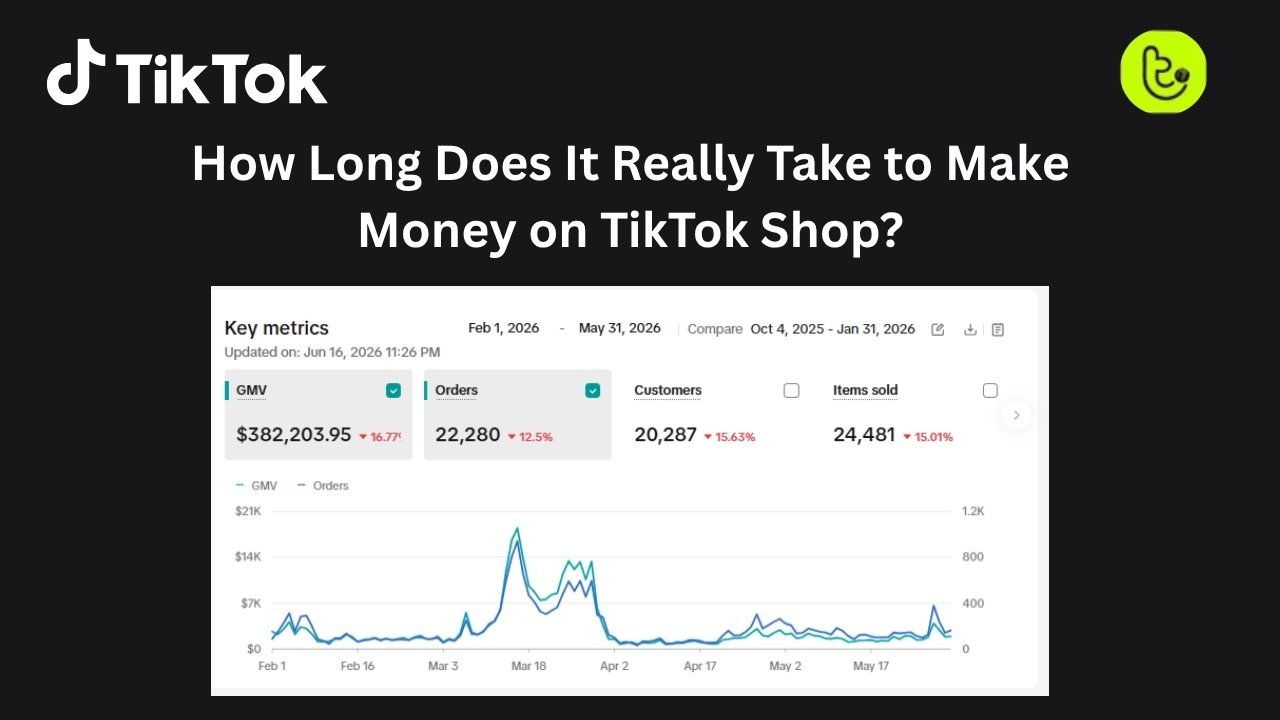
How Long Does It Really Take to Make Money on TikTok Shop?
Here is what most TikTok Shop sellers experience across their first three months:
Why Seller Timelines Vary So Much
No two TikTok Shop journeys look the same. The biggest variables that determine how fast you see results include:
- Product demand: how many people are actively searching for or buying your product
- Competition: how saturated your category is
- Content quality: whether your videos stop the scroll and drive clicks
- Creator partnerships: whether affiliates are promoting your listings
- Store trust signals: reviews, ratings, and seller history
- Fulfillment experience: shipping speed and return rates
Factors that Determine the Timeline of Your Success TikTok Shop?
The time it takes to make money on TikTok Shop varies widely from seller to seller. While some stores generate sales within days, others may take several months to gain traction. The difference usually comes down to a few key factors that influence visibility, conversions, and overall growth.
Product Selection
The single biggest driver of early success is whether your product has natural demand on TikTok. Problem-solving products that can be demonstrated visually tend to perform well. Trend-driven products can generate fast early sales but carry risk if the trend fades.
Entering a saturated category without a clear differentiator makes it harder to stand out, while untapped niches can produce faster results with less content investment.
Content Performance
TikTok is a content-first commerce platform. Discovery happens through video, which means your content acts as your storefront. Testing different creative angles, hooks, formats, and product demonstrations is essential to understand what actually drives clicks and conversions.
Consistency matters more than sheer volume. Five well-structured, intentional videos will usually outperform thirty rushed uploads.
If you want to speed up this process, Tiksly also offers content creation services focused on high-converting TikTok Shop creatives.
Affiliate and Creator Partnerships
Affiliates accelerate growth by putting your product in front of audiences that already trust the creator promoting it. Creator content typically converts better than brand-owned content because it feels more authentic.
Common mistakes include sending products to creators without a clear brief, choosing creators based on follower count rather than niche relevance, and not following up after initial outreach.
Store Optimization
A well-optimized listing supports conversion once traffic arrives. This includes high-quality product images, a clear and keyword-rich product title, a description that answers common buyer questions, competitive pricing, and enough reviews to establish credibility.
Weak listings lose sales even when content performance is strong.
When Do TikTok Shop Sellers Actually Start Making Money?
Real sellers across TikTok Shop communities regularly share their timelines and frustrations. Here are some of the most common experiences reported in recent threads.
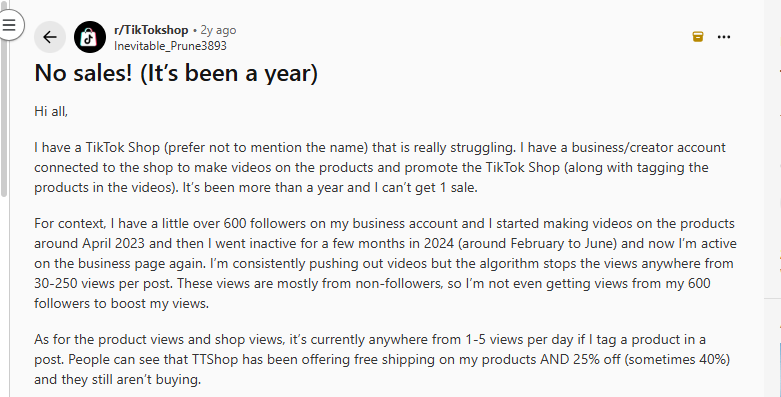
“I’ve Been Posting for Weeks and Still Have No Sales”
This is one of the most frequently posted complaints in TikTok Shop seller communities. New sellers often launch with a product they believe in, post consistently for two to four weeks, and then see almost no movement.
Community feedback in these threads typically points to listing gaps, weak hooks in content, or missing social proof rather than the algorithm being at fault.
“One Viral Video Changed Everything”
Some sellers go through a slow start that can last six to eight weeks before a single video finally gains traction and starts driving a large wave of orders. This early stage is often treated as a testing period where data is collected, content styles are refined, and different product angles are tested.
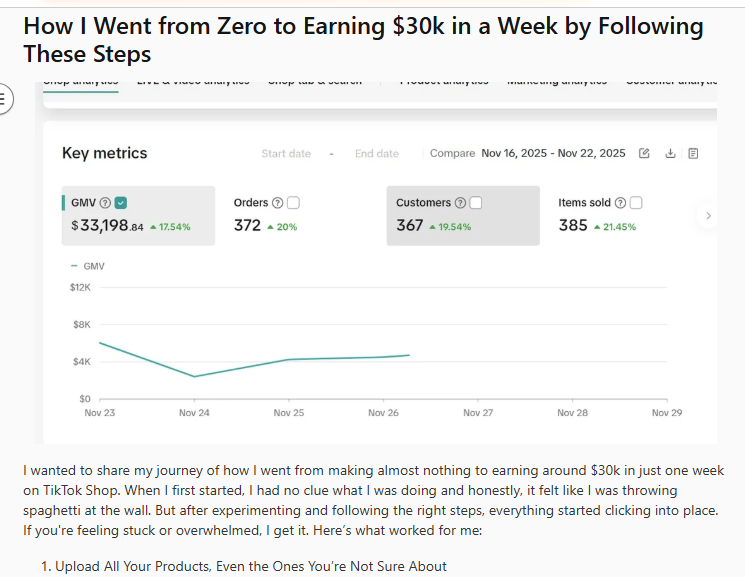
Across seller discussions, this pattern shows up repeatedly. The early phase is less about fast results and more about learning what the audience responds to. Sellers who continue publishing and adjusting their approach are the ones who eventually see strong momentum once a piece of content takes off.
Common Pain Points Mentioned by TikTok Shop Sellers
While every seller’s experience is different, discussions across TikTok Shop communities reveal several recurring challenges during the first few months of selling. Most new sellers struggle with visibility, creator partnerships, and inconsistent sales performance before gaining traction.
- No sales after launch, even with regular posting
- Low video views during the first two to four weeks
- Difficulty finding relevant creators willing to promote the product
- Product saturation making it hard to differentiate
- Inconsistent traffic with no clear pattern
- Low conversion rates despite reasonable view counts
- Unclear timeline for when the store will become profitable
Why Many Sellers Don’t Make Money as Quickly as Expected
While TikTok Shop can generate significant revenue, the platform rarely delivers instant results. Most sellers who struggle to make money in the early months encounter a handful of common mistakes that slow growth and delay profitability. Understanding these obstacles can help set realistic expectations and prevent costly missteps during the launch phase.
Expecting Immediate Results
TikTok Shop is not a passive income channel. It requires consistent testing, iteration, and learning from performance data.
Sellers who expect sales in the first week often make reactive decisions, changing their product, dropping their price, or abandoning their content strategy before the algorithm has had time to learn.
The stores that succeed are typically those that treat the first 30 days as a testing phase, not a revenue phase.
Posting Too Little Content
One or two videos per week is rarely enough to build momentum in a competitive category. The more content you produce, the more data you collect on what resonates with your audience.
High-performing sellers typically post multiple times per week, especially during the early testing phase, and use view and click-through data to double down on what works.
Choosing the Wrong Product
Poor product-market fit is the most common reason new TikTok Shop sellers stall out. If demand is low or the product does not lend itself to video content, no amount of creative testing will overcome the core problem.
Sellers who validate demand before launch, by studying competitor performance, checking TikTok product discovery tools, and analyzing search volume, tend to reach their first meaningful revenue milestone significantly faster.
Ignoring Affiliates
Many new sellers skip affiliate recruitment entirely, either because they do not understand how it works or because they underestimate its impact. This is a significant missed opportunity.
Affiliate creators bring their own audience and credibility, which shortens the trust-building process considerably. A single creator with a highly engaged niche audience can outperform dozens of brand-owned videos in terms of CVR.
How Long Does It Take to Break Even on TikTok Shop?
For many new sellers, reaching break-even is a more meaningful milestone than generating revenue. While sales numbers can look impressive on the surface, profitability depends on how much of that revenue remains after accounting for product, fulfilment, marketing, and operational costs. Understanding the factors that influence profit can help sellers set realistic expectations and measure success more accurately.
Revenue vs Profit
Revenue and profit are not the same thing, and conflating the two leads to inflated expectations. A seller generating $5,000 in monthly revenue might be operating at a net loss once all costs are factored in. Understanding your unit economics from the beginning, what you earn per unit sold after all deductions, is critical for setting a realistic break-even target.
Costs That Affect Profitability
- Product costs: manufacturing, procurement, or wholesale pricing
- Shipping: outbound fulfilment costs and return shipping
- Creator commissions: affiliate rates typically range from 10% to 30% of the sale price
- Returns: high return rates can significantly erode margins
- Advertising expenses: TikTok Ads spend, if applicable
When Most Sellers Reach Break-Even
Most TikTok Shop sellers operating on healthy margins reach break-even somewhere between the end of month two and the end of month four. Sellers with high product costs, heavy reliance on paid traffic, or elevated return rates may take longer.
The fastest path to break-even combines strong organic content performance with affiliate-driven sales, since both channels carry lower per-order acquisition costs than paid advertising.
Step-by-Step: How to Reduce the Time It Takes to Make Money on TikTok Shop
While there is no guaranteed shortcut to profitability, sellers can significantly improve their chances of generating sales faster by following a structured launch strategy. The goal is to reduce guesswork, identify winning content quickly, and build momentum through consistent testing.
Step 1: Validate Demand Before Launch
Before investing in inventory or content production, confirm that there is active demand for your product on TikTok. Study top-performing competitor listings in your category, check view and sales counts on similar products, and use TikTok’s native product discovery tools to gauge search volume. If similar products are generating strong organic performance, that is a positive signal.
Step 2: Create a Content Testing System
A content testing system is a structured approach to creating multiple variations of your product content and measuring which performs best. Test different hooks in the first three seconds of each video, different formats (tutorial versus transformation versus testimonial), and different creators. The goal is to identify your highest-converting creative angle as quickly as possible.
Step 3: Build an Affiliate Network
Affiliate recruitment should begin as soon as your product listing is live. Identify creators in your niche whose audience aligns with your customer profile, offer free samples alongside a clear outreach message, and provide a competitive commission rate. Follow up consistently, most successful creator partnerships come from the second or third follow-up, not the initial message.
Step 4: Optimize Your Product Listings
A high-traffic video only converts if the listing it links to is strong. Prioritize your product title, include the primary keyword and a key benefit. Write a description that answers the top three buyer questions. Use clean, high-resolution images that show the product in context. If you can generate early reviews through legitimate means, do so before scaling content spend.
Step 5: Scale Winning Content
Once you identify content that performs, high CTR, strong CVR, consistent sales, invest in scaling it. Repurpose winning creative concepts across different creators, extend your best-performing videos into new formats, and increase distribution through TikTok’s paid amplification tools. Scaling what already works is always faster than starting from scratch.
Can a TikTok Shop Agency Help You Make Money Faster?
For many sellers, the decision to work with a TikTok Shop agency comes down to one question: can expert support shorten the path to profitability? The answer depends largely on your experience level, available resources, and stage of growth.
When DIY Growth Works
Early-stage sellers with a small product catalog and the time to create content consistently can make meaningful progress without agency support. If you are willing to spend the first 60 days learning the platform, testing content, and building creator relationships, the DIY approach is viable. The trade-off is time, the learning curve is steep, and most sellers make the same avoidable mistakes in the early phase.
When Sellers Hit a Growth Plateau
The most common trigger for seeking agency support is a growth plateau, a period where sales have stabilized at a level below the seller’s target and organic efforts are no longer moving the needle. Content fatigue sets in, creator relationships become harder to scale, and testing cycles slow down. This is the stage where external creative support tends to deliver the clearest return.
How Expert Creative Support Can Shorten the Learning Curve
Agencies that specialize in TikTok Shop bring faster content production, established creator networks, and data-backed optimization processes. Rather than spending 60 to 90 days figuring out what works through trial and error, sellers who work with specialists can compress that timeline significantly by applying proven frameworks from day one.
How Tiksly Helps Reduce the Time It Takes to Make Money on TikTok Shop
Success on TikTok Shop depends heavily on how quickly a seller can identify winning content, reliable creators, and high-converting product angles. Since the platform is driven by discovery rather than search intent, the speed of testing and optimization often determines how fast a store reaches consistent revenue.
Why Content Is the Biggest Driver of TikTok Shop Sales
TikTok Shop works on a discovery-based system where users see products through short-form videos on their For You Page rather than actively searching for them. In this setup, content becomes the entry point to every sale.
Content drives discovery, engagement builds interest, and conversion happens when both the video and product listing work together. Sellers who understand this system tend to reach sales traction faster because they focus on content performance instead of relying only on product listings or ads.
Tiksly’s Growth Process
Tiksly follows a structured four-stage approach designed to reduce the testing phase and help brands move toward revenue faster.
Product and Market Analysis
Before scaling content or creators, the focus is on understanding the market position of the product.
- Competitor research to identify gaps in existing content
- Product positioning analysis to find the strongest selling angles
- Content gap review to highlight underused hooks and formats in the niche
This step helps reduce guesswork and ensures content is built on real market signals.
Creator Recruitment and Management
Creators are a core part of TikTok Shop performance, especially in the early stages of growth.
- Sourcing micro and mid-tier creators relevant to the niche
- Supporting affiliate setup and commission structures
- Coordinating posting schedules to maintain consistent output
This approach helps build steady content flow instead of irregular posting patterns that slow down learning.
Creative Production
Content creation is structured around conversion-focused frameworks rather than random experimentation.
- UGC content designed using proven performance patterns
- Multiple creative angles tested at the same time
- Scripts and hooks built to capture attention quickly in the first few seconds
The goal is to identify winning formats faster and reduce time spent on low-performing content.
Optimization and Scaling
Once strong content patterns are identified, the focus shifts to scaling what works.
- Tracking performance across CTR, CVR, and GMV
- Refining creative direction based on real campaign data
- Expanding winning campaigns through more creators and selective paid promotion
This stage is where consistent revenue becomes more predictable as successful formats are amplified.
Why Sellers Partner With Tiksly
- Official TikTok Shop creative partner
- Focus on creator-led commerce and performance-based growth
- Emphasis on measurable sales outcomes rather than surface-level metrics
- Experience across multiple product categories and seller stages
Conclusion
Most TikTok Shop sellers take around 30 to 90 days to start generating consistent revenue. The timeline depends on product selection, content quality, creator activity, and how quickly performance data is used to refine strategy.
Sellers who reach profitability faster usually treat the early stage as a testing phase. They validate demand early, work with creators from the start, and continuously adjust content and listings based on real performance signals.
Consistent testing shortens the learning curve, while stopping early slows progress.
If you want support with accelerating your TikTok Shop growth, you can book a free 1:1 consultation with Tiksly today!
Frequently Asked Questions
Can you make money on TikTok Shop in your first month?
It is possible but uncommon. Sellers who launch with validated demand, a strong product listing, and early creator partnerships are most likely to see first-month sales. For most sellers, the first month is a testing and setup phase rather than a revenue phase.
How long does it take to get your first sale on TikTok Shop?
First sales typically arrive within two to four weeks of launching, assuming the product listing is complete and some content is live. Sellers with affiliate support or existing audiences can see first sales within days. Sellers without either may wait longer.
Why am I not making money on TikTok Shop?
The most common reasons include low review counts reducing buyer trust, content that does not convert at the listing level, a product with insufficient demand on TikTok, or a lack of affiliate activity. Reviewing your CTR and CVR data will usually identify where the gap is.
How many videos should I post before expecting sales?
There is no fixed number, but most sellers should expect to post at least 20 to 30 videos before drawing conclusions about performance. The goal of early posting is data collection, not immediate conversion. Each video provides signal about what hooks and formats your audience responds to.
Do affiliates help sellers make money faster on TikTok Shop?
Yes. Affiliate creators bring their own engaged audiences and provide social proof that brand-owned content cannot replicate. Sellers who build active affiliate networks consistently report faster revenue growth and better conversion rates than those relying solely on their own content.
What is the fastest way to grow a TikTok Shop?
The fastest path combines pre-launch product validation, a structured content testing system, and an active affiliate network. Sellers who do all three simultaneously, rather than sequentially, tend to reach consistent revenue faster than those who tackle each element one at a time.