 Ayesha Khan
A seller spends three days and a few hundred dollars on a cinematic product video, color grading, transitions, a hired voiceover, and it earns a few hundred views. The same week, a 30-second clip filmed in a bedroom, no script, slightly shaky, racks up six figures of watch time and becomes the product’s best-converting asset. This isn’t a fluke. It’s the pattern.
Yes, simple storytelling videos consistently outperform heavily edited videos for most TikTok Shop products, because they feel authentic, relatable, and native to the platform rather than like an interruption to it. Buyers on TikTok trust creators who show them how a product actually works in a real moment, not creators who perform a polished pitch at them.
This article looks at why that happens, the platform behavior behind it, what TikTok Shop sellers are saying about it in their own communities, and a practical storytelling framework you can apply to your next video.
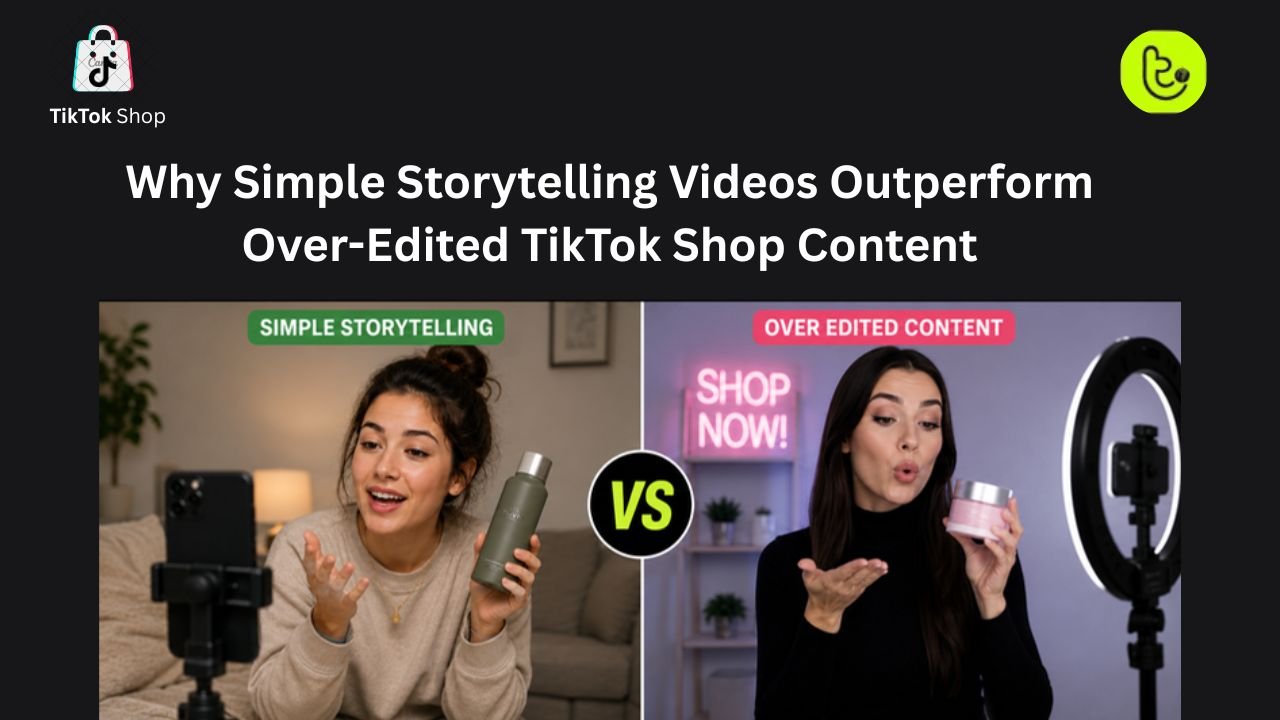
Why Simple Storytelling Videos Outperform Over Edited TikTok Shop Content
TikTok Shop sits inside a feed that was built around entertainment, not catalog browsing. Understanding the platform’s underlying psychology explains why simplicity tends to win.
TikTok users want content that feels native, not commercial
People open TikTok to be entertained or informed, not to shop. A video that looks like a commercial signals “ad” within the first second, and TikTok users are fast to scroll past anything that reads that way. A video shot in a normal room with normal lighting, on the other hand, matches the visual language of everything else in the feed, so it gets watched instead of skipped.
Storytelling creates emotional connection before selling
A video that opens with a relatable problem, frizzy hair before a big event, a cluttered desk, a skincare routine that wasn’t working, pulls a viewer in emotionally before the product ever appears. By the time the product shows up, the viewer is already invested in the outcome, which makes the recommendation feel earned rather than forced.
Longer watch time improves product discovery
TikTok’s algorithm uses completion rate and watch time as strong signals for distribution. Storytelling formats are built to hold attention through a beginning, middle, and end, which keeps people watching longer than a straightforward product pitch. That extra watch time is what gets a video pushed to more For You Pages, which is what creates the discovery sellers are chasing in the first place.
Authentic demonstrations build purchase confidence
Seeing a real person use a product in a real setting answers the question a buyer is actually asking: will this work for someone like me? A flawless, heavily produced demo can’t answer that question as convincingly as someone visibly experiencing the product in real time, reactions, results, and all.
The Biggest Mistake Sellers Make With TikTok Shop Videos
Many businesses bring a traditional advertising mindset to TikTok Shop, assuming that more production effort automatically means a better-performing video. In practice, the opposite is often true.
- Expensive editing with heavy color grading and motion graphics that signal “brand commercial.”
- Cinematic production, multiple camera angles, studio lighting, that distances the video from how content normally looks on the platform.
- Scripted dialogue that sounds rehearsed instead of like a genuine reaction or recommendation.
- Excessive transitions and effects that interrupt the flow a viewer expects from organic content.
- Prioritizing perfect lighting and framing over authenticity, even when it slows down production and limits how often new content goes out.
Each of these choices makes a video easier to recognize as an advertisement, and once viewers label something as an ad, they tend to become more skeptical and scroll away before the product is even shown. Using natural, content-driven approaches through content creation services can help you keep videos aligned with native platform behavior and improve overall viewer retention.
What Real Sellers Say About Over Edited TikTok Shop Content (Community Insights)
Communities like r/TikTokShop, r/TikTokSeller, r/Entrepreneur, r/socialmedia, and r/ecommerce are full of sellers comparing notes on what actually moves units. A few recurring themes stand out.
Sellers whose simple videos unexpectedly became top performers
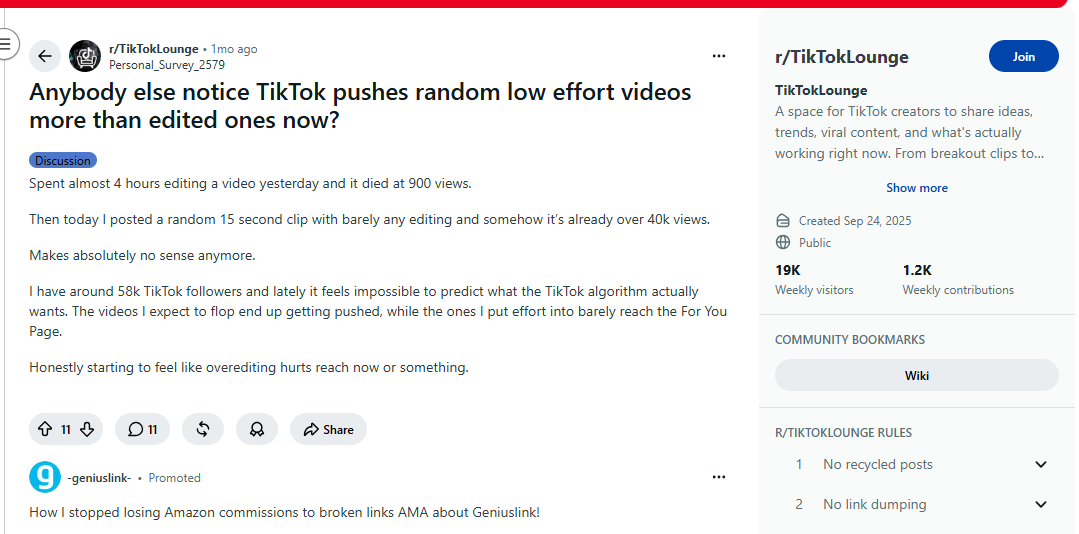
In several seller threads, creators have described uploading an unscripted, single-take demo as a placeholder while waiting on a “real” edited version, only to watch the rough clip outperform every polished video they had planned for that product.
Why polished brand videos received fewer conversions
Sellers running side-by-side tests, a studio-shot ad against a phone-shot demo of the same product, commonly report the studio version getting more views from paid boosting but fewer add-to-carts, because viewers can tell when they’re being sold to.
Why authenticity matters more than production quality
A recurring theme across r/socialmedia threads is sellers realizing that small flaws, a stumble, background noise, an unedited reaction — actually extended watch time instead of hurting it, because the imperfection read as proof the video wasn’t scripted.
Over-Edited
Simple Storytelling Framework You Can Use for Every TikTok Shop Video
This six-step framework works across almost any product category and doesn’t require a script, a studio, or a production team.
Step 1:Start with a relatable problem
Open with something your audience already deals with, “My skin has been so dry this winter” or “I was so tired of my desk looking like this.”
Step 2:Show yourself experiencing the problem
Let the viewer see the actual frustration, not just hear about it, the messy drawer, the tangled cords, the before photo.
Step 3: Introduce the product naturally
Bring the product in the way you actually would, “So I picked this up after seeing it everywhere”, rather than a formal product reveal.
Step 4: Demonstrate the product in real life
Show it being used in the same environment as the problem, with the same lighting and setting as the rest of the video.
Step 5: Share honest results
Show the after, even if it’s not perfect. A genuine “this helped a lot” lands better than an exaggerated claim.
Step 6: End with a natural recommendation instead of a sales pitch
Close the way you would tell a friend, “Honestly, I’d get this”, and let the Shop tag do the selling.
Example: a kitchen gadget seller might open on a sink full of dishes, complain about how long peeling takes, introduce the gadget mid-complaint, peel a few vegetables on camera, react to how fast it was, then close with “if you hate peeling as much as I do, just get this.” No script, no studio, just the framework.
Simple Storytelling vs Over Edited TikTok Shop Videos
| Simple Storytelling | Over Edited Videos |
|---|---|
| Authentic | Looks like an ad |
| Higher trust | Lower trust |
| Better retention | Viewers swipe sooner |
| Easier to produce | Expensive |
| Scalable | Hard to scale |
| Fits TikTok culture | Feels like traditional advertising |
Heavily produced video still has a place, a brand trailer, a seasonal campaign hero asset, or content for a website rather than the For You Page can justify more polish. But for everyday TikTok Shop content meant to drive daily sales, simple, story-led videos are the more reliable engine.
How Tiksly Helps You Turn Storytelling Into More TikTok Shop Sales
Tiksly is an official TikTok Shop Creative Partner, and the agency’s entire model is built around the pattern described above: brands grow faster on TikTok Shop through creator-led storytelling, not polished commercials.
Rather than producing a small number of expensive, heavily edited videos, Tiksly helps brands build a pipeline of authentic, story-driven content that can be tested, refreshed, and scaled continuously.
Tiksly’s Content Creation Process
- Product onboarding: understanding the product, the audience, and what problem it actually solves.
- Creator matching: pairing the product with creators whose tone and audience already fit it.
- Story-based scripting: building loose, problem-first outlines instead of rigid ad scripts.
- Native TikTok filming: shooting in real environments, on phones, the way organic content is actually made.
- Editing that preserves authenticity: light, intentional edits that keep the native feel intact.
- Performance testing: running multiple hooks and angles to see what the audience actually responds to.
- Continuous content optimization: using performance data to guide the next batch of videos.
For sellers, that process translates into more creator content in the pipeline, consistent publishing instead of sporadic uploads, scalable testing across multiple hooks and creators, improved engagement, and stronger conversion rates from videos built to feel native rather than promotional.
If you’re ready to move from one-off polished videos to a steady stream of content that actually converts, Tiksly’s creative team can help you build that engine.
Best Practices for Creating Storytelling Videos That Convert
The difference between a video that gets skipped and one that drives sales often comes down to a few simple storytelling principles.
- Show the product within the first few seconds, don’t make viewers wait through a long setup.
- Speak naturally, the way you would talk to a friend, not the way you’d read a script.
- Keep imperfections in, a stumble or a candid reaction usually helps more than it hurts.
- Use real environments, your kitchen, your car, your actual desk, instead of a staged set.
- Demonstrate actual use cases instead of just describing features.
- Focus on one problem per video rather than trying to cover every benefit at once.
- Let customer reactions drive the narrative instead of a brand-written voiceover.
- Test multiple hooks for the same product before deciding which angle works best.
- Produce consistently instead of chasing a single perfect video.
Conclusion
Authenticity consistently wins attention on TikTok Shop, and buyers purchase from creators they trust rather than ads that talk at them. Storytelling creates stronger engagement than polished advertising because it earns watch time before it asks for a sale, and consistent testing matters more than expensive production in determining which videos actually convert.
If you’re ready to create authentic, high-converting TikTok Shop videos at scale, book a consultation with the Tiksly experts. As an official TikTok Shop Creative Partner, Tiksly helps brands develop creator-led storytelling content, test winning concepts, and build a sustainable video strategy that drives more sales.
FAQs
Why do simple TikTok Shop videos perform better than professionally edited videos?
Simple TikTok Shop videos often perform better because they feel authentic and blend naturally into the For You Page. Viewers are more likely to watch, comment, and share content that looks like a genuine recommendation instead of a traditional advertisement. Strong watch time and engagement are important ranking signals, making relatable videos more likely to reach a wider audience.
How long should a TikTok Shop storytelling video be?
The ideal length for a TikTok Shop storytelling video is between 21 and 45 seconds. This gives creators enough time to introduce a relatable problem, demonstrate the product, and deliver a clear outcome without losing viewer attention. Testing different video lengths can help identify what your audience watches to comthe experience-driven, behind-the-scenes, long-termpletion.
Does high production quality hurt TikTok Shop performance?
No, high production quality does not automatically hurt performance. Good lighting and clear audio can improve the viewing experience. The problem arises when excessive editing, scripted dialogue, or polished effects make the video feel like an advertisement. TikTok users generally respond better to content that feels natural and experience driven.
Can small businesses succeed on TikTok Shop without expensive video production?
Yes. Small businesses can compete successfully using simple smartphone videos. Authentic product demonstrations, customer stories, and behind the scenes content often generate more trust than expensive promotional videos. Many successful TikTok Shop sellers grow by creating consistent, relatable content instead of investing in costly production.
How many TikTok Shop storytelling videos should you post each week?
Posting three to five storytelling videos each week is a practical starting point for most TikTok Shop sellers. Testing different hooks, product angles, and storytelling styles helps identify what resonates with your audience. Consistent publishing and regular testing usually produce stronger long term results than relying on a single polished video.