 Ahmad Amin
Did you know TikTok Shop is set to reach $30 billion in global sales this year? The platform has completely changed how people shop online.
In the U.S., sales have already crossed $1 billion every month since mid-2024, and its reach is expected to grow to 55% of the market by the end of 2025.
What’s even more interesting is how many people keep coming back. Over 80% of TikTok Shop sales come from repeat buyers. That shows real trust and consistency, people enjoy the experience and want more.
But guess what?
Creators are the driving force behind this growth. They bring products to life and make them part of everyday moments. Around 78% of users discover new products through influencers, which shows how strongly creators influence shopping decisions.
TikTok’s design also makes buying easier. Since everything happens within the app, users can move from watching a video to making a purchase in seconds. That’s why 67% of users end up buying something after seeing it on TikTok.
For brands, this is where the real opportunity lies. Growth now depends on how well they use authentic content, creator collaborations, and AI tools to reach more people and boost sales. TikTok Shop has become the place where entertainment meets e-commerce — and it’s only getting stronger.
Why Real People Sell More Than Polished Ads
TikTok Shop’s biggest strength lies in one thing and it is authenticity. People on TikTok mostly buy products by trusting other people’s experiences. Instead of polished ads, they look for real opinions and relatable stories.
That’s why User-Generated Content (UGC) has become the main fuel behind TikTok’s high conversion rates.
Why Raw and Real Content Converts Better
On TikTok, trust is built through genuine content. Around 60% of consumers say UGC feels more authentic than branded posts, and that perception directly boosts performance. In fact, UGC performs 22% better than branded content, and when brands use it in ads, they can see up to 4x higher click-through rates (CTR).
Moreover, TikTok’s algorithm also favors this kind of natural, unpolished content because it sparks more engagement. For creators, that means less time spent on heavy production and more freedom to focus on connection and creativity, while brands enjoy faster turnarounds and lower costs.
Why Brands Are Paying for UGC
While organic content from the community still matters, it isn’t enough for big brands that need a steady flow of videos. That’s why many are now paying creators to produce TikTok-style videos that look organic but are planned to match their brand message and visual tone.
This approach bridges the gap between authentic storytelling and professional marketing. It helps brands get a consistent supply of high-performing content while maintaining creative control. If you want to scale faster, explore our TikTok Shop content creation services to get tailor-made videos that match your brand’s voice and drive conversions.
The Affiliate Engine: How Hybrid Models Drive Growth
TikTok Shop’s success with creators goes beyond viral videos, it’s powered by a strong affiliate system. In 2025, TikTok is reshaping its Affiliate Program with hybrid earning models that blend fixed payments and commissions. This approach helps both creators and brands build long-term consistency while driving measurable sales results.
How TikTok Shop Affiliates Earn
Through the TikTok Shop Affiliate Program, creators can promote products in their videos and earn a commission on every sale. The usual commission range is 10% to 20%, which is attractive given TikTok’s strong engagement rates.
Affiliate links on TikTok get an average click-through rate (CTR) of 5.2%, that’s 160% higher than what creators see on platforms like Instagram or YouTube.
Thanks to these numbers, many small and mid-level creators (with 10K–50K followers) are earning between $700 and $1,200 per month, with affiliate income forming a big part of their revenue.
This performance-driven system gives creators a steady income path while giving brands measurable conversion data.
The Rise of the Hybrid Retainer Model
To maintain consistency and attract top creators, brands are now using Hybrid Retainer Models. In this setup, creators receive a base monthly fee plus a sales-based commission.
The base fee ensures income stability and consistent content output. The commission, on the other hand, motivates creators to push for higher sales.
For example, one creator who generated $8,000 in monthly sales moved to a hybrid deal of $1,000 base pay plus 20% commission, a win-win setup for both sides.
This model works best for Direct-to-Consumer (DTC) brands that want regular content while keeping performance-based incentives in place.
To connect with the right creators and build stronger partnerships, check out our influencer outreach services.
Comparing Creator Compensation Models
Model | Structure | Creator Incentive | Brand Benefit & Risk |
Pure Commission | 10–20% of each sale | High reward if content goes viral, but income can fluctuate | Low risk for brand; payment only when sales occur |
Pure Fee (UGC Purchase) | Fixed rate per video | Guaranteed income for creators | Higher brand risk; ensures content volume but no performance guarantee |
Hybrid Retainer | Base fee + performance commission | Balanced earnings and motivation to sell | Best mix of stability and performance for both sides |
Scaling Success with Paid Amplification
While organic reach and affiliate marketing help products get discovered, real growth comes from paid amplification. Brands use Shop Ads, especially Spark Ads, to boost top-performing UGC.
This strategy takes already successful content and scales it through paid campaigns. Case studies show that boosted affiliate content can achieve 3.2x Return on Ad Spend (ROAS) and up to 1450% sales growth in a month.
Because TikTok Shop tracks all in-app performance signals, brands get accurate results without extra tracking pixels or tools. It’s a fully connected system where creators don’t just act as influencers, they become high-performing media channels amplified by brand budgets.
In short, this hybrid and performance-driven ecosystem turns creativity into predictable, scalable revenue.
AI Assistants: Powering Speed and Efficiency on TikTok Shop
Running a $30 billion marketplace requires more than just creativity, it demands speed, precision, and automation. That’s where Artificial Intelligence (AI) steps in. From content creation to campaign management, AI drives the entire TikTok Shop ecosystem, helping sellers and creators move faster, stay consistent, and scale smarter.
Generative AI: Keeping Up with Content Demand
For most creators, the hardest part of selling online is keeping up with the constant need for fresh, high-quality content. Generative AI solves this problem by making large-scale video production possible for everyone.
Tools like Arcads let creators make realistic AI-based UGC videos or even use synthetic avatars to produce content in bulk. They can instantly test different versions of videos (A/B testing) to see which message or visual style performs best.
Other tools, like Lumen5, go a step further by turning existing marketing material—such as product descriptions or blog posts—into TikTok-ready videos. These integrations, including Shopify imports, help brands repurpose their content faster and stay consistent without overloading their teams.
In short, AI makes small creators operate like large creative agencies, supporting frequent posting and experimentation.
According to Influencer Marketing Hub, AI-powered UGC tools are already reshaping e-commerce campaigns. Brands using them can scale video production faster and often see higher engagement and conversion performance.
Smarter Distribution with AI Algorithms
AI doesn’t stop at content creation, it also controls how content reaches people. Machine learning algorithms analyze more than 200 user signals, including device type, language, and interaction patterns, to decide which videos appear on the For You Page (FYP).
Platforms like Euka AI use this data to manage creator relationships and ensure every piece of content reaches the right audience. The result is hyper-personalized targeting that increases the chances of conversion and strengthens the creator-brand connection.
Automating Seller Operations
Behind the scenes, AI supports the massive operational side of TikTok Shop, making it easier for sellers to manage campaigns, logistics, and compliance.
- GMV Max: An AI-powered tool that automates ad campaign management—handling audience targeting, bidding, and creative selection. It helps sellers boost Gross Merchandise Value (GMV) while freeing up time to focus on strategy and growth
- Seller Assistant: A built-in AI guide within the Seller Center that helps merchants navigate policies, logistics, and platform updates 24/7. It reduces confusion and keeps sellers compliant.
- Trust and Safety AI: About 80–85% of content moderation is now automated. AI flags inappropriate or policy-violating content instantly, maintaining platform trust at scale.
The New Edge: Speed and Data Execution
AI has completely reshaped competition on TikTok Shop. Since content creation and production costs are now much lower, quality alone isn’t enough to stand out. The real advantage comes from how fast a brand can act.
Winning brands are the ones that can:
- Spot a new trend early using AI analytics.
- Create and test content instantly with AI UGC tools.
- Launch optimized campaigns at scale through systems like GMV Max.
This combination of speed, data, and automation is now the key differentiator in digital commerce.
How AI Supports Every Stage
AI Tool/Function | Primary User | Operational Impact | Strategic Advantage |
Generative AI (AI UGC) | Creator/Affiliate | Enables mass-scale video creation and quick A/B testing | Faster content production, lower costs |
GMV Max | Seller/Brand | Automates targeting, bidding, and creative scaling | Higher GMV and reduced manual workload |
Algorithm Optimization | Content Creator | Analyzes 200+ signals for personalized delivery | Maximizes reach to high-converting audiences |
Seller Assistant | Seller/Brand | Provides instant help for policies and logistics | Reduces errors and simplifies operations |
AI is no longer just a tool, it’s the engine that powers TikTok Shop’s growth. It speeds up everything from content production to campaign optimization, making the platform more efficient, data-driven, and scalable than ever.
As AI reshapes how creators and brands work, the next challenge isn’t creativity,it’s efficiency. The focus now shifts to profitability and cost control in an increasingly data-driven ecosystem.
Strategic Outlook 2025: Balancing Growth and Profitability
For high-volume Direct-to-Consumer (DTC) brands, 2025 brings a new challenge. Sales on TikTok Shop continue to grow rapidly, but maintaining healthy profit margins is getting tougher. As platform fees and affiliate commissions rise, brands must focus on understanding the True Cost of Sale (TCOS) to protect their bottom line.
Why Net Margin Modeling Matters
TikTok Shop’s fee system is still competitive, but costs can add up fast. Most sellers pay a referral fee of 6% to 8% per order, though some categories can go higher—up to 9% in the UK or 14.58% for high-risk electronics.
On top of that, sellers pay a transaction fee of about 2.9%, plus logistics costs that vary by order size. Those using the Fulfilled by TikTok (FBT) program pay around $3.58 per single-unit order.
When calculating the True Cost of Sale, brands need to include all these expenses:
TCOS = Platform Fee + Affiliate Commission + Transaction Fee + FBT/Shipping + Ad Boost Cost
For example, if a seller faces a 7% platform fee and a 15% affiliate commission, then 22% of total revenue is already spent before even counting product costs or ad spend. That’s why brands must focus on high-margin products that can handle these performance-based payouts without cutting into profits.
What’s Next for the Creator–Seller Relationship
The creator economy on TikTok Shop is evolving fast. Two big shifts are expected to shape how brands and creators work together in 2025:
1. The Rise of Creator Entrepreneurs
Creators who’ve mastered content creation and sales will start launching their own product lines. With the Seller Center becoming more advanced and AI UGC tools more accessible, top affiliates can now run their own mini e-commerce businesses.
Instead of earning 10%–20% commissions promoting someone else’s product, they could keep 40% or more in gross margins from their own branded items. This shift will blur the line between creator and seller, turning top influencers into independent e-commerce brands.
2. New Rules Around AI and Authenticity
AI-generated UGC is becoming so realistic that it may soon raise regulatory concerns. TikTok is expected to introduce synthetic media disclosures or visual badges to identify AI-generated videos.
This will impact how audiences perceive “authentic” content. Brands may need to rethink their strategies as transparency becomes a key factor in maintaining trust and engagement. The current advantage of AI UGC could level off as platforms enforce stricter authenticity policies.
Profitability on TikTok Shop in 2025 isn’t about driving more sales, it’s about managing costs and staying ahead of change. Brands that model every expense, prioritize high-margin products, and adapt to the creator economy’s new dynamics will be the ones that stay profitable in this next phase of social commerce.
Conclusion
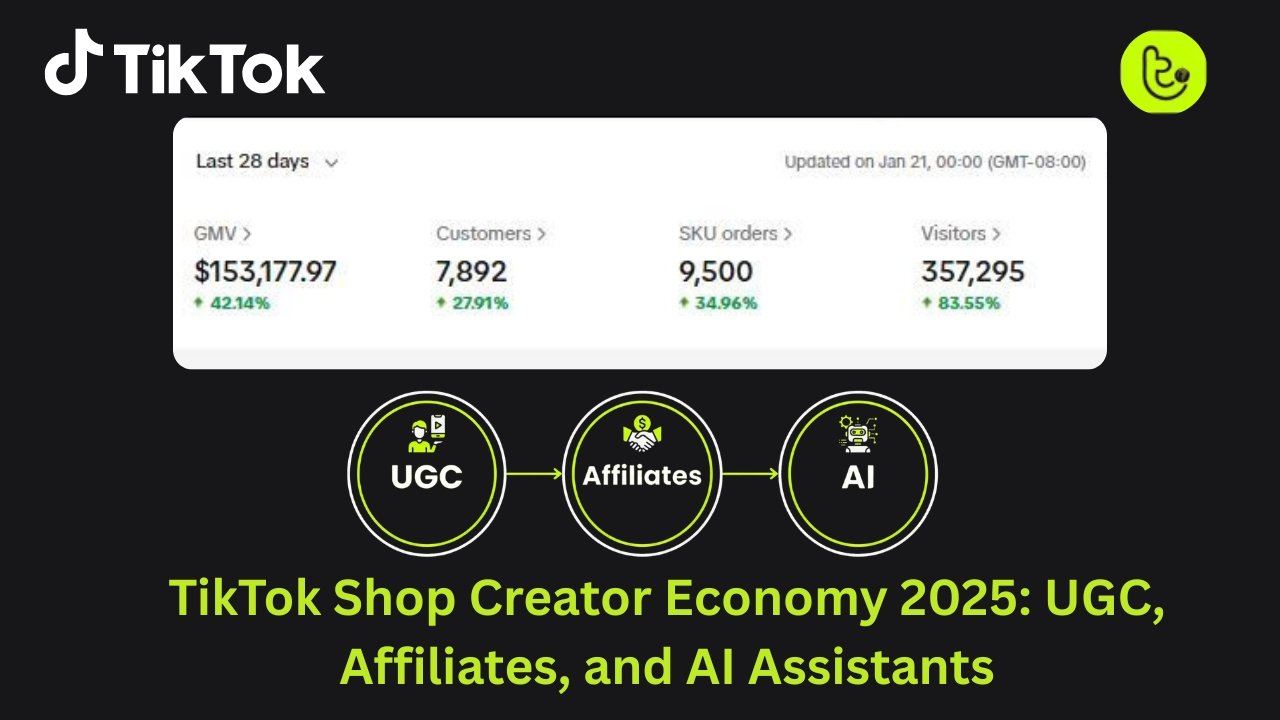
By 2025, the TikTok Shop creator economy has become essential for brands looking to scale. Success depends on building an integrated system where UGC, affiliate models, and AI tools work together as one strong conversion engine.
For e-commerce leaders, the goal should shift from one-off influencer deals to long-term hybrid partnerships that mix creativity with performance. UGC is no longer a cost, it’s an investment in creative testing to find what converts before scaling with paid ads.
Media budgets should boost proven affiliate content, ensuring every dollar supports what already drives sales.
The brands that capture most of TikTok Shop’s projected $30 billion GMV will be the ones using AI systems, real-time data, and financial discipline to move faster and smarter in social commerce.
Ready to turn your TikTok Shop strategy into real growth?
At Tiksly, we help brands create high-performing content, connect with the right creators, and scale faster through data-driven strategies. Book your 1:1 consultation today to start driving conversions that last.