 Ayesha Khan
Many sellers focus on revenue numbers and forget that sales do not equal profit. A product that generates $10,000 in sales may leave far less after TikTok Shop commissions, shipping costs, advertising spend, returns, affiliate commissions, and operational expenses. The gap between gross revenue and what actually lands in your bank account is wider than most new sellers expect.
This guide provides a complete TikTok Shop fee breakdown so you can understand what you actually keep from every sale, where most sellers lose money, and how to improve profitability without sacrificing growth.
Understanding the Complete TikTok Shop Fee Breakdown
If you want to understand what your actual profit looks like, you need to look beyond your sales figures. Every order comes with multiple deductions that affect your bottom line, and overlooking even one of them can lead to inaccurate profit calculations. Here are the primary costs every TikTok Shop seller should track.
The Main Costs Every Seller Should Expect
When you sell on TikTok Shop, your revenue is reduced by several overlapping cost categories. Each one is manageable on its own, but together they can consume a far larger portion of your sales than most sellers plan for.
The main costs are: TikTok Shop commission (referral) fees, payment processing fees, affiliate commissions paid to creators, shipping and fulfillment expenses, advertising costs, product returns and refunds, and packaging and operational overhead.
Most sellers who struggle with profitability are not losing money on one cost, they are losing money on all of them simultaneously, without a clear picture of the total impact.
Why Revenue Numbers Can Be Misleading
A $100 sale does not mean $100 earned. Here is a simplified look at what commonly gets deducted from a single order:
- Platform referral fee (6%): −$6.00
- Payment processing (~1–2%): −$1.50
- Affiliate commission (if applicable, ~13%): −$13.00
- Shipping and fulfillment: −$5.00 to $10.00
- Proportional ad spend: −$5.00 to $20.00
- Product cost (COGS): −$25.00 to $40.00
On a $100 sale with typical costs, a seller may realistically keep $10 to $30 before accounting for packaging, customer service, and software tools. Revenue is the starting line, not the finish line.
TikTok Shop Fees Explained by Category
Before you calculate profit, you need to understand how each fee is applied at the transaction level and how even small percentages add up across every order.
TikTok Shop Commission Fees
The referral fee is TikTok’s cut from every completed sale. For US sellers in 2026, this is a flat 6% on most product categories, calculated on the customer payment plus any platform-funded discounts, minus taxes. Select jewelry categories carry a reduced 5% rate.
New sellers benefit from a promotional rate of approximately 3% for the first 30 days. This discount often gives new shops a misleadingly optimistic first impression of their margins, since the standard 6% kicks in immediately after.
One important nuance: when TikTok funds a promotional discount or “Deals For You” voucher, the subsidized amount is added back into the commission base. This means the platform charges its 6% on the full pre-discount value, not just what the customer paid, a detail that catches many sellers off guard.
Payment Processing and Transaction Costs
On top of the referral fee, most US sellers encounter a payment processing fee of approximately 1.02% to 2.9% per transaction, depending on the payment method used. For a $50 sale, that represents an additional $0.50 to $1.45 per order. Across hundreds of orders per month, these charges accumulate into a meaningful cost line.
TikTok Shop’s blended effective take-rate, once the processing fee is layered onto the 6% referral fee, sits at roughly 7% to 9% of gross order value for most sellers.
Shipping and Fulfillment Expenses
As of early 2026, US sellers are required to use TikTok-approved logistics options, including Fulfilled by TikTok (FBT), Upgraded TikTok Shipping, or Collections by TikTok. Independent seller shipping is still permitted following a policy reversal in February 2026 after pushback from the seller community.
FBT fees start at approximately $2.86 to $3.58 per unit, with the lower rate applying to multi-unit orders. For products in the $20 to $80 price range, shipping and fulfillment typically represents 8% to 15% of order value. Higher-priced products tend to absorb shipping costs as a smaller percentage of revenue.
FBT also includes storage fees after 60 days of free storage. Slow-moving inventory accumulates charges per cubic foot per day, which can quietly compound if not monitored.
Affiliate Marketing Commissions
TikTok Shop’s affiliate program is one of the platform’s most powerful growth tools — and one of its most significant margin risks. Sellers set their own commission rates, and creators browse available products to promote. The higher the commission, the more likely top-performing creators will choose your product.
The average US affiliate commission rate in 2026 sits at approximately 13%, but category benchmarks vary considerably. Beauty and skincare brands routinely offer 15% to 30% because product margins support it. Fashion sellers typically run 10% to 15%. Electronics brands often cap at 5% to 10% due to thinner margins.
In open collaboration campaigns, where any creator can pick up your product, competitive rates start around 10% to 15%. In targeted collaborations with specific high-performing creators, rates can reach 20% or higher. Live shopping sessions frequently command 20% to 30% due to higher conversion rates.
A critical detail many sellers overlook: if a customer returns a product, the affiliate commission already paid to the creator is not automatically reclaimed. On items with higher return rates, this creates a compounding loss, you refund the customer and absorb the creator’s commission.
Advertising Costs
TikTok Shop Ads are technically optional, but in practice, organic visibility on TikTok Shop is limited for most sellers without consistent ad investment. Sellers who run no paid campaigns often see traffic decline 30% to 50% month over month after initial launch momentum fades.
Most TikTok Shop sellers allocate 15% to 25% of revenue to advertising, including GMV Max campaigns, Spark Ads, and product-specific ad formats. For newer sellers establishing their first products, ad spend can temporarily run even higher while optimizing toward a sustainable return on ad spend (ROAS).
The key metric to watch is cost per acquisition (CPA). If your average order value is $50 and you are spending $15 in ads to acquire each customer, your effective ad cost is 30% of revenue, far more than the platform’s published referral fee.
If you’re unsure how to balance ad spend with profitability, getting guidance from experienced TikTok Shop ad experts can help you avoid overspending and improve your return on investment.
Example TikTok Shop Profit Calculation (Real Scenario)
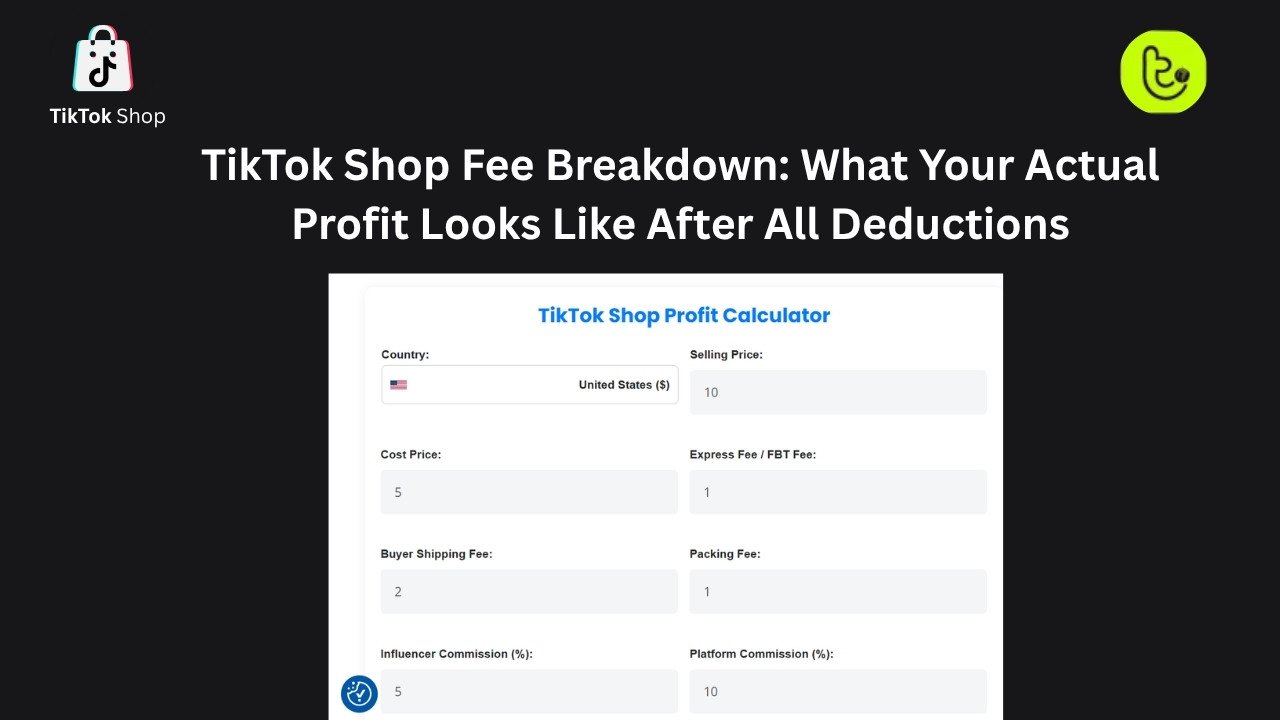
Here is a simple example that shows how a single $50 order translates into actual profit after all key deductions are applied.
Example Product Sale Breakdown
Let us walk through a realistic example for a health and wellness product priced at $50.
| Item | Amount |
|---|---|
| Product Revenue | $50.00 |
| TikTok Referral Fee (6%) | −$3.00 |
| Payment Processing (~1.5%) | −$0.75 |
| Affiliate Commission (13%) | −$6.50 |
| Shipping / FBT Fulfillment | −$4.00 |
| Proportional Ad Spend (~15%) | −$7.50 |
| Product Cost (COGS, ~35%) | −$17.50 |
| Net Profit | $10.75 |
What the Seller Actually Keeps
In this example, a $50 sale returns approximately $10.75 in net profit, a margin of roughly 21.5%. That is a reasonable outcome for a seller running a well-managed TikTok Shop with controlled affiliate rates and moderate ad spend.
However, change just one variable, raise the affiliate commission to 20%, add a 10% return rate, or increase ad spend to 20%, and that margin falls below 10%, or into negative territory entirely.
The TikTok Shop profit margin benchmark varies by category. Beauty sellers with strong organic content and controlled affiliate rates can achieve 25% to 40% net margins. Electronics sellers frequently land at 15% to 20%. Fashion brands running heavy affiliate programs often see margins compress to single digits without careful management.
The Biggest Profit Killers TikTok Shop Sellers Talk About
Real sellers selling on TikTok Shop frequently discuss margin issues in online communities, and the same pain points surface repeatedly. These are the concerns that do not always appear in official platform documentation.
Affiliate Commissions Becoming Unsustainable
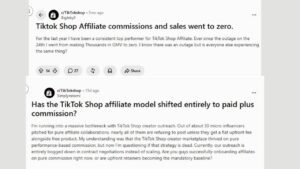
(may be we can merge both ss or use only one)
Sellers consistently report that affiliate commissions are the single biggest threat to profitability. A product can generate strong GMV numbers while the seller earns almost nothing, because a double-digit affiliate rate is consuming a significant portion of every order.
The issue compounds because of TikTok’s commission protection rules. When a seller sets a high rate to attract creators and then tries to reduce it after a video goes viral, existing creators are locked into the original rate for 30 days.
Rate cuts must be planned well in advance. Many sellers who rush to attract creators with aggressive commissions find themselves locked into rates they cannot afford once volume scales.
The practical takeaway: set affiliate commissions based on your actual unit economics, not what competitors are offering or what you think will attract the most creators. A 20% commission that drives volume but eliminates margin is worse than a 10% commission with disciplined creator selection.
Returns and Refund Abuse
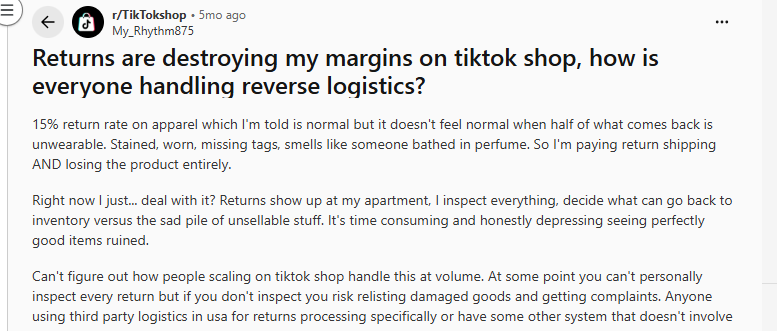
Returns represent a triple loss for TikTok Shop sellers. You lose the product cost, the outbound shipping cost, and, in many cases, the affiliate commission that was already paid to the creator. None of these are automatically recovered when a buyer returns an order.
TikTok charges a Refund Administration Fee of 20% of the original referral fee on returned orders, capped at $5 per SKU. Your Shop Performance Score (SPS) also affects how return shipping costs are split. Sellers with an SPS of 4 or above pay 20% of return shipping on change-of-mind returns; lower-scoring sellers pay 50%.
For sellers in fashion, electronics, and home goods, categories with historically higher return rates, a 15% return rate on a product with a 15% affiliate commission can cut net margins by half or more.
Rising Ad Costs
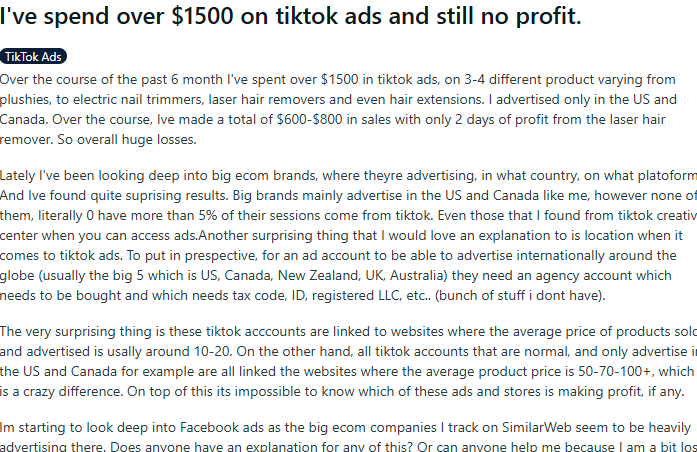
Advertising on TikTok Shop has become more competitive as the platform has grown, and the cost of customer acquisition has risen accordingly. Sellers who built their businesses on early-stage low-CPM environments frequently report that their ad economics no longer hold at current pricing.
The challenge is structural. TikTok Shop’s discovery algorithm favors sellers with active ad campaigns, which means reduced ad spend leads to reduced organic visibility, creating pressure to maintain spend even when ROAS is declining.
Sellers who do not actively test new creative formats tend to experience ad fatigue, where the same content loses effectiveness over time while costs continue to rise.
Unexpected Operational Costs
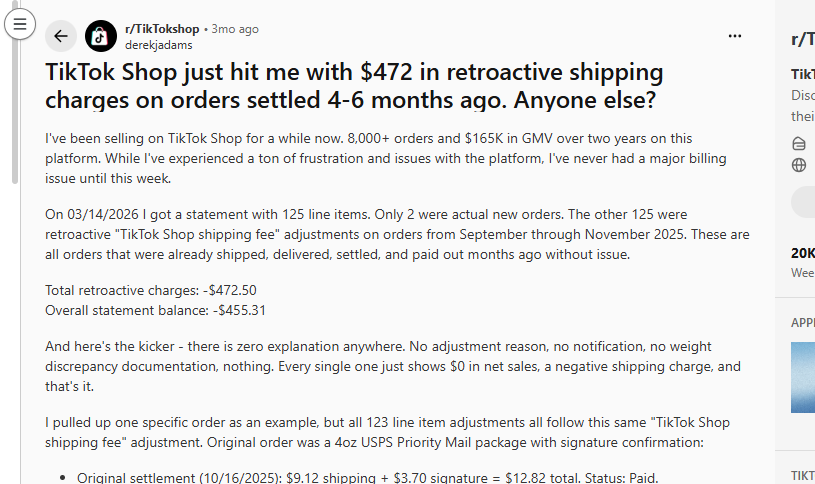
The costs that sellers most often underestimate are the ones that do not appear on TikTok’s fee schedule. These include packaging materials (especially for branded unboxing experiences), warehouse preparation for FBT compliance, customer service staffing or software, seller analytics tools, and creator sample costs.
Sending free samples to creators before a campaign launch is a common practice. At scale, if you are sending 50 samples per month at a product cost of $15 each, that is $750 per month in unrecovered inventory before a single piece of content is guaranteed. Factor sample costs into your true cost of affiliate-driven revenue.
How to Calculate Your Real TikTok Shop Profit Margin
To understand what you actually take home from each sale, you need to break your revenue down step by step and account for every cost that reduces your payout.
Step 1: Start With Gross Revenue
Gross revenue is the total value of completed orders before any deductions. This is the number displayed prominently in your TikTok Seller Center dashboard, and it is the number that most sellers focus on. It is also the least useful number for understanding profitability.
Step 2: Subtract All Platform Fees
Pull your itemized fee report from the TikTok Shop Seller Center. This includes the referral fee and any payment processing charges deducted from each order. Do not estimate these, use the actual amounts from your settlement reports.
Step 3: Include Creator and Affiliate Costs
Affiliate commissions are one of the most commonly missed costs in seller profit calculations. They are deducted from payouts and may be logged separately from platform fees.
To manage this properly, connect with the right influencers through agencies that provide transparent influencer outreach services, and track every commission paid to creators across open collaborations and direct partnerships.
Step 4: Add Advertising Expenses
Your ad spend sits outside TikTok Shop’s fee schedule entirely, which means it does not show up in settlement reports. Pull your total ad spend from TikTok Ads Manager and add it as a cost against your revenue for the same period.
Step 5: Factor in Returns and Refunds
Returns reduce your realized revenue. For each return, you lose the sale, the outbound shipping cost, and, in some cases, affiliate commissions already paid. Calculate your return rate per SKU and apply it to your revenue calculation to arrive at net realized revenue.
Step 6: Calculate Net Profit Margin
Once you have subtracted all costs, platform fees, affiliate commissions, ad spend, shipping, COGS, and operational overhead, divide your remaining profit by your gross revenue and multiply by 100.
Net Profit Margin = (Net Profit ÷ Gross Revenue) × 100
A healthy TikTok Shop profit margin depends on your category and sales model. Organic-first sellers who create their own content and keep affiliate rates controlled often achieve 35% to 39% net margins. Sellers relying heavily on paid affiliates and ads typically see 10% to 18%.
TikTok Shop Fee Breakdown vs Other Selling Channels
To compare profitability across platforms, you need to look beyond headline fees and focus on how each ecosystem structures advertising, fulfillment, and creator payouts.
TikTok Shop vs Amazon
On the surface, TikTok Shop’s 6% referral fee looks far more attractive than Amazon’s 15% to 30% category fees. But the full cost picture is more complicated.
Amazon’s fee structure is more predictable. Sellers pay a referral fee, FBA fulfillment costs, and storage fees, and while those add up, the affiliate and advertising cost structures differ significantly. Amazon Associates pays creator commissions of 1% to 10%, set by Amazon. TikTok Shop commissions, set by sellers and averaging 13%, represent a far larger variable cost.
TikTok Shop’s advertising ecosystem is also less mature than Amazon’s, which means ad spend produces less predictable returns in the early stages. Sellers who migrate from Amazon to TikTok Shop sometimes underestimate the content creation and creator management overhead required to make the platform work.
Where TikTok Shop wins: the discovery-driven purchase model can drive higher conversion rates for the right products, and the content flywheel, once established, can generate organic sales at minimal incremental cost.
| Cost | TikTok Shop | Amazon |
|---|---|---|
| Platform Fee | 6% (US) | 15–30% by category |
| Affiliate Commission | 10–30% (seller-set) | 1–10% (Amazon-set) |
| Advertising Spend | 15–25% of revenue | 10–20% of revenue |
| Fulfillment (FBA/FBT) | $2.86–$3.58/unit | Varies by size/weight |
| Organic Discovery | Content-driven, high ceiling | Limited without ads |
TikTok Shop vs Shopify
Shopify charges a monthly platform fee rather than a per-sale commission, which makes it structurally more cost-efficient at higher volumes. However, Shopify sellers bear the full cost of driving their own traffic, whether through paid ads, email marketing, SEO, or social content, without access to TikTok Shop’s built-in discovery engine.
For sellers with established audiences and strong content capabilities, a hybrid approach, using TikTok Shop for discovery and Shopify for direct customer ownership, often produces better long-term economics than either channel alone.
| Cost | TikTok Shop | Shopify |
|---|---|---|
| Platform Fee | 6% per sale | Monthly subscription + 0.5–2% per transaction |
| Advertising | High, algorithm-dependent | Fully seller-controlled |
| Affiliate Ecosystem | Native, large creator pool | Requires third-party setup |
| Customer Ownership | Limited (TikTok owns data) | Full ownership |
| Margin Potential | 10–39% depending on model | 20–50%+ with strong retention |
Why Most Sellers Focus on Traffic Instead of Conversion
Most TikTok Shop sellers try to grow by increasing ad spend. More budget often means more reach, but without stronger creative performance, that traffic does not convert efficiently. The result is higher spending for similar outcomes.
Profit comes from conversion quality, not traffic volume. On TikTok Shop, conversion is driven mainly by content.
Tiksly’s Approach to TikTok Shop Growth
Tiksly is an Official TikTok Shop Creative Partner working within TikTok’s ecosystem with access to platform-level insights and tools.
Instead of focusing on volume, Tiksly focuses on improving creative performance through UGC production, product storytelling, creator collaboration support, and structured testing of multiple content angles to find what drives conversions.
Better conversion reduces cost per acquisition, which directly improves profit margins even if revenue stays the same.
The Tiksly Process
- TikTok Shop audit to identify margin leaks
- Competitor and creative analysis
- Content strategy development based on product and audience
- UGC and product video production
- Testing multiple creative angles
- Performance optimization using live data
- Scaling winning creatives
How Better Creative Performance Improves Profitability
If ad performance improves from 2.0x ROAS to 3.5x ROAS, cost per acquisition drops significantly without increasing budget, improving net profit directly.
Stronger content also reduces reliance on high affiliate payouts, giving you more control over overall costs.
Tiksly helps TikTok Shop sellers improve creative performance, increase conversions, and scale revenue more efficiently through data-driven content strategies and platform expertise.
Common Mistakes That Make TikTok Shop Sellers Think They’re Profitable
Before you scale any TikTok Shop strategy, it helps to understand the most common mistakes that quietly distort your view of profit and lead to decisions based on incomplete numbers.
Ignoring Affiliate Costs
Affiliate commissions are the most commonly overlooked cost in TikTok Shop profit calculations. Because they are deducted separately from platform fees and may not appear in the same dashboard view as your other costs, many sellers simply do not include them in their margin calculations until they run a full profit and loss review.
Looking Only at Revenue
TikTok Shop Seller Center prominently displays GMV, gross merchandise value, or total sales. This number does not reflect returns, fees, commissions, or ad spend. Building business decisions around GMV without tracking net profit leads sellers to scale spending on channels that are not actually generating profit.
Not Tracking Refund Rates
Return rates vary significantly by product category, listing quality, and fulfillment accuracy. A seller with a 20% return rate is not just losing those sales — they are losing the shipping cost, any affiliate commission paid, and in some cases the product itself. Tracking return rates at the SKU level helps you identify problem listings before they compound.
Scaling Ads Too Quickly
New sellers who achieve early success often scale ad spend before their creative and operational infrastructure can support it. Rapid scaling typically increases CPM (cost per thousand impressions) while creative performance remains flat or declines due to ad fatigue, producing deteriorating ROAS and compressed margins.
Failing to Measure Net Profit
Revenue is visible. Net profit requires calculation. Many sellers operate for months without a clear picture of their actual profitability because they have not built a system to aggregate all cost categories, platform fees, affiliate commissions, ad spend, COGS, shipping, and overhead, into a single view. Building this habit early is the most important thing a TikTok Shop seller can do for their long-term business health.
Conclusion
A successful TikTok Shop business is built on profit, not revenue. Understanding the complete TikTok Shop fee breakdown helps you see where your money goes and which costs impact your margins the most. Tracking every deduction, platform fees, affiliates, ads, shipping, returns, and overhead gives you clearer control over real profitability.
The strongest sellers are not just the ones with high GMV, but those who manage costs well and focus on conversion-driven creative instead of raw traffic.
If you want help improving your TikTok Shop margins, you can book a 1:1 consultation with Tiksly to review your store and optimize your growth strategy.
FAQs
What fees does TikTok Shop charge sellers?
TikTok Shop charges US sellers a 6% referral fee on most product categories (5% for select jewelry). Payment processing adds approximately 1% to 2.9% per transaction. If you use the Fulfilled by TikTok service, per-unit fulfillment fees apply starting at roughly $2.86. Affiliate commissions are set by sellers and typically range from 10% to 25%. Advertising costs are separate and typically run 15% to 25% of revenue for active sellers.
How do I calculate profit on TikTok Shop?
Start with gross revenue, then subtract TikTok referral fees, payment processing fees, affiliate commissions, shipping and fulfillment costs, advertising spend, product cost (COGS), and operational overhead. The result is your net profit. Divide that by gross revenue and multiply by 100 to get your net profit margin.
Are TikTok Shop commission fees the biggest expense for sellers?
For most sellers, the platform’s 6% referral fee is not the largest cost. Advertising spend (15% to 25% of revenue) and affiliate commissions (10% to 30% of affiliate-driven sales) are typically much larger cost drivers. The referral fee is the most visible cost but often ranks third or fourth in total impact.
What is a good TikTok Shop profit margin?
Net profit margins vary by category and sales model. Beauty sellers with strong content and controlled costs can achieve 25% to 40%. Sellers relying heavily on paid affiliates and ads typically land at 10% to 18%. Electronics sellers average 15% to 20%. A margin below 10% typically indicates unsustainable cost structure.
Do affiliate commissions reduce TikTok Shop profitability?
Yes, significantly. Affiliate commissions are the most commonly underestimated cost on the platform. The average US commission rate is approximately 13%, and competitive categories routinely require 15% to 25% to attract quality creators. For a seller doing 50% of their volume through affiliates at a 15% commission, the blended impact on overall margins can be 7% to 9% of total revenue — before returns and ad spend are accounted for.
How can sellers increase profit without increasing ad spend?
The most effective lever is improving creative performance, which increases conversion rates on existing traffic and reduces cost per acquisition. Testing multiple content angles, optimizing product listings, improving offer clarity, and refining your affiliate strategy (selecting fewer, better-matched creators rather than broad open collaboration) all improve margins without requiring higher ad budgets. Reducing return rates through more accurate product descriptions and better listing photography is another often-overlooked path to improved profitability.