 Ayesha Khan
Want to tap into a $1.34 billion beauty market where health and beauty products account for 79.3% of total platform sales in the United States? Social commerce is reshaping how you sell by blending entertainment, influencer content, and instant checkout into one seamless shopping experience.
But entering the beauty category is not as simple as listing your products. You must meet strict approval requirements, follow compliance standards, and structure your operations correctly to compete and scale. Many brands lose momentum during this stage due to incomplete documentation or lack of strategic support.
In this guide, you will learn how the beauty approval process works, what documents you need, and how specialized partner agencies can help you grow faster and more efficiently.
Social Commerce in the Beauty Industry: Market Trends, Sales Data, and Consumer Behavior
Before you invest in beauty social commerce, you need to understand why this category dominates platform sales. The numbers show strong demand, fast growth, and high repeat purchases. If you are selling cosmetics or skincare, this landscape directly impacts your growth potential.
Why Beauty Leads Social Commerce Sales
Beauty and personal care products have become the most viral and shoppable category across social platforms. Short form video allows you to showcase results, tutorials, and real customer experiences in seconds. Instead of sending shoppers to an external website, the integrated shop model keeps them inside the app, reducing drop off and increasing conversions.
This direct path from product discovery to checkout removes friction. Your customers can watch a demo, read reviews, and purchase immediately. That seamless flow is a major reason beauty brands outperform many other categories.
How Consumer Behavior Drives Beauty Sales Growth
Your buyers are not responding to traditional ads in the same way they once did. They want real demonstrations, honest reviews, and relatable creators. Around 45 percent of shoppers say they are influenced by paid creator recommendations. That means your creator partnerships can directly impact revenue.
Gen Z plays a major role in this shift. About 43 percent of Gen Z users now start their product searches on social video platforms instead of search engines. If your beauty brand is not visible in this environment, you are missing early stage discovery traffic.
Repeat purchases are also strong in this category. Skincare, makeup, and personal care products naturally require replenishment, which drives long term revenue.
Beauty Social Commerce Market Data and Sales Metrics
The table below highlights the most important performance indicators shaping the beauty sector in social commerce.
| Beauty Social Commerce Market Metric | Current Performance Insight |
|---|---|
| US Beauty Sales Share | 79.3% of all platform shop sales |
| Global Unit Volume | 370M+ units sold in the beauty and personal care category |
| Sales Growth | 22% annual increase in beauty sales via social commerce |
| Gen Z Search Preference | 43% of Gen Z users start product searches on social video platforms |
| Repeat Purchase Rate | 81.3% of sales come from existing customers |
These figures show clear dominance. Beauty products account for the majority of shop sales in the United States, with 79.3 percent of total platform revenue. Globally, more than 370 million units are sold annually in the beauty and personal care category. Sales continue to grow at 22 percent each year, supported by strong repeat purchase behavior, with 81.3 percent of sales coming from returning customers.
What This Means for Your Beauty Brand
If you are building a beauty brand, this data confirms that social commerce is not optional. It is a high performing sales channel backed by measurable growth. Your strategy should focus on creator partnerships, short form product education, and retention marketing to capture repeat buyers.
Understanding this landscape prepares you for the next step: meeting category approval requirements and positioning your brand for scalable growth within the beauty sector.
Understanding the Role of Partner Agencies in Beauty Social Commerce
As you move deeper into social commerce, technical setup and compliance can quickly become overwhelming. This is where partner agencies step in. They support your brand at every operational level, helping you stay compliant, improve performance, and grow sales faster without costly trial and error.
Partner agencies work as strategic operators. They manage technical tasks, guide content strategy, and help you meet category requirements so you can focus on product quality and brand growth.
How Partner Agencies Support Beauty Brands
Partner agencies typically cover three core areas. Technical operations, creator management, and LIVE selling execution. Each area directly impacts your ability to scale within the beauty category.
Technical Integration and Storefront Management for Beauty Shops
Before you can drive sales, your shop must function smoothly. Agencies handle backend processes that keep your storefront accurate and conversion ready.
They manage catalog synchronization so your product listings, pricing, and inventory stay consistent across the platform. This prevents listing errors that can delay approvals or confuse buyers.
Agencies also conduct storefront audits. They review product images, titles, and descriptions to spot gaps that may reduce trust or clarity. By refining these elements, you improve buyer confidence and turn more visits into completed purchases.
Creator and Affiliate Coordination for Beauty Brands
Creator content plays a major role in beauty sales. Shoppers want to see real results, real routines, and real feedback before buying.
Partner agencies connect you with vetted creators who align with your brand values and audience. They manage outreach, content guidelines, and performance tracking so campaigns stay consistent and compliant.
Agencies also run affiliate programs where creators earn commissions on sales they generate. This keeps creators motivated while tying their success directly to your revenue growth.
If you want to expand your reach efficiently, TikTok Shop influencer outreach service connects your brand with vetted creators who resonate with your audience and drive authentic engagement.
LIVE Selling and Event Production in Beauty Social Commerce
LIVE selling creates urgency and trust at the same time. Agencies plan and execute these events with trained hosts and production teams.
During a live session, viewers can ask about ingredients, skin type suitability, or application methods and receive instant answers. This mirrors the experience of an in store beauty consultation and often leads to higher conversion rates during the event window.
The Beauty Brand Approval Process Explained
Beauty and personal care products fall under a restricted category. Before you can sell, your brand must pass a category qualification process designed to protect consumers.
This review confirms that your products meet safety, labeling, and regulatory standards. Approval is required for all skin, hair, and body products listed on the platform.
Required Documentation for Beauty Manufacturers and Importers
If you manufacture your own products or import them, you must submit proof of regulatory compliance. For the United States market, FDA registration is mandatory.
The table below outlines the core documents you need and what each must include.
| Required Document | Key Details Must Include |
|---|---|
| FDA Establishment Registration | Name and physical address of the facility |
| Cosmetic Product Listing | Unique listing numbers CPLN or National Drug Code for OTC items |
| Product Labeling | Principal Display Panel with product name and net contents |
| Information Panel | Full ingredient list and manufacturer or distributor contact information |
Your labels must also show required warning statements and expiration dates in the correct format. Products that make medical or treatment claims must include a Drug Facts label. This commonly applies to sunscreens and acne treatments.
Agencies like Tiksly’s product category approval service help ensure your listings pass the platform’s restricted category review quickly, reducing delays and streamlining the approval process.
Approval Requirements for Beauty Resellers and Distributors
If you are not the manufacturer, you must prove that your products come from an approved supplier.
Resellers are required to submit a purchase invoice dated within the last 365 days. The invoice must be in English and clearly list the supplier’s name, address, and products that match the beauty category you are applying for.
Meeting these requirements upfront reduces delays and increases your chances of fast approval. Once compliance is in place, you are better positioned to scale sales through creators, LIVE shopping, and affiliate partnerships.
Top Partner Agencies for Beauty Brands in Social Commerce
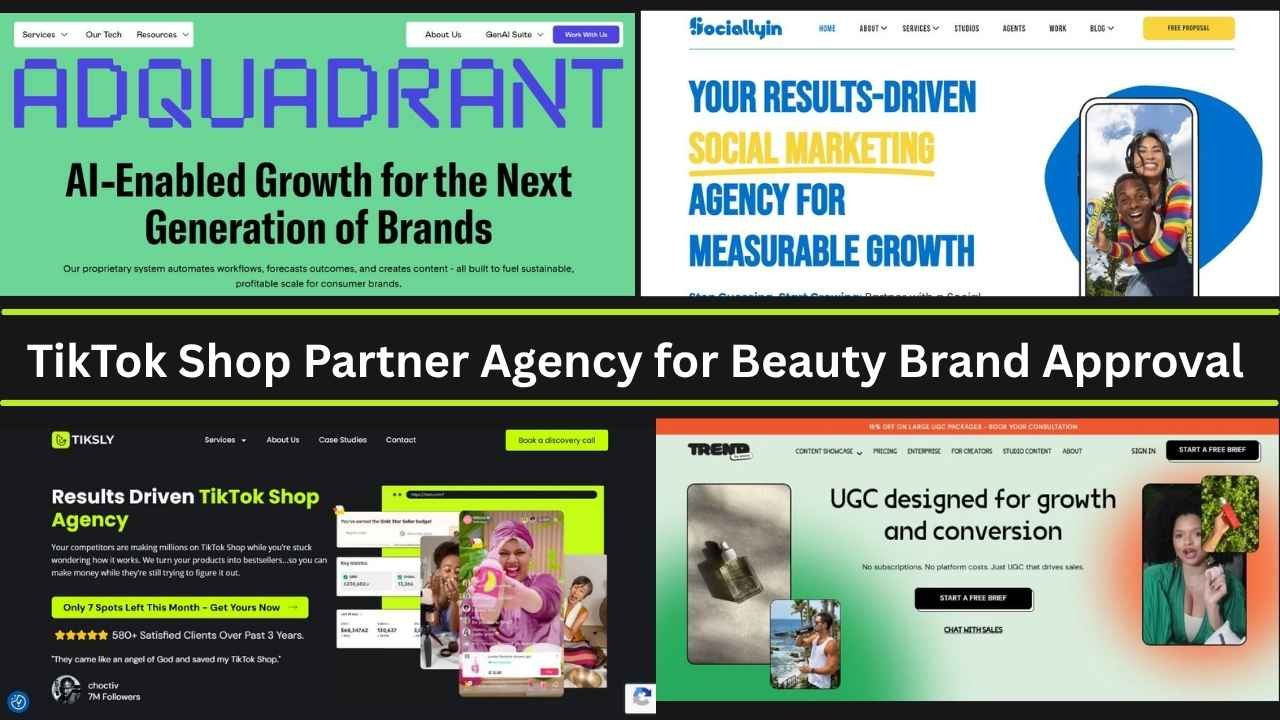
Once you understand the approval process, the next step is choosing the right partner agency. The best agency for you depends on your current stage. You may need technical approval support, performance marketing, creator management, or full scale growth execution.
Below are leading partner agencies that support beauty brands across compliance, content, paid media, and LIVE commerce.
Tiksly: Technical Approval and Shop Management Experts

If you are struggling with category approval or account health, Tiksly focuses on the technical backbone of your shop. Unlike general marketing firms, they prioritize compliance, documentation, and operational stability.
Their core services include:
- Product category approval support for restricted beauty listings
- Account violation removal and recovery
- Listing optimization aligned with platform standards
- One to one consultations focused on compliance and shop growth
Tiksly is especially helpful if your beauty brand has faced rejection or policy issues and needs structured guidance to regain approval.
Avenue Z: Data Driven Beauty Commerce Strategy

If your focus is brand visibility and cultural relevance, Avenue Z blends data analysis with creative storytelling. They specialize in translating complex ingredient education and beauty science into engaging, shareable content.
Their proprietary AI discovery framework tracks trends and audience behavior in real time. This allows you to adjust campaigns quickly based on performance insights.
MuteSix: Performance Marketing for High Growth Beauty Brands

MuteSix works with brands aiming to scale aggressively. They combine custom creative production, including live action video and user generated content, with structured audience testing.
Their strength lies in return on ad spend optimization. If your goal is measurable growth and efficient paid acquisition, their performance driven model can support that objective.
Sociallyin: Full Funnel Social Commerce Management
If you want end to end support, Sociallyin manages the journey from shop setup to revenue scaling. They focus heavily on community engagement and seasonal content planning.
Their services include:
- Influencer seeding
- Storefront optimization
- Paid media management
- Custom content calendars aligned with promotional cycles
This approach helps you maintain consistent brand activity throughout the year.
The Short Media: Authentic Creator Pairing for Beauty Brands
The Short Media focuses on matching your beauty brand with creators who already convert in specific regions or niches.
They manage the entire workflow, including briefing, campaign coordination, and performance tracking. If you are launching a new product and need credible creator partnerships, this structured system reduces guesswork.
AdQuadrant: Scalable Direct to Consumer Strategy

AdQuadrant works closely with high growth direct to consumer beauty brands. Their strategy blends organic social content with paid advertising to move customers through the full funnel.
They emphasize conversion optimization, helping you turn traffic into actual revenue rather than vanity metrics.
Viral Nation: Enterprise Level Beauty Campaign Management
If you manage a large budget and operate at a national or global level, Viral Nation provides advanced infrastructure.
They use proprietary technology for creator management and brand safety monitoring. Their expertise in large scale LIVE selling production makes them suitable for major campaign launches.
Trendio: AI Powered Affiliate and Creator Scaling

Trendio is built for automation focused growth. They use AI tools to match beauty brands with large networks of creators and affiliates.
This allows you to test multiple creator partnerships quickly and scale campaigns based on real time performance data. If speed and experimentation matter to your strategy, Trendio offers a structured way to expand reach efficiently.
Beauty Product Listing Compliance and Quality Standards
Getting category approval is only the first step. To keep your beauty products active and penalty free, every listing must meet strict compliance and quality standards. If your product pages fail to meet these rules, you risk removal, reduced visibility, or account violations.
Below is what you need to focus on to protect your shop and maintain strong performance.
Product Photography Guidelines for Beauty Listings
Your product images directly impact approval, trust, and conversions. The platform requires high resolution photos that are at least 600×600 pixels. Blurry or incomplete images can trigger listing rejection.
Show the Full Packaging Clearly
You must display all sides of the product and its packaging. This includes:
- Front and back of the box
- Side panels
- Labels and warning sections
This allows reviewers and buyers to verify ingredients, usage instructions, and safety information.
Ensure All Text Is Legible and Unedited
Every detail printed on the packaging must be clear. Ingredient lists, warning statements, expiration dates, and manufacturer information should be readable without zoom distortion.
You should not digitally alter packaging details. Edited labels can raise compliance concerns.
Avoid Prohibited Content in Images
To stay compliant, do not include:
- Seller website URLs
- References to other ecommerce platforms
- Unauthorized logos or branding
Your images should focus only on the product and approved brand elements.
Optimizing Beauty Product Titles and Content
Once your images meet standards, your product title and description must also follow strict guidelines.
Write Clear and Descriptive Product Titles
Your title should explain exactly what the product is without unnecessary clutter. Avoid:
- All capital letters
- Special characters or symbols
- Promotional phrases such as best seller or free shipping
Keep it factual and structured. A clean title improves approval rates and search visibility.
Follow Brand Authorization Rules
If you are selling branded beauty products, you must have authorization from the brand owner. The brand name should also be visible in the product images.
If your product is designed to work with another brand but is not manufactured by them, you must use phrases such as compatible with or intended for. This protects you from intellectual property violations.
Why Listing Compliance Protects Your Beauty Brand
Strong compliance practices reduce account risk and improve long term visibility. High quality images and properly structured titles increase buyer trust and reduce listing rejections.
When your product listings meet these standards, you create a stable foundation for scaling through creators, LIVE selling, and paid campaigns without compliance interruptions.
Strategic Content and Affiliate Growth for Beauty Brands
Once your beauty shop is compliant and optimized, growth depends on how you combine organic content with paid promotion. The strongest brands do not rely on one tactic. They build momentum through affiliates, then scale proven content with ads and LIVE selling.
If you want consistent revenue, you need both trust and distribution. Here is how that works in practice.
The Power of Affiliate Marketing in Beauty Social Commerce
Affiliate programs drive a large share of sales for top beauty shops, often between 60% and 80%. This happens because affiliates create authentic, relatable content that feels natural to viewers.
Instead of investing only in a few polished ads, many successful brands send product samples to a wide group of creators. This generates dozens or even hundreds of short form clips. That volume builds social proof.
When potential buyers see multiple creators using the same product, it strengthens credibility. You benefit from diverse voices, different skin types, and varied application styles. That variety increases trust and expands reach.
If you are launching a new beauty product, affiliate volume is often the fastest way to build awareness.
Leveraging Video Shopping Ads to Scale Winning Content
After identifying a high performing organic video, you can amplify it using Video Shopping Ads. This approach focuses your budget only on content that has already proven it converts.
Brands such as Love & Pebble have used this strategy to drive dramatic revenue growth, in some cases increasing sales by more than 1,000% while lowering cost per acquisition.
Spark Ads allow you to promote a creator’s original post directly from their account. This keeps the content looking authentic while giving you full paid reach. Because the ad runs through the creator profile, viewers are more likely to trust it.
This method blends organic credibility with paid distribution, which often leads to stronger performance than traditional brand ads.
Choosing the Right Growth Strategy for Your Beauty Brand
Different campaign types serve different goals. The table below outlines how each growth lever supports your beauty social commerce strategy.
| Beauty Social Commerce Campaign Type | Primary Benefit | Strategic Use Case |
|---|---|---|
| Affiliate Program | Scalable social proof and content volume | Initial product launch and early momentum |
| Video Shopping Ads | High attribution and clear sales tracking | Scaling content that already converts |
| LIVE Selling Events | Real-time engagement and high sales bursts | Flash sales and in-depth product education |
| Search Optimization | High intent conversion | Capturing users actively looking for a solution |
Affiliate programs help you build awareness and credibility. Video Shopping Ads allow you to scale proven creative with measurable results. LIVE selling drives urgency and education at the same time. Search optimization captures buyers who are already searching for specific beauty solutions.
When you combine these strategies intentionally, you create a growth engine that supports both short term revenue spikes and long term brand expansion.
Beauty Brand Costs and Financial Planning for Social Commerce
Before you hire an agency or launch paid campaigns, you need a realistic financial plan. Building a profitable beauty shop requires investment in compliance, content, advertising, and creator partnerships. When you budget properly from the start, you reduce surprises and protect your cash flow.
Below is a breakdown of the main cost areas you should prepare for.
Agency Service Fees for Beauty Brands
Agency pricing depends on scope, experience, and performance expectations. Here is what you can expect.
Monthly Retainers
Standard shop management retainers often start between $1,000 and $3,000 per month. For full service management that includes strategy, creator coordination, paid ads, and compliance oversight, fees can exceed $10,000 per month.
Ad Management Fees
Most agencies charge 10% to 20% of your total ad spend to manage paid campaigns. If you plan to scale aggressively, this percentage becomes an important part of your financial forecast.
Consultation and Technical Support
If you only need strategy or approval guidance, hourly consultation rates usually range from $150 to $300 or more depending on the agency’s expertise.
When planning your budget, factor in both management fees and advertising spend. Many brands underestimate this combined cost.
Content and Creator Budgeting for Beauty Growth
In addition to agency fees, you must allocate funds for creator collaborations and video production.
Nano Influencer Costs
Nano influencers may charge between $100 and $500 per video. Some will accept free product plus commission through affiliate programs. This approach works well for early stage social proof building.
Professional Video Production
High quality edited videos produced through agencies often cost between $500 and $3,000 per asset. These videos are commonly used for Video Shopping Ads and scaling campaigns.
Total Launch Investment
Launching and optimizing a beauty shop for high volume sales can take several months. In some cases, total launch costs may reach $70,000 when combining agency fees, ad spend, content production, and sampling.
If you want strong results, treat this as a growth investment rather than a short term experiment.
Troubleshooting Beauty Shop Rejections and Account Violations
Even with preparation, rejections can happen. Understanding common causes helps you resolve issues faster.
Common Reasons for Beauty Product Rejection
- Incomplete business registration or tax information
- Blurry product images or missing packaging views
- Unsupported health or beauty claims
- Mismatched names between FDA documents and product labels
Many rejections are administrative rather than permanent. Small documentation errors can trigger delays.
How to Recover from Account Violations
You can review your violation history in the Seller Center under Shop Health. If you believe a violation is incorrect, you can submit an appeal through the official portal.
Agencies such as Tiksly specialize in appeal management. They help remove health points, restore listings, and correct documentation errors to bring your shop back online.
Quick action prevents long term account damage.
If your shop faces penalties or frozen listings, TikTok Shop violation removal service can help recover your account and resolve compliance issues efficiently.
Conclusion
Succeeding in the beauty category requires more than strong products. You need clear documentation, strict compliance with FDA and labeling standards, and a structured content strategy built around creators and affiliates.
By working with specialized agencies such as for technical compliance or for data driven scaling, you reduce costly mistakes and accelerate growth.
As social commerce continues to expand, beauty brands that combine authentic creator storytelling with disciplined operational management will capture a larger share of this billion dollar opportunity.
For tailored guidance, Tiksly’s 1:1 consultation helps you navigate technical setup, compliance requirements, and shop strategy to accelerate growth.
FAQs
What is the most important document for beauty brand approval?
For U.S. beauty brands, proof of active FDA registration is critical. It must include the establishment name, physical address, and registration number. These details must exactly match the manufacturer name on your product label.
Can a new beauty brand get approved?
Yes. Both new and established brands can qualify. Approval depends on accurate documentation and compliant product listings. Agencies can help you prepare a strong application to avoid early rejections.
How long does beauty shop approval take?
If your documents are correct, review time usually ranges from one to three working days and can extend up to six days. Incomplete submissions may delay approval for weeks.
Do you need approval for every product?
After receiving Category Level Qualification for beauty and personal care, you can generally list products within that category without reapplying. Some high risk products may still require Product Level Qualification.
What should you do if your product application is rejected?
Check the rejection reason in your Message Center. Often, you need to upload a clearer label image or provide an updated supplier invoice.
Is an agency necessary for a small beauty brand?
It is not mandatory, but it is highly recommended if you want to scale quickly. Agencies manage creator requests, compliance updates, and campaign execution, which can overwhelm small teams.