 Ahmad Amin
Want your products to get approved on TikTok Shop? First, you need to understand category qualification. TikTok has grown beyond viral videos into a powerful shopping platform where users don’t just scroll, they buy. In 2024, TikTok Shop’s global GMV reached $33.2 billion, and in the first half of 2025, it was reported at $26.2 billion, indicating strong continued growth for the year. This is a huge opportunity for sellers who approach it strategically.
High-risk and regulated items such as Dietary Supplements, Beauty and Personal Care, and Electronics require approval before they can be listed. Failing to meet the requirements can lead to rejected listings or even account issues.
Mastering the category approval process is more than just following rules. It opens the door to high-demand niches with less competition and gives sellers a strong position in one of the fastest-growing marketplaces online.
How TikTok Shop Classifies Product Access
TikTok Shop organizes product approval into three distinct tiers to match regulatory scrutiny with the risk profile of the items being sold. Knowing these tiers is essential for planning a successful application strategy.
Category Level Qualification (CLQ)
This is the most common and efficient pathway. CLQ applies to broad product groups that require standardized oversight. Major categories include Automotive Parts, Household Appliances, Pet Supplies, and, most importantly, Beauty and Personal Care, Dietary Supplements, and Electronics.
The main advantage of CLQ is operational efficiency. Once your business qualifies at the category level, you can list any compliant product within that category without submitting full documentation for each SKU. This turns what could be a tedious, item-by-item process into a single, streamlined gateway.
Product Level Qualification (PLQ)
PLQ is required when regulatory risk depends on the characteristics of individual products rather than the entire category. Approval is granted on a product-by-product basis, with documentation tailored to each item. Categories subject to PLQ include Collectibles and some Jewelry, Watches, and Accessories.
Invite-Only Qualification (IOQ)
IOQ is the most restrictive tier, reserved for specialized or high-risk products that require strict pre-vetting. Sellers must apply through the Qualification Center, and approval is highly selective. Examples include Precious Metal Bullions, certain Medical Devices, select Fresh Flowers and Live Plants, and some specialized Food and Beverage items.
The Qualification Roadmap: A Step-by-Step Guide
The path to qualification is detailed and must be followed meticulously.
Rule Zero: The Pre-Application Strategy
Before you click “submit” in the Seller Center, you must commit to Rule Zero: Applications submitted with missing, incorrect, or low-quality documents will be immediately rejected. This rejection triggers a delay and forces a time-consuming re-submission process.
Your critical pre-application checklist should be viewed as a mandatory audit of your documentation :
- Gather Primary Proof: For resellers, this means securing valid purchase invoices. For manufacturers or importers, this means obtaining primary certifications like Certificates of Compliance (COCs) or facility registrations. If you are a reseller, work directly with your supplier or manufacturer, they are typically required to provide these foundational documents.
- Verify Legibility and Currency: Ensure all text in documents and photos is clear, high-resolution, and unaltered. Critically, check the issue dates. Most purchase invoices must be issued within the last 365 days (12 months).
- Ensure Identity Match (The Biggest Pitfall): This single point causes the majority of rejections. The recipient name (the buyer) on the purchase invoice must exactly match the legal entity name registered on your TikTok Shop seller account. If the invoice is addressed to “John Smith” but your shop is registered under “JS Commerce LLC,” the application will fail the Know Your Business (KYB) check. This verification establishes a legitimate, traceable financial trail.
Choosing Your Submission Path
TikTok Shop offers multiple methods to submit your application.
Application During Product Listing
This pathway integrates the qualification process into the creation of a new product listing :
- Sign in to your Seller Center account, open the Products tab from the left menu, and go to Manage Products.
- Click the option to create a new product listing.
- Add your product photos and enter the product name.
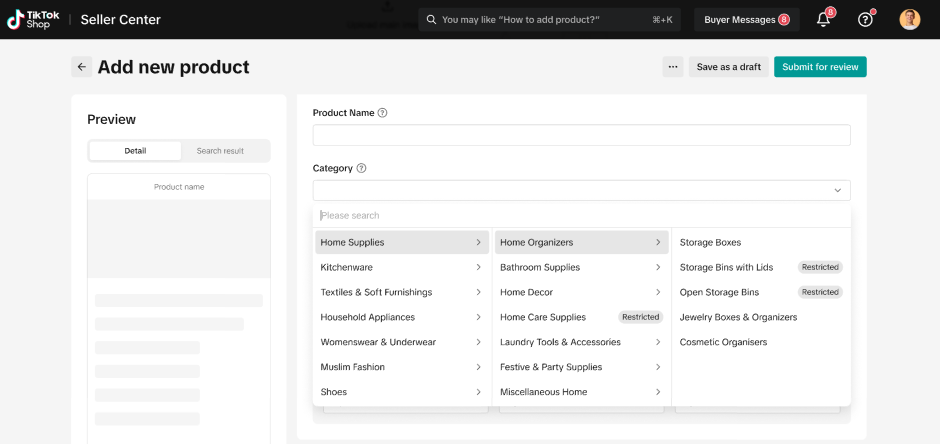
- Go to the category section. You can either select the category yourself or use the recommended one suggested by the system. If the chosen category falls under restrictions, you will be required to request approval. This can be done before submitting the listing or once the submission is complete.
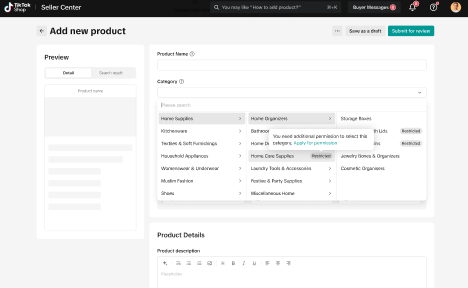
Source: TikTok
If you want to request category approval before finalizing your listing, follow these steps:
5. Find the category section and select the Apply now option located beneath it.
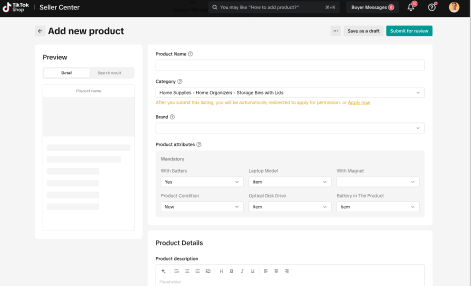
Source: TikTok
6. A separate window will open, guiding you through the requirements on the Add Category Authorization page. Fill in all the requested details there.
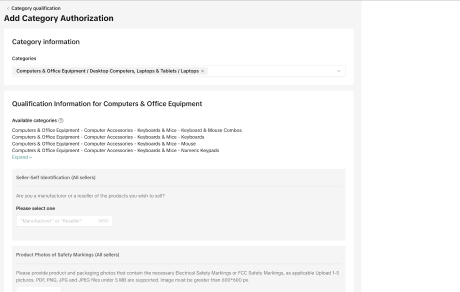
Source: TikTok
After finishing the form, select Submit. Go back to your product listing, fill out the remaining details, and then choose Submit for review.
Note: You can also request category approval after creating your listing. Once you submit the product for review, you will be taken to the same authorization step where you can complete and send the category qualification form.
How to Apply for Category Level Qualification Using the TikTok Shop App
- Open the app and tap Add Product.
- Upload your product images and enter the product name.
- Select your desired category or use the one suggested by TikTok. If the category is restricted, you will need to request approval either before submitting the listing or after it has been submitted.
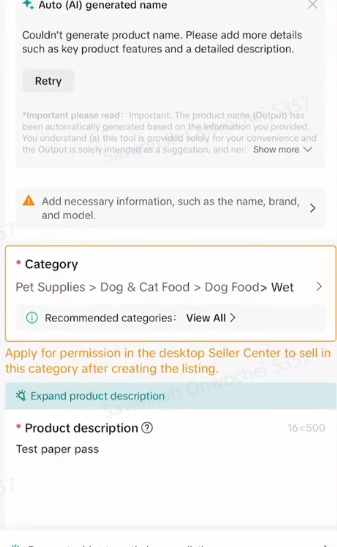
Source: TikTok
- Complete all the remaining product information and tap Submit for Review. A confirmation will appear letting you know your product is now under review.
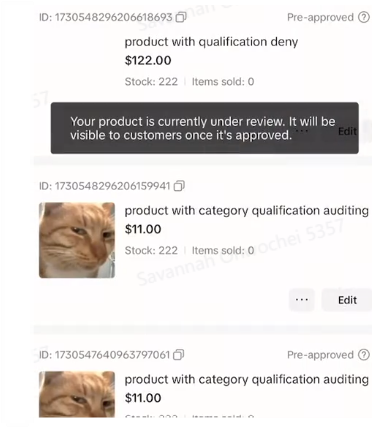
Source: TikTok
- Next, open the desktop Seller Center and navigate to Products > Manage Products.
- Find the product you just submitted and click the question-mark icon displayed beside the Restricted label.
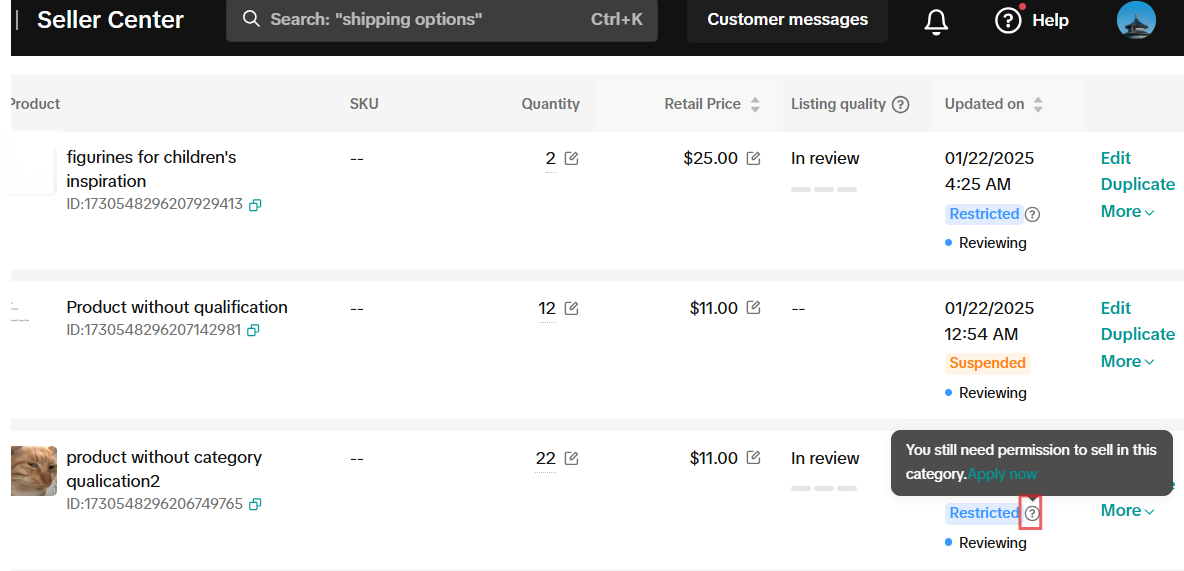
Source: TikTok
- Select Apply now. A separate window will open, follow the instructions on the Add Category Authorization page, fill in all required information, and then click Submit to send your application.
Defining Your Seller Identity
During the application, you must clearly specify your role, as this dictates the required documentation:
- Reseller: This status applies if you purchase finished products from a third-party manufacturer or distributor and resell them. Your core duty is proving the supply chain (via Purchase Invoices) and ensuring compliant product labeling.
- Manufacturer, Importer, or Repacker (M/I/R): This status applies if you own the manufacturing process, import products directly, or repackage them. You must provide primary regulatory proofs, such as FDA facility registrations, Certificates of Conformity (COCs), and cGMP proofs.
Whether you’re a reseller or manufacturer, providing the correct documentation is critical. Our Product Category Approval service helps ensure your identity and supply chain documents meet TikTok Shop standards.
The Reseller’s Core Compliance Toolkit
For the majority of TikTok Shop merchants operating as resellers, compliance centers on two critical document types: the Purchase Invoice and the Product Label Images.
The Valid Purchase Invoice: Proving the Chain of Custody
The purchase invoice is your proof of legitimate sourcing. It replaces the need for complex manufacturing certifications by demonstrating a legal, traceable chain of custody for the product.
Your invoice must comply with these strict requirements :
- Identity Match is Non-Negotiable: As stressed earlier, the legal name of the entity listed as the buyer on the invoice must be an exact match for the legal entity name registered on your TikTok Shop account. A mismatch is an instant rejection.
- Date of Purchase: The invoice must be recent, issued within the last 365 days. An invoice that is 13 months old will be automatically rejected.
- Supplier and Product Specificity: The document must clearly identify the supplier (name, address, contact information) and must explicitly list the product, brand, quantity, and price. The details must directly correlate with the product you intend to list.
- Accepted Format: The document must be a formal invoice or receipt. Unofficial documents are strictly prohibited. Do not submit packing slips, delivery bills, screenshots of marketplace orders, or purchase orders (POs).
Product and Packaging Image Requirements
You must provide high-quality, real-life images of the final product and its packaging. These photos serve as physical evidence that your product meets mandatory labeling standards.
The images must clearly capture :
- Full Product View: A complete and unedited view of the product and its retail packaging.
- Legible Label Information: All printed label information must be crystal clear. This includes the full ingredient or supplement facts list, usage directions, and net content.
- Manufacturer/Distributor Data: The label must clearly display the name and address of the manufacturer or the responsible distributor. Crucially, for many regulated products, the label must list the reseller’s company name and address as the domestic distributor for consumer traceability.
- Safety Markings: For electronics or appliances, required safety markings (like FCC or UL) must be clearly visible on the packaging or the product itself.
Category Deep Dives: Mastering Specific Requirements
Compliance is not a one-size-fits-all process. The necessary documentation shifts dramatically depending on the specific regulations governing each product category.
Dietary Supplements: The 180-Day Rule
The Supplements category, including vitamins, sports nutrition, and herbal products, is subject to intense scrutiny due to its direct impact on health.
1. Reseller Labeling Requirements
You must submit images of the front, back, and supplement facts panel of a sample product. Key elements required on the label are :
- Front Label: Clearly displays the Product name, Net weight/quantity, and the specific Type of supplement.
- Back Label (The Compliance Corner): Must include a detailed Supplement Facts panel and two critical compliance markers:
- The mandatory FDA-mandated disclaimer stating that “the FDA has not evaluated the claim and that the product is not intended to diagnose, treat, or cure disease”.
- Your company name and address listed clearly as the distributor.
2. Manufacturer Requirements (The Recency Challenge)
If you are the Manufacturer, Importer, or Repacker, you face a stricter standard regarding recency. While the initial steps require Proof of FDA Food Facility Registration and cGMP Certification , the specialized document is the Product Lab Test Report. This report must be :
- Issued within the last 180 days (six months). This short window is non-negotiable and requires ongoing testing.
- Include test components confirming adherence to cGMP standards (21 CFR 11/117 or equivalent).
- Match the products listed on the purchase invoice, including brand and manufacturer details.
Beauty and Personal Care: MoCRA and Labeling Integrity
The Beauty and Personal Care sector is regulated by safety protocols, including MoCRA (Modernization of Cosmetics Regulation Act).
1. Labeling Distinction: Cosmetic vs. OTC Drug
The label content required depends on the product’s function :
- Cosmetic Label: Required for standard beauty products. Must have a Principal Display Panel (Product name and Net contents) and an Information Panel listing the full Ingredient list, Warning statements, and the Manufacturer/Distributor’s name and address.
- OTC Drug Facts Label: Mandatory if the product offers medical benefits (e.g., medicated creams, high SPF sunscreens). This label requires a specific “Drug Facts” panel, active/inactive ingredients, detailed instructions, and a valid Expiration Date (month, date, and year).
2. Prohibitions
Note that certain products are strictly prohibited, regardless of qualification: this includes topical products containing Cannabidiol (CBD) (creams, serums, masks), and products aimed at skin whitening, lightening, or bleaching (though those enhancing brightness or evening skin tone are generally permissible).
Electronics: The Dual Safety Marking Requirement
Electronics require stringent verification of safety standards, especially for wireless features.
1. The Reseller Image Mandate
Resellers must provide clear images of the product or packaging that show evidence of two critical safety markings :
- Product Electrical Safety Marking: A required safety certification (e.g., UL, ETL).
- FCC Safety Marking: This is mandatory for any device featuring wireless capabilities (Bluetooth or Wi-Fi functions).
The markings must be securely affixed, legible, and unedited. Double-stickering is not allowed.
2. Manufacturer COC
Manufacturers, Importers, or Repackers must submit a Certification of Compliance (COC) issued within the past 2 years. This COC must list the safety standards tested, the accredited laboratory that performed the testing, and the product details.
Troubleshooting and Long-Term Compliance
Even with meticulous preparation, applications can be rejected. To avoid delays and simplify compliance, consider using our Product Category Approval service, which helps sellers submit correct documentation and maintain ongoing category qualification. Here are some common reasons for rejections.
The Top Three Reasons for Rejection
Rejections are almost always due to documentation errors. The most common pitfalls include :
- Seller Information Mismatch: The buyer name on the Purchase Invoice does not exactly match the legal entity registered on the TikTok Shop Seller Account.
- Missing or Expired Dates: Documents lack an issue date, or the purchase invoice is older than the required 365-day window, or the supplement lab report is older than 180 days.
- Unqualified Document Type: Submitting informal documents like packing slips, delivery bills, or purchase orders instead of a formal, itemized invoice.
The Re-Application Strategy
If rejected, do not panic and do not resubmit the same application.
- Identify the Failure: Check your Message Center or the Qualification Center to view the exact rejection reason provided by the review team.
- Review and Correct: Carefully review the specific category policy linked in the rejection message. Secure updated, corrected, or replacement documentation that directly addresses the reason for rejection (e.g., getting a new invoice with the correct entity name or securing a fresher lab report).
- Resubmit: Only after the documentation is flawless, click Resubmit.
Post-Approval Vigilance
Category qualification is an ongoing commitment, not a one-time clearance. TikTok Shop maintains the right to conduct regular compliance reviews and may request additional documentation at any time while your product is live.
If non-compliance is identified later (e.g., certifications expire or policies change), TikTok Shop may take enforcement action, including assigning violation points or removing product listings. Maintaining rigorous, up-to-date compliance records is a non-negotiable operational duty for sustained success.
Conclusion
TikTok Shop’s category qualification process is the necessary foundation for building a successful e-commerce business on the platform, especially within restricted, high-demand verticals like Supplements and Beauty.
By diligently following this playbook, meticulously verifying your seller identity against your supply chain documents, adhering to strict recency rules (365 days for invoices, 180 days for supplement testing), and ensuring your product labels comply with specific FDA and FCC standards, you convert a complex regulatory hurdle into a profound competitive edge.
Need expert guidance to navigate the process smoothly? Book a free consultation with Tiksly experts and get personalized support to secure your category approval.
FAQs
How long should I expect the category qualification review process to take?
Most applications for category qualification are reviewed efficiently, typically processed within six days. However, processing times can vary depending on the volume of applications or the complexity of the specific category under review.
In some instances, it can extend up to 14 days. To ensure the quickest possible approval, verify that all documentation is complete, legible, and accurate prior to the initial submission.
As a reseller, what is the single most common reason my application will be rejected?
The most frequent cause of rejection is a Seller Information Mismatch. This occurs when the recipient name (the buyer) listed on the official Purchase Invoice does not exactly match the legal entity name registered on your TikTok Shop seller account.
TikTok Shop requires a perfect match to verify the legitimacy of your supply chain and account ownership.
Do I need to provide manufacturing certifications, like cGMP or FDA registration, if I am a reseller?
No. If you correctly identify yourself as a Reseller during the application, you are typically exempt from providing manufacturing-specific documentation such as FDA Food Facility Registration, cGMP certifications, or complex product lab tests required of manufacturers.
Your core compliance duty rests upon providing a valid, recent Purchase Invoice to prove legal sourcing and ensuring that the product’s Labels comply with all regulatory requirements (e.g., displaying the full ingredient list and your company’s distributor information).